
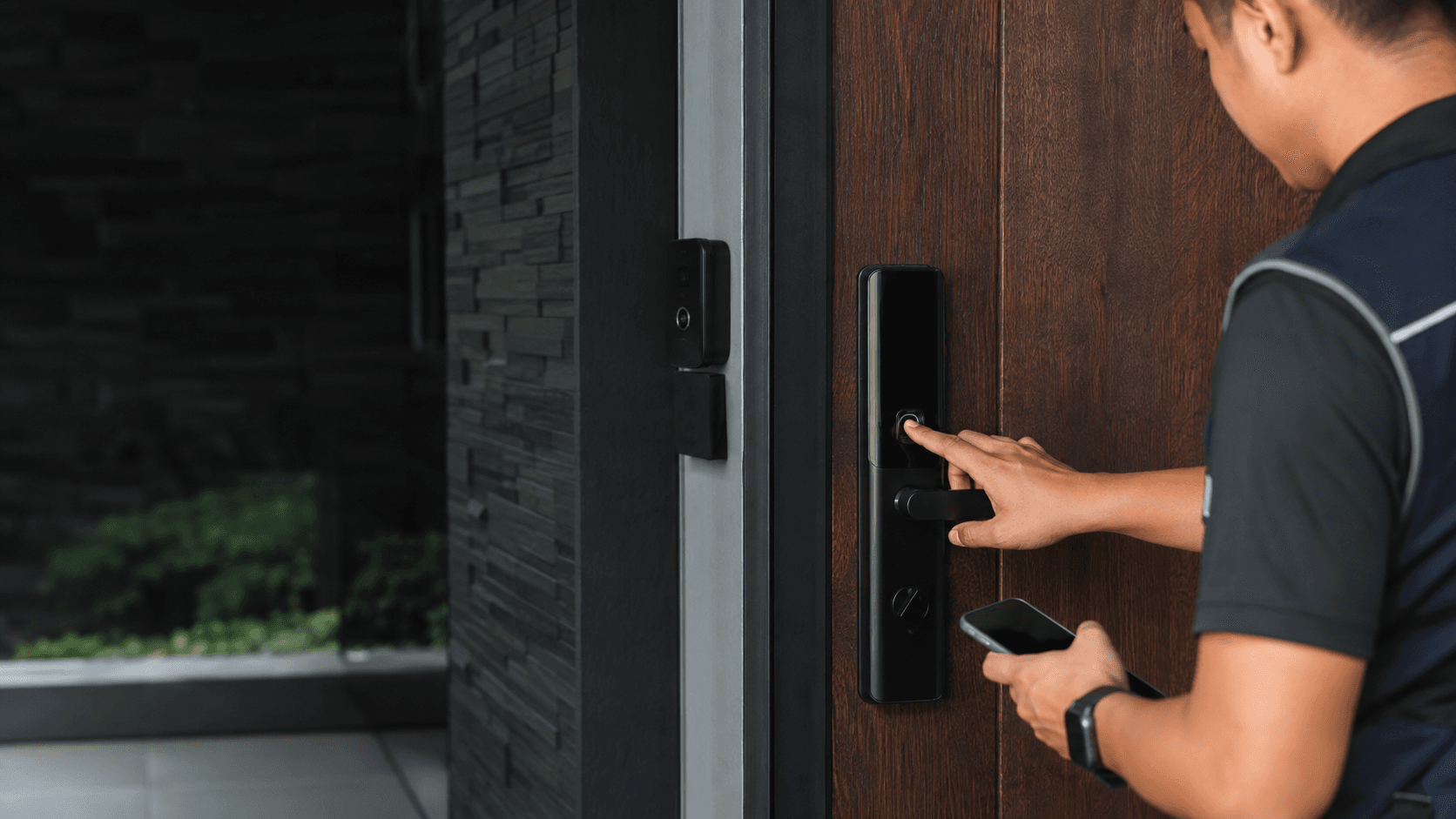
The category sits between two familiar products. It is not a plain mechanical deadbolt, and it is not a full access-control panel with a networked controller and software. It is a self-contained lock body with a keypad on the outside, a radio inside, and a battery powering both.
That middle position explains most of the questions buyers in Malaysia raise. The lock has to fit an existing door, survive daily use by several people, and still let someone in when the phone is elsewhere or the battery is flat.
Bluetooth Keypad Door Lock. What the Term Covers
The phrase describes three separate functions that happen to live in one housing. The keypad is the entry method that works without a phone. Bluetooth is the short-range radio used for pairing, app setup, and permission changes. The lock mechanism is the part that actually throws or retracts the bolt.
Because the three functions are independent, a lock can keep working on the keypad even when Bluetooth is unavailable. That distinction matters more than any single feature list, because it decides whether the door still opens during a phone problem.
Two access models exist in this category. A standalone lock holds its own user list and codes inside the lock. An access-control panel centralises users, schedules, and audit records on a separate system. Eyonic's smart lock door access review notes that for business use, the usual check is whether a standalone smart lock or an access-control panel is more appropriate. That is a site question, not a product question.
Keypad entry code versus app-only access
A keypad entry code is issued to a person, not a device. It survives a lost phone, a dead phone battery, and a guest who never installs the app. App-only access depends on the phone being present, charged, and paired.
For a family home, the keypad usually carries most of the daily traffic. For a rental or a shop, the keypad is what a cleaner, a contractor, or a delivery person can use without being added to anyone's phone.
What Bluetooth pairing actually does
Bluetooth pairing links a phone to the lock over a short distance. It is used to add the lock to an app, issue or remove codes, and change settings. It is not the same thing as remote unlocking from another city, which depends on a bridge or gateway that the supplied evidence does not confirm for any specific model.
This is the single most common expectation gap. A buyer who assumes Bluetooth means control from anywhere will be disappointed. A buyer who understands Bluetooth as local setup and local unlock will not.
How Bluetooth Keypad Door Lock Access Works Day to Day
Daily use is simpler than the feature list suggests. Someone arrives, enters a code or unlocks through a paired phone, and the bolt retracts. The lock records what it can record, and the battery drains slowly in the background.
What changes between sites is who holds access and how quickly it can be withdrawn.
User permissions and access removal
Every code issued is a decision that has to be reversed later. A household might have four or five permanent codes. A shop might have a manager code, a staff code, and a temporary code for a contractor working for two weeks.
The practical test is removal. If a staff member leaves, the code should be deletable in the app without visiting the door, and without disturbing anyone else's access. If removal requires a factory reset, the lock is a poor fit for a site with turnover.
Eyonic's smart lock door access review frames this as planning user permissions and backup entry properly, which is the same point from the installer's side: the access list is designed before the lock is mounted, not after.
Battery life and low-battery warning
The lock runs on batteries, and the supplied evidence does not include verified battery type, battery life, or low-battery warning behaviour for any specific model. What can be said safely is that battery state is a maintenance item, not a one-off purchase decision.
A low-battery warning is only useful if someone acts on it. In a home, that is usually the owner. In a shop or office, it needs an owner too, otherwise the warning is seen by nobody and the door eventually stops responding to the keypad.
Standalone lock versus access control panel
A standalone lock suits a single door with a small, stable user group. An access-control panel suits multiple doors, scheduled access, and a record of who entered when. The trade-off is cost and complexity against control and reporting.
A shop with one back door and six staff does not need a panel. A building with a front entrance, a staff entrance, and a storeroom usually does, because managing three separate user lists by hand becomes the problem rather than the lock.
Door Frame and Gate Conditions That Decide Fit
The door decides more than the lock does. A lock that fits one door may not fit the next one in the same building, and the difference is usually visible before anything is ordered.
Door thickness and frame condition are the two conditions that most often change the plan. A thin door, a warped frame, or a frame that has already been cut for a different lock body can all push a straightforward job into a fabrication job.
Door thickness and handing
Lock bodies are made for a range of door thicknesses, and the supplied evidence does not include verified supported thickness figures for any model. Handing matters too. a lock made for a left-hand door does not simply flip to a right-hand door without the correct variant.
Both are measurable on site in minutes. Both are expensive to discover after the lock has been ordered.
Frame condition and existing cutouts
An existing cutout is either an advantage or an obstacle. If it matches the new lock body, installation is quicker. If it does not, the frame may need patching, re-cutting, or a different lock entirely.
Older Malaysian shoplots and terrace houses often carry frames that have been modified more than once. That history is worth checking before assuming a standard fit.
Gates and outdoor doors
An outdoor gate or an exposed door adds weather to the list. The supplied evidence does not include verified IP ratings for any Bluetooth keypad door lock, so no claim can be made about rain resistance for a specific model. Where a gate is involved, the honest position is that the lock's own documentation decides suitability, and that documentation should be read before purchase.
Power Backup Entry and Connectivity Limits
Three failure modes matter. the phone is out of range, the battery runs down, and the internet drops. Each has a different answer.
Phone out of range is normal, not a fault. Bluetooth is a short-range radio, so a phone in another state cannot unlock the door through Bluetooth alone. The keypad still works.
A flat battery is the failure that actually locks people out. A backup key or mechanical override is the answer, and it should be tested before the lock becomes the only way through the door.
An internet outage affects remote features, not the keypad. If the lock is standalone, the door keeps working. If the lock depends on a bridge or gateway for remote access, that remote access stops until the connection returns, while local code entry continues.
Why the backup method is not optional
A backup key or mechanical override is the difference between an inconvenience and a locksmith call. It also has to be stored somewhere that is not inside the locked space, which is a small decision people routinely get wrong.
For a business, the backup method should be documented and held by more than one person. A single key in a single pocket is a single point of failure.
Connectivity claims to verify before buying
The supplied evidence does not confirm remote unlocking, Wi-Fi bridging, Matter, Z-Wave, or smart home platform support for any specific Bluetooth keypad door lock. Those claims belong to the manufacturer's own documentation for the exact model, and they should be read there rather than assumed from the category name.
The same applies to encryption standards, certification, and independent security testing. No verified claim is available here, so none is made.
Checks Before Installation
These checks are ordered so that the cheapest decisions happen first. Each one can eliminate a lock option before money is spent.
- Confirm door and frame condition, including any existing cutouts and whether the frame is sound enough to carry the lock body.
- Confirm door thickness and handing, so the correct lock variant is ordered rather than adapted on site.
- Confirm who needs access and how access is removed, including temporary codes for contractors and a clear removal step when someone leaves.
- Confirm the backup entry method, and store the backup key or override tool somewhere outside the locked space.
- Confirm power and battery expectations, including who is responsible for acting on a low-battery warning.
- Confirm whether a standalone lock or an access-control panel suits the site, based on the number of doors and how much access records matter.
Working through the list in order usually settles the product question before any model is compared. It also produces the information an installer needs for a site survey.
Working With an Installer in Sarawak and Malaysia
Installation is where the checks become physical. Eyonic's CCTV installation process runs through site survey, system proposal, installation, and handover, and the same sequence applies to door access work: the survey establishes door condition and user roles, the proposal sets out what will be supplied, installation fits it, and handover confirms the people who need access can actually use it.
Handover and user testing are the step most often skipped. A lock that works for the installer but not for the staff member on the early shift has not been handed over.
Eyonic Sdn Bhd is a security system supplier in Sarawak working on CCTV and ELV systems for homes, offices, shops, and industrial sites. Completed work includes the Kuching Immigration Office project, which focused on arrival flow, staff areas, visitor movement, and dependable daily operation, and the KTA Sarawak Sdn Bhd project, which supported staff movement, visitor handling, tidy cabling, and clearer daily site control. Both are examples of the same principle: access decisions follow how a site is actually used.
For sites weighing door access against other security work, Eyonic's published packages include a Hikvision CCTV Package at RM 1,599, a Hikvision Alarm System at RM 1,599, and an Autogate Package at RM 1,599, each covering supply, setup, and handover. Door access is quoted separately because door condition and user count vary too much for a fixed package.
Share your location, property type and required system with Eyonic on WhatsApp at +60 11-5111 7959 for the next practical step.