
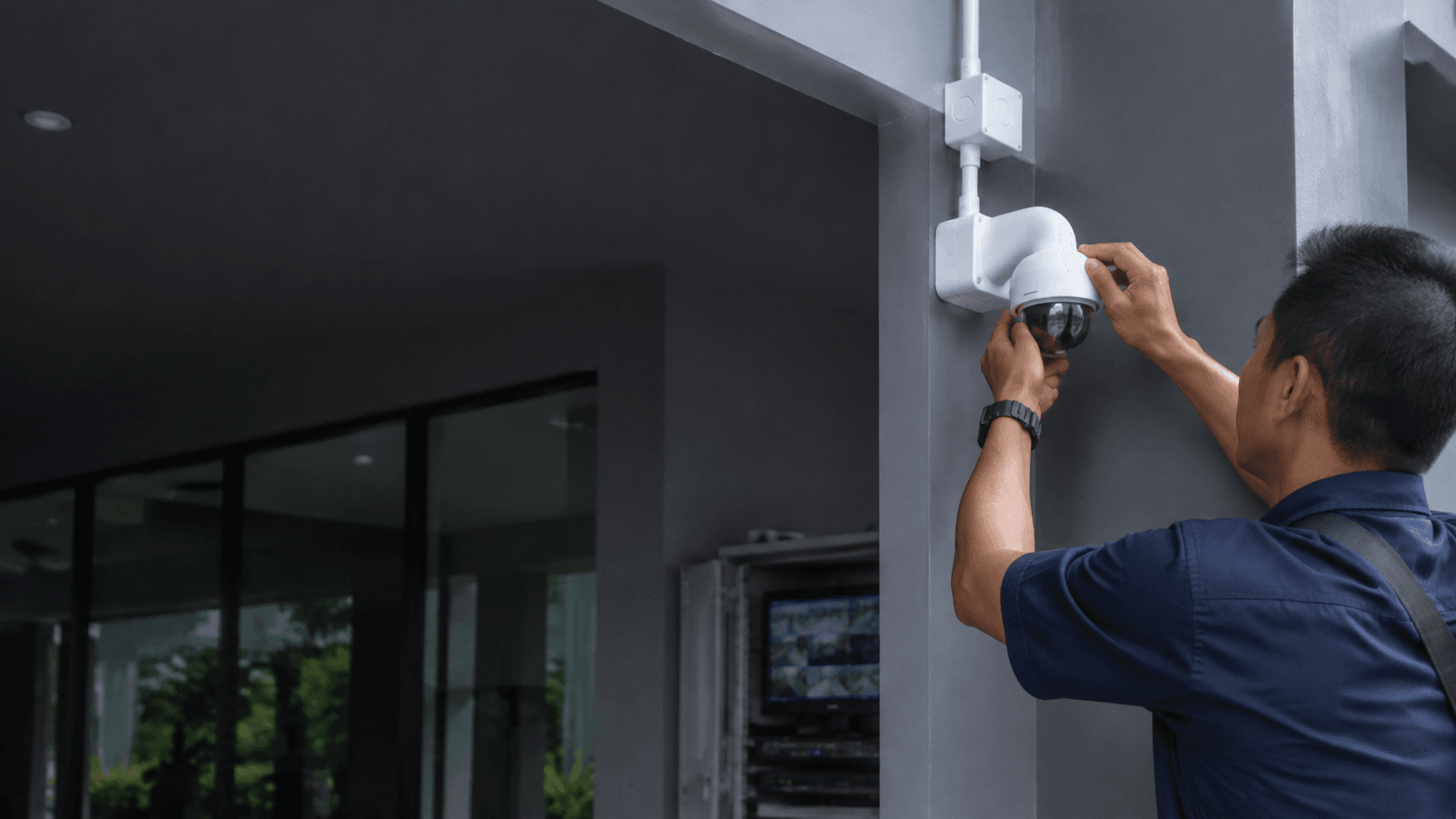
The exact-match query cctv recording system describes a chain rather than a single box. Cameras capture light, a recorder encodes and writes the video, storage holds it for a set period, and playback or remote viewing retrieves it. Each link constrains the next, which is why a setup that looks fine on paper can still fail when footage is needed.
Eyonic Sdn Bhd plans, supplies and installs monitoring systems with camera placement, recording and remote viewing for homes, offices, shops and industrial sites in Sarawak. The company's founder, Eric Yong, has worked in technical installation of digital security solutions for commercial businesses in Sarawak for more than 10 years.
What a CCTV recording system records and stores
Cameras convert light into a video signal. The recorder receives that signal, compresses it, and writes it to a hard drive or memory card. Playback reads the same file back. Nothing in that sequence is optional, and a weak link anywhere in it shows up as missing or unusable footage.
Two things determine whether the chain holds. The first is what the camera can actually see at the moment that matters. The second is whether the recorder has enough space and processing headroom to keep writing while older footage is overwritten. A recorder that fills too quickly forces a choice between shorter retention and lower recording quality.
Footage is normally stored locally on a drive inside the recorder. Local storage keeps recording working when the internet drops, which matters for premises where connectivity is inconsistent. Remote viewing is a separate layer that reads from that local store rather than replacing it.
What gets captured, and what does not
Coverage is decided by camera placement, not by recorder capacity. A recorder with spare channels still records nothing useful if the cameras point at the wrong areas. Entrances, counters, corridors and cash-handling points usually carry more value than wide perimeter shots that show movement without identifying it.
Recording also captures whatever the lens sees, including staff and visitors who have not consented to being filmed. That is a practical consideration for any premises open to the public, and it is one reason placement decisions deserve review before installation rather than after.
Recorder types and how they connect to cameras
Recorders fall into a few practical families, and the choice usually follows the cameras already on site or the cabling that can realistically be run.
A DVR works with analog-style cameras over coaxial cable. It suits sites that already have coax in place, because existing cable runs can often be reused. An NVR works with IP cameras over network cable and typically carries power to the camera over the same cable. A hybrid recorder accepts both, which helps when a site is partway through a changeover.
The connection method shapes the installation more than the recorder brand does. Coax runs have distance limits and need their own power. Network runs need a route back to the recorder and a switch or recorder port with enough power budget. Whichever path is chosen, cable routing and recorder location get decided together, because the recorder needs ventilation, power and reasonable access.
Matching recorder to camera
Recorder and camera must be compatible. A recorder that cannot decode a camera's format will not record it, regardless of how many channels remain free. This is the single most common mismatch when equipment is bought separately, and it is why the camera list and recorder specification are usually confirmed as one decision.
Channel count sets the ceiling on how many cameras the system can carry. Buying a recorder with no spare channels removes any option to add coverage later without replacing the unit. Leaving headroom costs little at the point of purchase and avoids a full replacement when a site expands.
Storage, retention and playback in daily use
Retention is the practical question most sites care about: how far back footage can be reviewed. Retention depends on how many cameras run, what resolution they record at, whether recording is continuous or triggered by motion, and how much storage the recorder holds. Those four factors move together, so changing one changes the others.
Continuous recording captures everything and consumes storage fastest. Motion-triggered recording stretches the same drive further but can miss the start of an event. Many sites settle on continuous recording for high-value cameras and motion recording elsewhere, which balances coverage against retention.
Playback is where a system proves itself. Reviewing footage means finding a time window, locating the right camera, and exporting a clip that can be shared if needed. A recorder that is awkward to search turns a five-minute review into an hour of scrolling, and that cost lands on whoever is asked to check the footage.
Remote viewing and its limits
Remote viewing lets a phone or computer read live and recorded video from the recorder. It depends on the recorder staying online and on the connection at the viewing end being stable. When the internet drops, local recording continues and remote access stops until the link returns.
Remote access also widens who can see the footage. Account permissions and password hygiene matter as much as the camera specification, because a shared login removes any record of who viewed what.
Lighting and placement before recording quality
Recording quality is decided before the recorder is switched on. A camera pointed at a dark corner records a dark corner, and no storage or resolution setting fixes that. Eyonic recommends checking actual lighting conditions before confirming placement for ColorVu-style cameras, because the real scene at night is what the camera will record.
Placement decisions worth settling early include:
- Site survey to walk the premises and identify what needs coverage.
- System proposal setting out camera positions, recorder location and storage.
- Installation of cameras, cabling and recorder.
- Handover covering playback, remote viewing and day-to-day use.
Backlight is the other common problem. A camera facing a bright doorway or window records silhouettes rather than faces, because the sensor adjusts for the brightest part of the frame. Moving the camera or changing its angle usually solves more than adjusting settings does.
Weather and mounting also matter in Sarawak. Cameras need housings suited to heavy rain, and mounting points need to survive wind and vibration without drifting out of alignment. A camera that shifts a few degrees over months can quietly stop covering the area it was installed for.
How Eyonic plans a in Sarawak
Eyonic's installation process runs through site survey, system proposal, installation and handover. The survey establishes what needs covering and where cabling can realistically run. The proposal sets out the camera and recorder arrangement. Installation follows, and handover covers how to review footage and use remote viewing.
That sequence matters because recorder, storage and camera choices depend on the site. A shop with a single entrance and a counter needs a different arrangement from an office with multiple access points and a reception area. The Kuching Immigration Office project focused on arrival flow, staff areas, visitor movement and dependable daily operation, which is a coverage question before it is an equipment question. The KTA Sarawak Sdn Bhd project needed a practical office setup in Kuching supporting staff movement, visitor handling, tidy cabling and clearer daily site control.
Budget expectations vary with scope. The Kuching Immigration Office project carried an approximate budget of RM 12,000 to RM 28,000, and the KTA Sarawak Sdn Bhd project an approximate budget of RM 8,000 to RM 18,000. Eyonic's Hikvision CCTV Package is listed at RM 1,599 and covers camera supply and setup, basic recording configuration, and mobile viewing handover.
For a site that needs a starting point, sharing the location, property type and required system with Eyonic on WhatsApp at +60 11-5111 7959 is the next practical step.
Questions that come up before installation
How long will footage be kept? Retention follows from camera count, resolution, recording mode and storage size. It is set during planning rather than discovered afterwards, and it should be confirmed in writing before installation.
Can recording continue without internet? Yes. Local recording runs independently of the internet connection. Remote viewing is the part that stops when connectivity drops.
Can cameras be added later? Only if the recorder has spare channels and the cabling route allows it. Both are easier to allow for at the planning stage than to retrofit.
What happens when storage fills? The recorder overwrites the oldest footage to keep recording. That is normal behaviour, and it is why retention length is a planning decision rather than a fault.
Does night recording need special cameras? It needs cameras suited to the actual light level at each position. Checking the scene at night before confirming placement is more reliable than choosing on specification alone.