
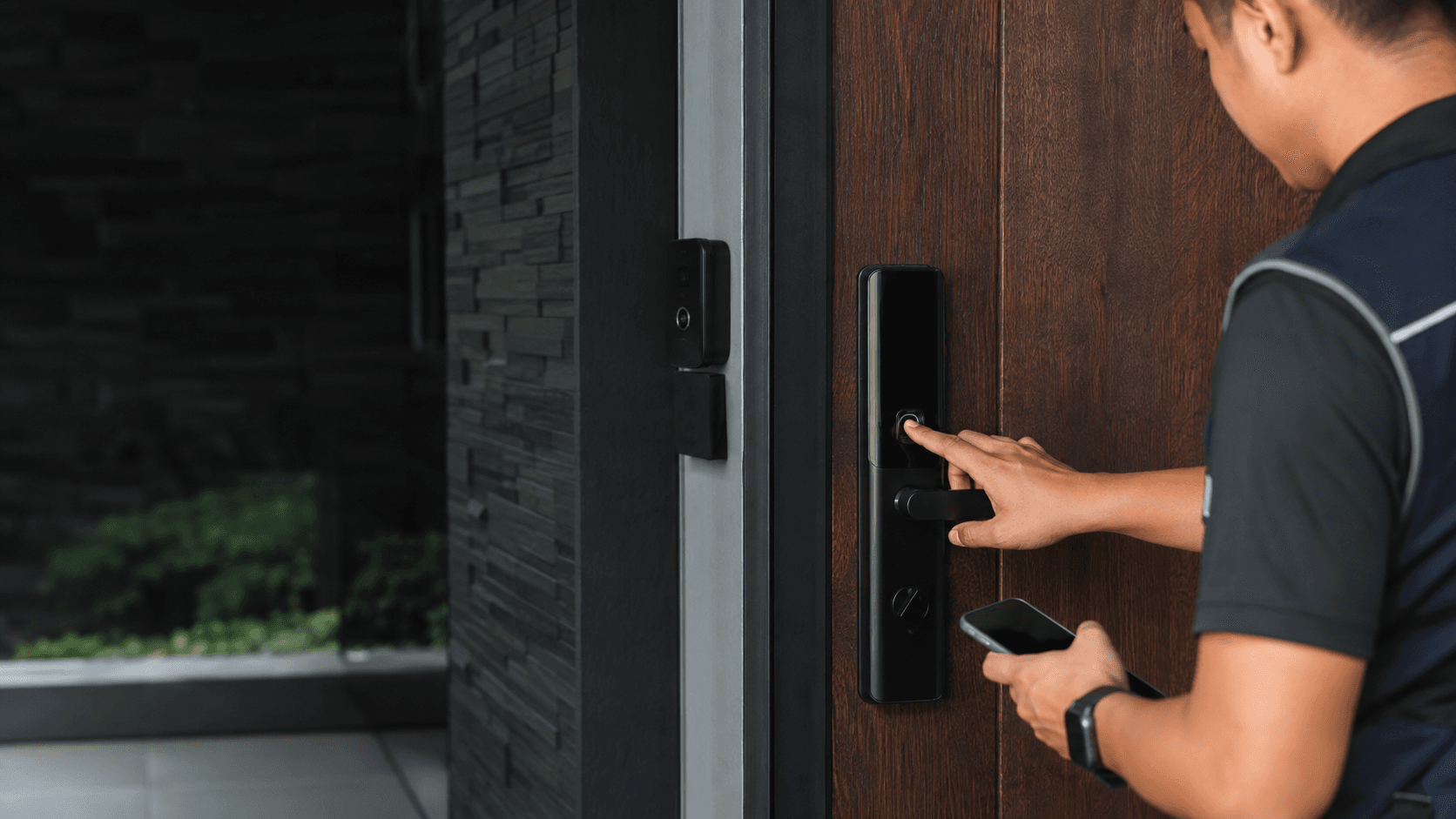
The category sits between two familiar options. A mechanical lockset gives every keyholder the same access, while a full access-control panel suits sites that need logged, role-based entry across several doors. An electronic front door lock and handle occupies the middle: one entrance, several ways in, and a record of who used which method.
Eyonic Sdn Bhd plans, supplies and installs security and ELV systems in Sarawak, and its product review notes that smart locks work best when door condition, user roles and backup method are reviewed before installation. For business use, the same review checks whether a standalone smart lock or an access-control panel is the more appropriate route.
What an electronic front door lock and handle combines
A single unit usually merges three parts that are separate on a traditional door. The locking mechanism secures the door. The handle provides the physical pull. The electronic interface accepts a code, card, fingerprint or app command instead of, or alongside, a key.
That combination is why the phrase describes a product rather than a component. Buying a deadbolt alone leaves the existing handle in place. Buying an electronic front door lock and handle replaces both in one fitting, so the finish, backset and door preparation have to match together.
Two practical consequences follow. First, the exterior face of the door changes, which matters on heritage or strata-controlled entrances. Second, the interior side carries the battery or power route and the manual override, so the inside face needs clearance too.
Door condition and user roles before selection
Door condition decides whether the unit can be fitted at all. Frame alignment, existing bore holes, door thickness and the presence of a metal or glass leaf all affect what will seat correctly. A door that already sticks will keep sticking once a heavier electronic fitting is added.
User roles decide how the lock should be configured. A household needs a handful of codes and one spare. A shop or office needs separate credentials for staff, cleaners, contractors and management, with the ability to remove one person's access without reissuing everyone else's.
Eyonic's review of smart lock door access frames this as the deciding question for commercial sites: whether a standalone smart lock or an access-control panel is more appropriate. A single entrance with a small team usually suits the standalone unit. Multiple entrances, shift patterns or audit requirements usually point toward a panel.
Where a standalone unit stops being enough
Three conditions tend to push a site past a standalone electronic front door lock and handle. The first is more than one controlled entrance. The second is a need to prove who entered and when, beyond what a lock app retains. The third is integration with an existing alarm, intercom or CCTV setup, where a separate access-control layer is easier to manage than several unconnected locks.
Access methods and backup entry
Access methods vary by unit, and the mix matters more than the count. Common options include a numeric code, a keycard or fob, a fingerprint, a mobile app, and a mechanical key. Each has a failure mode. codes can be shared, cards can be lost, fingerprints can fail on worn or wet skin, apps depend on a working network and a charged phone.
Backup entry is the part most often decided last and regretted first. A mechanical key override, an external power point for a flat battery, or a second independent entry route all serve the same purpose. The right choice depends on who is on site when the primary method fails.
For a home, a key kept with a trusted neighbour may be enough. For a shop or office, the backup needs to work without waiting for one specific person to arrive, which usually means a key held by more than one responsible staff member or a second door that remains mechanically keyed.
Installation and handover expectations
Eyonic's installation process runs through site survey, system proposal, installation and handover. Applied to door access, the survey confirms the door and frame condition, the user roles, the access method and the backup route before any unit is ordered.
Handover is where the system becomes usable. Codes are issued to the right people, temporary credentials are removed, the backup method is tested with the door closed, and the person responsible for adding or removing users knows how to do it. A lock that works but that nobody can administer becomes a support call.
The Kuching Immigration Office project shows the same principle at building scale: arrival flow, staff areas, visitor movement and dependable daily operation were treated as one problem rather than separate fittings. Door access on a busy entrance belongs to that same flow.
Practical checks before confirming a unit
These checks follow the order Eyonic uses on site, from the door outward to the people who will use it.
- Confirm the door and frame condition, including thickness, alignment, existing bore holes and whether the leaf is timber, metal or glass.
- List every person or group who needs entry, and decide which of them should have their own credential rather than a shared one.
- Choose the access methods the entrance will actually use, and note what happens when each one fails.
- Agree the backup entry route and test it with the door closed before handover.
- Walk through handover testing. issue credentials, remove temporary ones, confirm the audit or app record, and show the responsible person how to add or revoke access.
Two constraints sit outside that list. Rental and strata properties may restrict changes to the exterior face or require landlord approval. And any unit that depends on a network or app for daily entry inherits the reliability of that connection, which is worth confirming before the door becomes dependent on it.
Where the checks point to a single controlled entrance with a small, stable group of users, an electronic front door lock and handle is a reasonable fit. Where they point to several entrances, changing user lists or a need for entry records, a separate access-control approach usually costs less to live with over time.
Share your location, property type and required system with Eyonic on WhatsApp at +60 11-5111 7959 for the next practical step.