
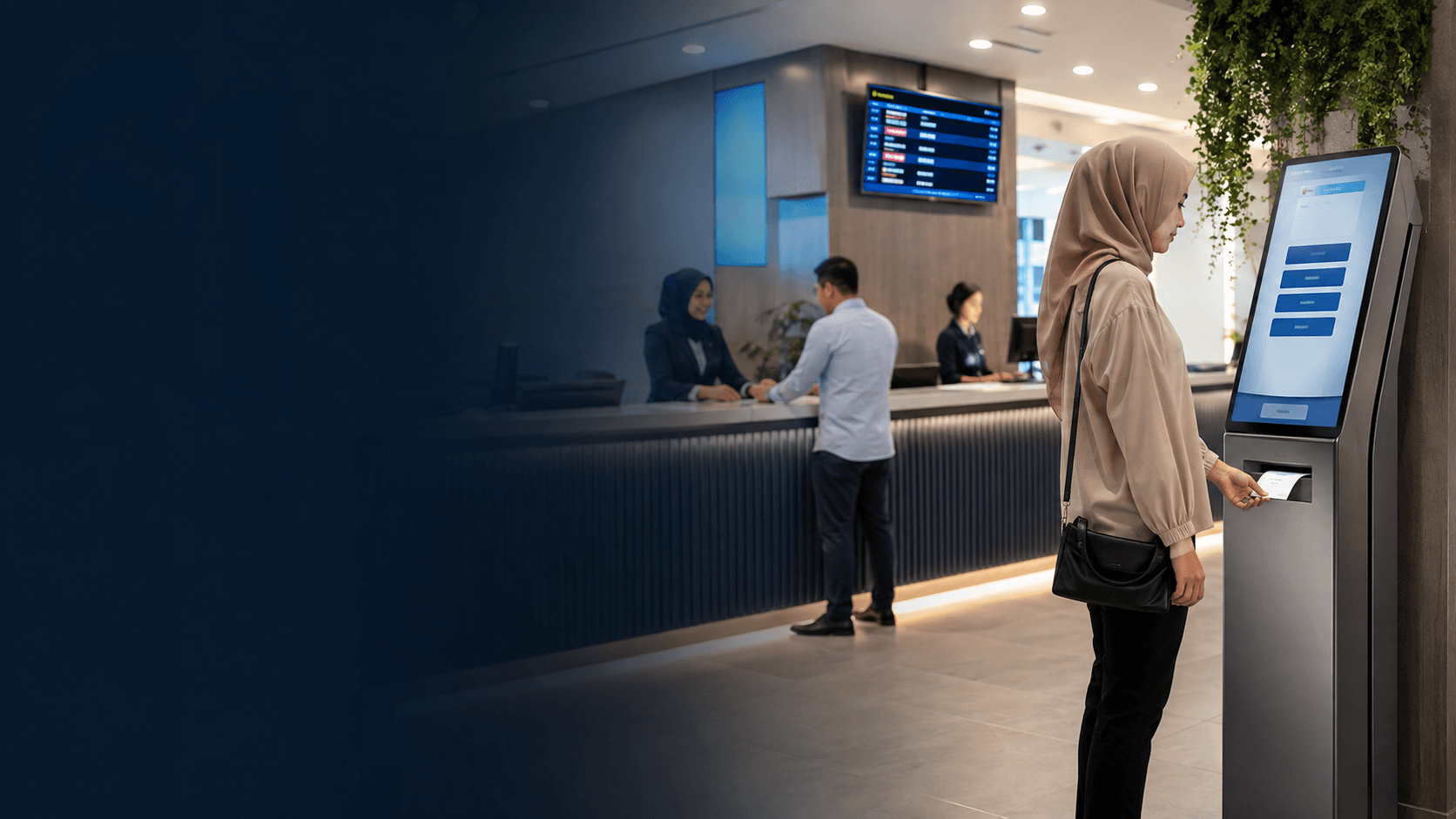
What Is a Queue Display Board?
A queue display board is the visual output of a queue management system. It shows the current ticket number being served and directs customers to the correct counter or service point. The board works alongside a ticket dispenser, a queue management system, and often an audio announcement to create a complete customer flow solution.
The core purpose is simple. replace crowded, unclear waiting areas with a clear sequence that customers can follow without asking staff. When a customer takes a ticket, the queue display board tells them when their number is called and where to go. This removes the anxiety of not knowing the waiting time and prevents disputes over who arrived first.
How a Queue Display Board Works in a Service Setting
A queue display board functions as part of a connected system rather than as a standalone screen. The process begins when a customer takes a ticket from a dispenser or checks in at a self-service kiosk. The queue management system assigns a number and places it in the service sequence.
When a staff member finishes with one customer, they signal the system to call the next number. The queue display board updates instantly to show the new ticket number and the assigned counter. Many systems pair the visual display with a voice announcement so customers who are not looking at the screen still hear their number called.
The display itself can take several forms. LED displays show numbers and counter assignments in bright, high-contrast text that remains readable from a distance. LCD screens and digital signage panels offer more flexibility, allowing businesses to show additional content such as service names, estimated waiting times, or promotional messages between calls.
Real-time queue information is the key advantage over older manual systems. When a customer sees their position moving on the display, they perceive the wait as shorter and more predictable. This matters in busy service environments where perceived waiting time often feels longer than actual waiting time.
Key Features to Compare Before Buying a Queue Display Board
Businesses comparing queue display boards should evaluate how well each option fits their specific service layout and customer volume. The right choice depends on the number of service counters, the physical size of the waiting area, and the type of customers being served.
- Assess the service points and customer flow to determine how many counters need display coverage and where customers wait.
- Choose a display type based on the environment: LED for bright, high-traffic areas, LCD or digital signage for flexible content and branding.
- Confirm the display integrates with the existing ticketing or queue management system, including the software protocol and connection method.
- Plan the installation position at eye level in the waiting area so customers can read the board without straining or crowding the counters.
- Train staff to manage the queue system, including calling the next number, handling no-shows, and managing service interruptions.
- Monitor performance after launch by tracking average waiting time, customer complaints, and staff feedback to adjust the setup.
Screen size and viewing distance are practical constraints that buyers often overlook. A small display in a large lobby will not serve its purpose, while an oversized board in a compact counter area wastes space and budget. The display must be readable from the farthest point where customers wait, which typically means larger text and higher brightness for longer viewing distances.
Connectivity options matter for installation flexibility. Some queue display boards connect through wired Ethernet, while others support Wi-Fi or serial connections. The choice affects installation cost and reliability. Wired connections generally offer more stable performance, but wireless options reduce cabling work in existing buildings.
Multi-language support is another consideration for Malaysian businesses serving diverse communities. Displays that can show ticket numbers alongside service names in Bahasa Malaysia, English, Mandarin, or Tamil accommodate a wider range of customers without additional staff effort.
Where Queue Display Boards Are Used in Malaysia
Queue display boards appear in any Malaysian service environment where customers wait for their turn. Government offices, banks, clinics, hospitals, telecommunications centres, and utility payment counters all use them to manage visitor flow. The common thread is a high volume of walk-in customers who need to be served in a fair, orderly sequence.
Public offices in Malaysia face particular pressure to manage visitor movement efficiently. Eyonic completed a project for the Kuching Immigration Office that focused on arrival flow, staff areas, visitor movement, and dependable daily operation. The project illustrates how public service environments need systems that support predictable customer movement throughout the day, not just during peak hours.
Healthcare facilities use queue display boards to manage patient flow across multiple service points such as registration, consultation, and pharmacy. Clinics with several doctors on duty can assign each patient to a specific room through the display, reducing confusion and ensuring patients see the correct practitioner.
Retail banks and financial service centres rely on queue display boards to separate different transaction types. Customers taking a ticket for a quick cash deposit may be served faster than those needing a loan consultation. The display communicates this priority system clearly, preventing frustration when customers see others served ahead of them.
Queue Display Board Installation and Maintenance Considerations
Installing a queue display board requires more planning than mounting a screen on a wall. The position must consider sight lines from every waiting area, lighting conditions that could cause glare, and the cable route from the display to the queue management system.
Lighting conditions deserve particular attention. Eyonic recommends checking actual lighting conditions before confirming placement for its ColorVu-style cameras, and the same principle applies to display screens. A board placed opposite a bright window or under direct ceiling lights may become unreadable during certain hours. Checking the environment at different times of day prevents installation mistakes that are costly to correct.
The installation process for a queue display board follows a similar pattern to other electronic system installations. Eyonic's CCTV installation process includes site survey, system proposal, installation, and handover. A queue display board installation benefits from the same structured approach: survey the site to understand customer flow, propose the appropriate display configuration, install the hardware and software, and hand over with staff training.
Maintenance requirements vary by display type. LED boards typically have long lifespans but may develop dead pixels over time. LCD and digital signage screens require periodic cleaning and may need backlight replacement after several years of continuous operation. Businesses should confirm the expected lifespan and service support before purchasing.
Power reliability is a practical concern for Malaysian businesses. Displays that run continuously during operating hours need stable power supply, and businesses in areas with frequent outages should consider surge protection or backup power for critical service points.
Choosing a Queue Display Board Supplier in Malaysia
Selecting a supplier for a queue display board requires checking more than the product price. The supplier should demonstrate experience with similar service environments and provide support for the full installation, not just the hardware sale.
A supplier with local project experience understands the practical realities of Malaysian service environments. Eyonic's work on the Kuching Immigration Office project and the KTA Sarawak Sdn Bhd project shows how installation teams must account for staff movement, visitor handling, and tidy cabling in real operating conditions. These factors determine whether a queue display board works reliably from the first day of operation.
The KTA Sarawak project, supporting an engineering consultancy office in Kuching, focused on practical office setup for staff movement, visitor handling, tidy cabling, and clearer daily site control. This demonstrates that queue management considerations extend beyond customer-facing counters to internal workflow organisation.
When evaluating suppliers, businesses should ask about the site survey process, the proposed display configuration for their specific space, and the training provided during handover. A supplier that offers only hardware delivery without installation support leaves the business to manage integration, positioning, and staff training independently.
The commercial relationship should also be clear about ongoing support. Queue display boards are part of daily operations, and downtime directly affects customer service. A supplier that can respond quickly to faults and provide replacement parts matters more than a marginally lower initial price.
For businesses in Sarawak considering a queue display board or related customer flow systems, Eyonic offers planning, supply, and installation services for commercial environments. Sharing the location, property type, and required system with Eyonic on WhatsApp at +60 11-5111 7959 provides the next practical step toward a working installation.