
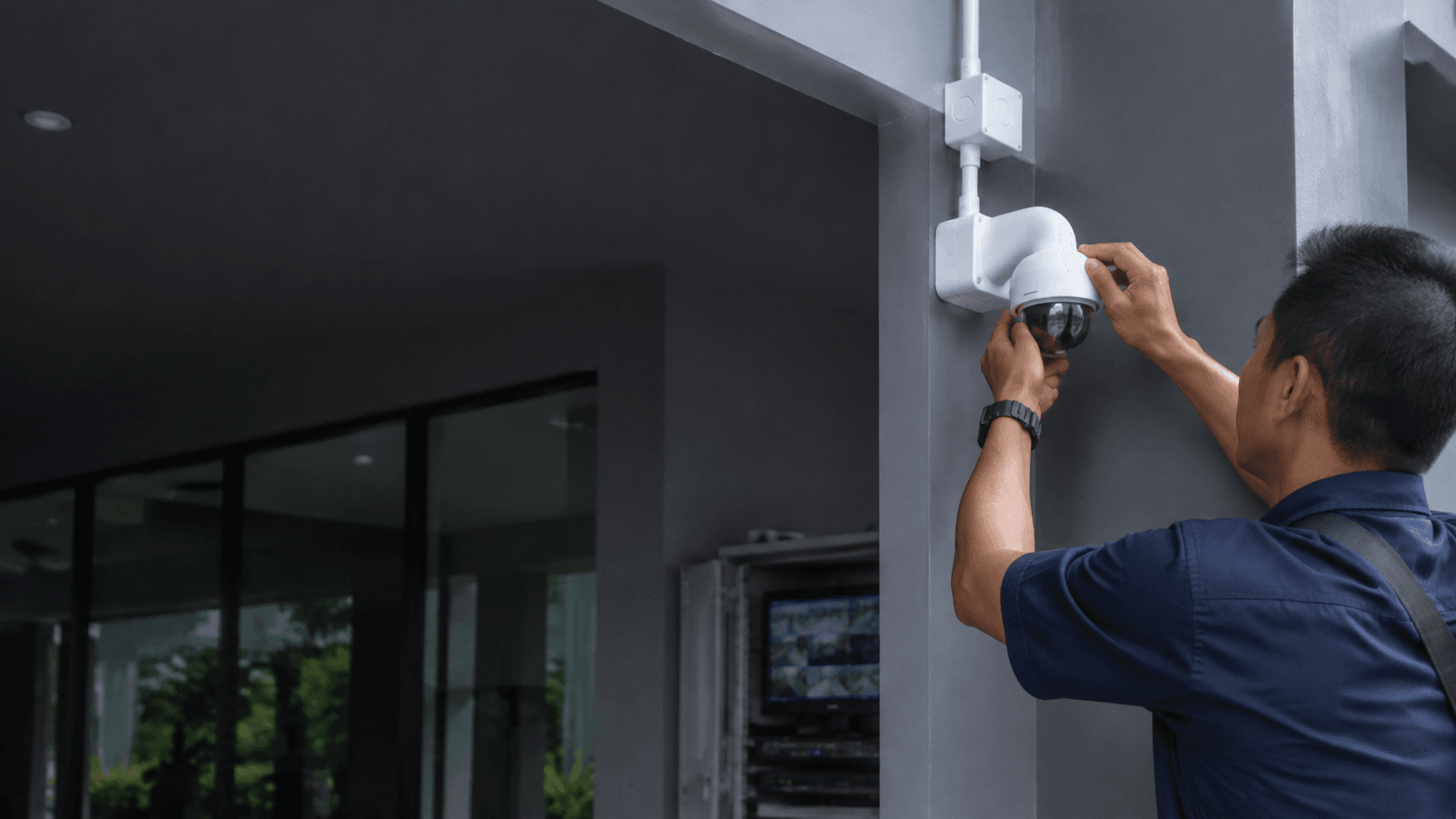
The term covers more than a camera body. It describes a working arrangement: an exterior Wi-Fi camera mounted where it can see what matters, a wireless path back to a recorder or hub, and a viewing method that lets someone check the feed without walking to the wall. Eyonic plans, supplies and installs monitoring systems with camera placement, recording and remote viewing for homes, offices, shops and industrial sites.
Three things decide whether that arrangement holds up. The mounting point has to sit inside usable Wi-Fi coverage. The scene has to be lit well enough for the camera to render useful detail. The recording and viewing path has to be configured and handed over properly. Everything else is secondary.
Camera Wifi Exterior. What the Term Covers in Practice
A camera wifi exterior installation is a chain, not a single device. Each link has to work for the next one to matter.
- Site survey — the property is assessed before any position is confirmed.
- System proposal — the recommended setup is put together from what the survey found.
- Installation — cameras, recording and viewing are installed and configured.
- Handover — the system is explained and passed to the user.
Those four stages are the documented Eyonic CCTV installation process. The order matters because a position chosen before the survey is a guess, and a guess that fails usually fails at the Wi-Fi link or the lighting, not at the camera.
Two terms get used loosely and are worth separating. An exterior Wi-Fi camera is the device itself. A wireless outdoor camera is the same idea described by its mounting situation rather than its network method. Neither phrase says anything about resolution, weather rating or night performance, because those are model-level facts that vary by unit.
Why Placement and Lighting Decide Most Camera Wifi Exterior Outcomes
Placement and lighting are the two variables that most often separate a camera wifi exterior setup that produces usable footage from one that produces a feed nobody checks twice.
Placement is a coverage question, not a height question
An exterior camera needs two things at once: a clear view of the area being watched, and a wireless path strong enough to carry the stream. Those two requirements pull in different directions. The position with the best view is often the position furthest from the router or access point, and the position with the strongest signal is often too low, too close to a wall, or pointed at the wrong angle.
That tension is why the survey comes first. A mounting point is only confirmed once both the sightline and the connection have been checked at the actual location, not estimated from a floor plan.
Lighting has to be checked on site
Eyonic recommends checking actual lighting conditions before confirming placement for ColorVu-style cameras. The reason is straightforward. a camera that performs well in one lighting environment can behave differently in another, and the difference is usually visible only at the mounting point itself.
An entrance with a porch light, a back lane with no light at all, and a shopfront under bright signage are three different problems. Confirming placement before checking the light at that spot risks a camera that is aimed correctly and still renders poorly after dark.
How a Camera Wifi Exterior Installation Runs From Survey to Handover
The process is deliberately front-loaded. Most of the decisions that determine whether the system works are made before anything is mounted.
During the survey, the property is walked and the candidate positions are assessed against both coverage and lighting. The proposal then sets out what the survey supports. Installation follows the agreed positions, and handover covers how the system is used day to day.
Handover is not a formality. A camera wifi exterior system that nobody knows how to view remotely is a system that gets ignored. Remote viewing is part of the documented Eyonic service scope precisely because the value of an exterior camera depends on someone being able to check it.
Camera Wifi Exterior Coverage for Homes, Shops, and Offices
The same four stages apply across property types, but the priorities shift.
For a home, the usual focus is the entry point, the gate, and any side or rear access that is not visible from inside. The constraint is often that the best viewing angle and the strongest signal are in different places, which is a placement problem rather than a hardware problem.
For a shop, the frontage and the counter area tend to matter most, and the lighting environment is usually more complex because of signage and display lighting. A shopfront that is bright at the window can still be dark at the doorway.
For an office, the pattern is closer to the Kuching Immigration Office project, where Eyonic provided practical support for a public office focused on arrival flow, staff areas, visitor movement and dependable daily operation. That project is a useful reference point because it shows the priorities an office setting tends to produce: entrances, movement between areas, and reliability across a normal working day rather than a single dramatic event.
The KTA Sarawak Sdn Bhd project followed a similar logic for an engineering consultancy, supporting staff movement, visitor handling, tidy cabling and clearer daily site control. Both projects point to the same conclusion: in commercial settings, the value of a camera wifi exterior setup comes from consistent daily coverage of movement, not from a single camera pointed at one door.
What Eyonic Checks Before Confirming a Position
Confirmation comes after the checks, not before. The survey exists to answer specific questions about the actual property.
The first is whether the intended view is achievable from a position that also has a workable connection. The second is what the lighting at that position actually looks like, which is why Eyonic recommends checking real conditions before confirming placement for ColorVu-style cameras. The third is how the camera fits into the wider system — recording and remote viewing are configured as part of the same installation, so a position that works in isolation but not within the recording setup is not a confirmed position.
Eyonic Sdn Bhd is a security system supplier based in Sarawak, and the founder, Eric Yong, has worked in the industry for more than ten years with a focus on technical installation of digital security solutions for commercial businesses in Sarawak. That background shapes what the survey looks for: not just whether a camera can be mounted, but whether the resulting system will still be doing its job months later.
Where a budget figure is useful, the published Hikvision CCTV Package is RM 1,599 and covers camera supply and setup, basic recording configuration, and mobile viewing handover. That package is not confirmed as an exterior Wi-Fi configuration, so it should be treated as a reference point for the entry level of a supplied and installed system rather than a quote for a specific camera wifi exterior layout. Larger commercial work sits in a different range: the Kuching Immigration Office project had an approximate budget of RM 12,000 to RM 28,000, and the KTA Sarawak Sdn Bhd project sat at approximately RM 8,000 to RM 18,000.
Questions Buyers Ask Before Committing
Does an exterior Wi Fi camera need a subscription
Nothing in the supplied evidence confirms subscription, warranty or cloud-storage terms for any specific model, so those questions are best answered against the exact unit being considered rather than assumed either way. What is confirmed is that recording and remote viewing are configured as part of the installation, which means the local recording path is set up during the job.
Can the camera be placed anywhere on the exterior wall
No. A position is only confirmed once the view, the connection and the lighting at that spot have been checked. A wall that is convenient to drill into is not automatically a wall that works.
How long does the installation take
The supplied evidence does not include a verified duration for a camera wifi exterior installation, so no reliable figure can be given. The sequence is fixed — survey, proposal, installation, handover — but the time each stage takes depends on the property.
What happens if the signal is weak at the chosen spot
That is exactly what the survey is for. Finding the weak point before mounting is cheaper than finding it afterwards, and it is the main reason placement is confirmed on site rather than agreed over the phone.
Is a wireless outdoor camera the same as a Wi Fi one
The phrases overlap but are not identical. Wireless describes the absence of a data cable to the recorder; Wi-Fi names the specific method used to carry that data. A camera can be wireless without using Wi-Fi, which is why the connection method is worth confirming rather than assumed from the word wireless.
For a property in Sarawak, the practical next step is to share the location, property type and required system with Eyonic on WhatsApp at +60 11-5111 7959 so the survey can be scoped against the actual site.