
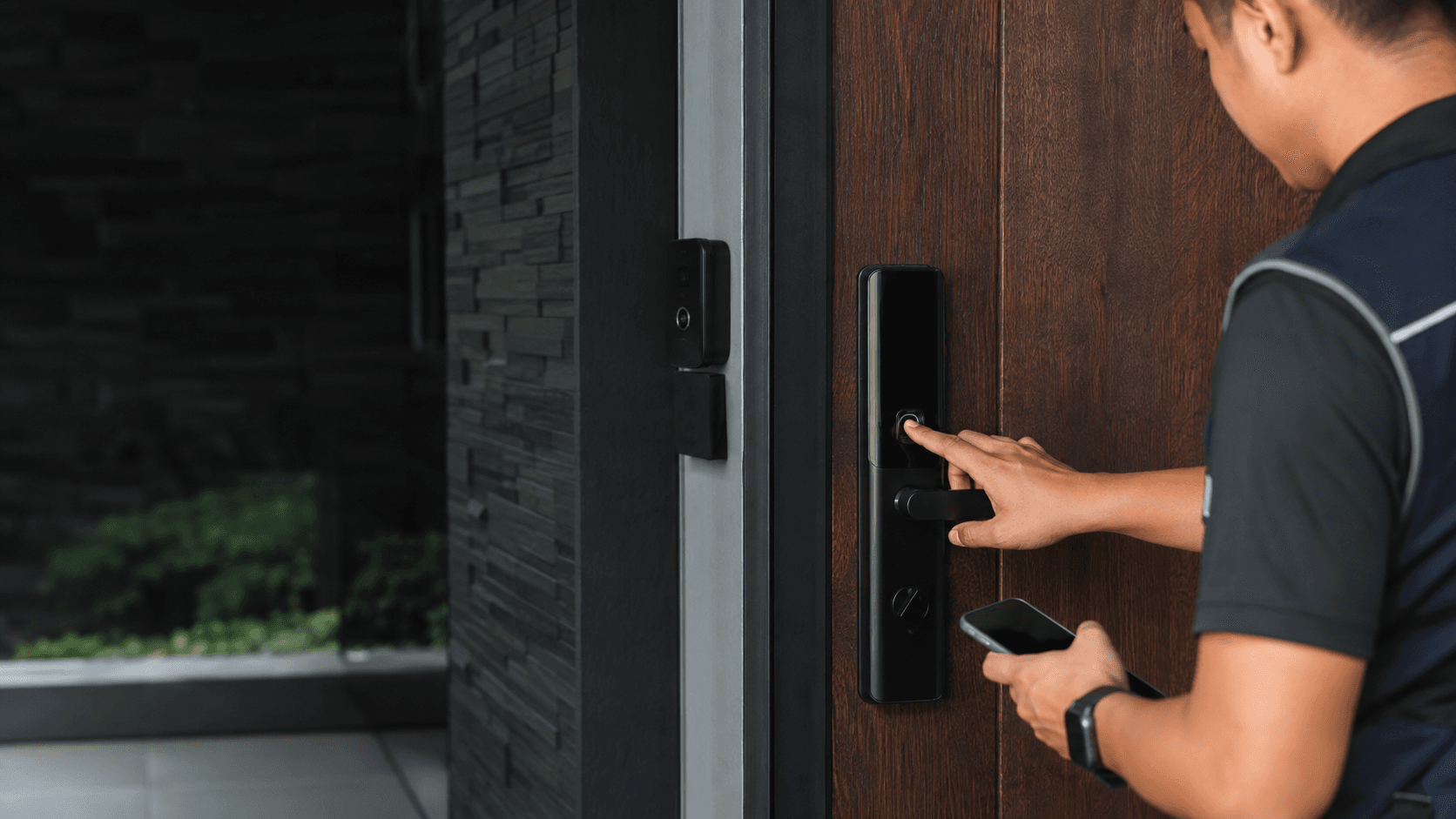
Yale lists those four access methods for the YDME 50 NxT across its regional product pages, and reseller listings repeat the same set. What those listings rarely cover is the part that decides whether the lock works in a Malaysian home or office: door condition, credential ownership, and what happens when the batteries run down.
What the Yale Ydme 50 Nxt is and who it suits
The Yale Ydme 50 Nxt sits in Yale's non-connected range. It replaces a conventional door lock with electronic access, but it does not depend on a phone, an app, or a network to open the door. That distinction matters more than any feature list, because it decides who should be looking at this lock at all.
A non-connected lock suits a reader who wants keyless daily entry without adding another device to manage. It also suits premises where a network link is impractical or unwanted, such as a shop lot with no reliable Wi-Fi at the door, a rented office where the tenant cannot modify the network, or a home where the owner prefers the lock to keep working during an internet outage.
The trade-off is visibility. A non-connected lock cannot report who entered and when to a remote dashboard, and it cannot be unlocked from another location. Where that record matters, the decision usually shifts toward an access-control panel rather than a standalone lock. Eyonic's own product review notes that smart locks work best when door condition, user roles, and backup method are reviewed before installation, and that for business use the choice between a standalone smart lock and an access-control panel is worth checking first.
Access methods on the Yale Ydme 50 Nxt
Four entry methods are documented for this model: fingerprint, PIN code, RFID card, and mechanical key. Each covers a different situation, and the practical question is not which one is best but which combination the site actually needs.
| Access method | Daily entry | Guest or temporary entry | Backup entry |
|---|---|---|---|
| Fingerprint | Yes | No | No |
| PIN code | Yes | Yes | No |
| RFID card | Yes | Yes | No |
| Mechanical key | No | No | Yes |
Fingerprint entry is the fastest option for people who use the same door every day, because there is nothing to carry and nothing to remember. It is a poor fit for visitors, since enrolment is personal and temporary users would need to be added and removed.
PIN codes cover the gap. A code can be issued to a cleaner, a contractor, or a short-stay guest and withdrawn afterwards, which is the main reason a code-based lock appeals to small offices and rental units. The risk is code sharing. once a code is passed to someone outside the intended group, the lock has no way to know.
RFID cards behave like a physical credential. They suit staff who already carry a card for other doors, and they can be handed over and collected at the end of a job. The cost is that a card can be lost or lent, so card-based access needs a plan for disabling a missing card.
The mechanical key is the fallback. It is the method that still works when electronics, batteries, or fingerprints fail, and it is the reason a locksmith or building manager can still open the door. Keeping that key accessible but not obvious is a decision worth making before installation, not after.
Door and installation checks before ordering a Yale Ydme 50 Nxt
Most failed smart lock projects fail at the door, not at the lock. The checks below are ordered so that the cheapest problems surface first.
- Confirm the door thickness and handing, and check whether the existing cutout matches a mortise lock body.
- Confirm the existing door cutout and mortise dimensions against the lock being ordered.
- Confirm who holds admin rights and who receives user credentials, and write that down.
- Confirm the backup key location and the emergency power method before the lock is fitted.
- Confirm the installer and the handover step, including a test of every access method.
Door thickness is the first filter. A lock body designed for one thickness range will not seat correctly in a door outside it, and a door that is too thin or too thick cannot be corrected with longer screws. Because no official Yale specification sheet for the Yale Ydme 50 Nxt was supplied for this article, the exact supported thickness range is not stated here; it should be confirmed against the current Yale documentation or with the supplier before ordering.
The second filter is the cutout. A door already prepared for a mortise lock has a pocket cut into its edge. If the new lock body does not match that pocket, the door needs additional carpentry, and on a metal or fire-rated door that work may not be acceptable at all. Measuring the existing cutout before ordering is faster than returning a lock that will not fit.
Handing matters too. A door that opens inward on the left is not the same installation as one that opens inward on the right, and the lock has to be set up for the correct side. This is a five-minute check that prevents a wasted site visit.
Power, alerts, and backup entry
Every electronic lock eventually loses power, and the plan for that moment should be settled before installation rather than discovered at the door. Three things need an answer. how the lock is powered, how low power is signalled, and how the door is opened when the lock is dead.
Reseller listings for this model describe low battery alerts and an emergency power method, but those listings are commercial pages rather than manufacturer documentation, and the specific battery type, expected battery life, and emergency power method for the Yale Ydme 50 Nxt were not confirmed by an official Yale datasheet in the evidence available for this article. Those details should be verified against current Yale documentation before purchase.
The mechanical key is the dependable fallback, because it does not rely on the lock's electronics at all. That makes key storage a security decision. A key left in a nearby drawer or under a planter defeats the purpose of the electronic access methods, while a key stored too far away is useless in an emergency. The practical answer is usually a key held by a responsible person on site, plus a second copy held off site.
Credential memory is the other edge case. When batteries are replaced, the lock should retain its enrolled fingerprints, codes, and cards rather than requiring every user to be re-enrolled. This is worth confirming for the specific unit, because re-enrolling a whole office after a battery change is a real operational cost.
Where Eyonic fits for Sarawak installations
Eyonic Sdn Bhd plans, supplies, and installs security and ELV systems in Sarawak, covering homes, offices, shops, and industrial sites. The company's documented process runs through site survey, system proposal, installation, and handover, which is the same sequence a door lock installation needs if the door condition is to be checked before the lock is ordered.
That survey step is where the door checks above get done properly. A surveyor can measure the door, confirm the cutout and handing, and identify whether the door is timber, metal, or fire-rated, which changes what installation work is acceptable. Eyonic's smart lock guidance already frames the decision this way: door condition, user roles, and backup method first, then the choice between a standalone lock and an access-control panel.
Eyonic's completed work includes the Kuching Immigration Office, where the focus was arrival flow, staff areas, visitor movement, and dependable daily operation, and the KTA Sarawak Sdn Bhd project, which covered staff movement, visitor handling, and tidy cabling in a Kuching office. Neither project is a Yale Ydme 50 Nxt installation, and no first-hand installation record for this specific model was supplied, so those projects are context for how Eyonic approaches access and movement rather than proof of experience with this lock.
For readers outside Sarawak, the same checks still apply, but the installer and the service arrangement need to be confirmed locally. A lock bought online without a local fitter can leave a door that is neither locked nor finished.
Questions to settle before confirming a Yale Ydme 50 Nxt
Does the lock connect to an app or a panel? No evidence was supplied that the Yale Ydme 50 Nxt connects to an app, bridge, or access-control panel, and Yale's own product pages place it in the non-connected range. Readers who need remote unlock or entry logs should treat that as a different product category.
Is it available in Malaysia, and at what price? No Malaysian pricing, stock, warranty, or authorised-dealer status for this model was supplied for this article. Those details need to come from a Malaysian supplier or Yale's local channel before any commitment.
Who installs it, and who is accountable afterwards? This is the question that decides whether the lock is a working system or a box on a shelf. The installer should be identified before purchase, the handover should include a test of every access method, and the person holding admin rights should be named in writing.
What happens if the door does not match? If the door thickness, cutout, or handing rules out this lock, the alternatives are a different lock body, additional door preparation, or a different door. Settling that during a survey costs far less than settling it after delivery.
Readers who want the door condition and access requirements reviewed before choosing a lock can share the location, property type, and required system with Eyonic on WhatsApp at +60 11-5111 7959.