
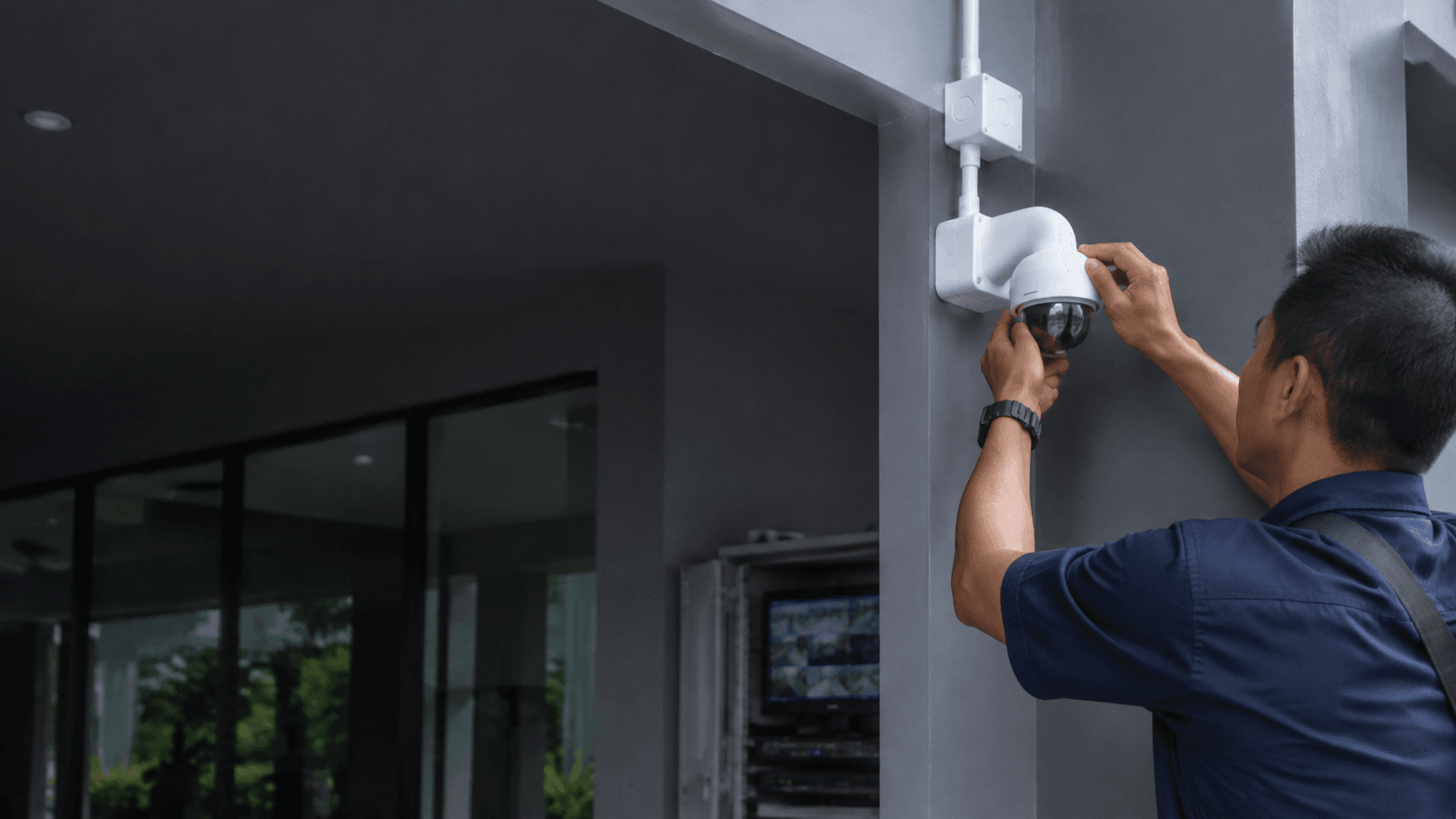
The term covers a fixed surveillance camera whose lens sits behind a curved or tinted dome cover, paired with infrared illumination so the unit can produce a usable image after ambient light drops. The dome shape is the defining physical trait; the IR element is the defining low-light trait. Buyers comparing models usually care about how those two features behave together on a real wall or ceiling, not about the label itself.
Ir Dome Camera. What the Term Covers
An IR dome camera is a fixed camera, not a moving one. The lens points in one direction once mounted, and the dome cover protects the lens and internal board from dust, contact and casual tampering. Infrared LEDs sit around the lens inside the same housing, so the light source and the lens share a line of sight.
That combination separates it from two neighbours. A bullet camera uses a cylindrical body that is easier to aim but far more obvious. A PTZ camera can pan, tilt and zoom, which costs more and adds moving parts. A dome unit trades flexibility for a low profile and a smaller visual footprint on a ceiling or wall.
Eyonic CCTV plans, supplies and installs monitoring systems with camera placement, recording and remote viewing for homes, offices, shops and industrial sites. The company also lists site survey, camera placement, NVR setup and remote viewing among its services, which means the dome unit is treated as one part of a wider system rather than a standalone purchase.
How IR Night Vision Works in a Dome Housing
Infrared LEDs emit light just outside the visible spectrum. The camera sensor still detects that light, so the scene appears as a monochrome image rather than a colour one. When ambient light is sufficient, the camera can stay in colour mode; when it falls below a threshold, the unit switches to IR mode and the image turns to black and white.
The dome cover matters here. A curved or tinted cover can reflect infrared light back toward the lens, which produces haze, glare or bright spots in the frame. This is a known behaviour of IR through dome covers, and it is one reason placement and cover condition are checked rather than assumed. A dirty or scratched dome makes the problem worse because the IR light scatters off the surface.
Eyonic recommends checking actual lighting conditions before confirming placement for ColorVu-style cameras. The same discipline applies to an IR dome camera: the lighting at the site at night decides whether IR is the right tool, and a survey is the point where that gets tested rather than guessed.
What IR Does Not Solve
Infrared light falls off with distance. A subject far from the camera receives less illumination than one close to it, so the far end of a long corridor or an open yard will look darker than the near end. IR also does not restore colour, and it does not see through glass cleanly because the glass can reflect the IR back at the lens. A camera aimed through a window at night often produces a washed-out frame for that reason.
Indoor and Outdoor Placement Considerations
Indoor placement is usually about coverage of a defined space: an entrance, a counter, a corridor, a stairwell or a room with equipment. The dome sits close to the ceiling, aims down and across, and covers a predictable area. Height matters because a camera mounted too high sees the tops of heads rather than faces.
Outdoor placement adds weather, distance and light variation. A camera under an eave is sheltered; one on an exposed pole is not. Direct sunlight into the lens at certain hours can wash out the image, and a bright light source inside the frame at night can pull the exposure away from the area that matters. Aiming the camera away from strong light sources is a placement decision, not a settings fix.
Vandal resistance and weather sealing are properties of specific models, and no supplied evidence states the IP rating or vandal rating of any particular IR dome camera. Those figures have to come from the manufacturer datasheet for the exact model under consideration, not from a general description of the category.
Mounting and Aiming Constraints
A dome camera is aimed before the cover goes on, and once the cover is fitted the direction is largely fixed. That makes the initial aim the important one. A camera pointed at a blank wall, at a reflection, or at a doorway from an angle that only captures the frame and not the person walking through it will record footage that answers nothing. The practical test is whether the recorded image shows a face, a plate or an action clearly enough to be useful later.
Ir Dome Camera Planning for Malaysian Sites
Planning starts with what the site needs to see, not with how many cameras fit a budget. A shop entrance, a back-of-house corridor, a loading area and a car porch each need different coverage, and a single camera rarely covers all of them well. The useful sequence is the one Eyonic follows on installation work:
- Site survey to review the property, the lighting at different hours, the mounting points and the cable routes.
- System proposal setting out camera positions, recording equipment and viewing arrangements.
- Installation of cameras, cabling and the recorder, with the aim of each unit confirmed on site.
- Handover covering live viewing, playback and mobile access so the system is usable from day one.
Eyonic completed a project for the Kuching Immigration Office, focused on arrival flow, staff areas, visitor movement and dependable daily operation. That project shows the pattern. the camera positions followed the movement of people through the building rather than a fixed template. A public office and a shop have different traffic, but both are planned around where people actually go.
Eyonic also completed work for KTA Sarawak Sdn Bhd, an engineering consultancy site in Kuching that needed a practical office setup supporting staff movement, visitor handling, tidy cabling and clearer daily site control. Tidy cabling is not a cosmetic point. Loose or poorly routed cable is where faults appear later, and it is easier to get right during installation than to correct afterwards.
Budget Context
Eyonic publishes a Hikvision CCTV Package at RM 1,599 covering camera supply and setup, basic recording configuration and mobile viewing handover. That package is a starting reference for a small system. Larger sites sit well above it. the Kuching Immigration Office project carried an approximate budget of RM 12,000 to RM 28,000, and the KTA Sarawak Sdn Bhd project an approximate budget of RM 8,000 to RM 18,000. No supplied evidence states a price for an individual IR dome camera or for a dome camera installation on its own.
Recording Viewing and System Handover
The camera is only the front end. Footage has to land somewhere, and the recorder is what makes the camera useful after the fact. A network video recorder stores the streams from IP cameras and serves them back for live viewing and playback. Eyonic lists NVR setup and remote viewing as part of its service scope, which places both inside the installation rather than leaving them to the buyer.
Remote viewing lets a phone or computer reach the recorder over the internet. It is convenient and it depends on a stable connection and correct configuration. When it is set up during handover, the person receiving the system can confirm the live view and the playback work before the installer leaves. When it is left as a later task, problems surface at the worst moment.
Storage capacity and retention periods depend on the number of cameras, the resolution, the frame rate and the size of the drive. No supplied evidence states retention periods or storage capacity for dome camera systems, so those figures have to be worked out for the specific site rather than quoted in advance.
What Handover Should Cover
A handover that only shows the live picture leaves gaps. The useful handover covers how to find footage from a specific time, how to export a clip, how to add or remove a user, and who to contact when something stops working. Eyonic's published process ends at handover, and the Kuching Immigration Office project description points to dependable daily operation as the outcome, which is what a proper handover is meant to protect.
Questions Before Installation
Most of the uncertainty around an IR dome camera comes down to a small set of questions that a survey answers directly.
Will IR actually be needed at this site? If the area has usable light at night, IR may rarely engage. If it is genuinely dark, IR is doing the work and the distance from camera to subject becomes the limiting factor. Eyonic's guidance on checking actual lighting conditions before confirming placement applies here.
Is the dome the right shape for this position? A dome suits a ceiling or a high wall where a low profile matters. A position that needs a long, narrow view down a corridor may suit a different housing better. The shape should follow the position, not the other way round.
What will the recorded image actually show? The test is whether a person walking through the covered area is identifiable in the footage. That depends on camera height, angle, distance and lighting together.
Who maintains it after handover? Domes collect dust and, outdoors, water marks. A dirty cover degrades the image and can worsen IR reflection. Cleaning and checking are part of keeping the system useful.
What happens if the internet drops? Recording continues locally on the recorder; remote viewing stops until the connection returns. That distinction is worth confirming during handover so a dropped connection is not mistaken for a failed camera.
Eyonic Sdn Bhd is a security system supplier in Sarawak working on CCTV and ELV systems, with Eric Yong as founder and more than ten years in the industry. The company's product range includes Hikvision cameras and smart locks, and its completed work includes government and engineering consultancy clients.
Share your location, property type and required system with Eyonic on WhatsApp at +60 11-5111 7959 for the next practical step.