
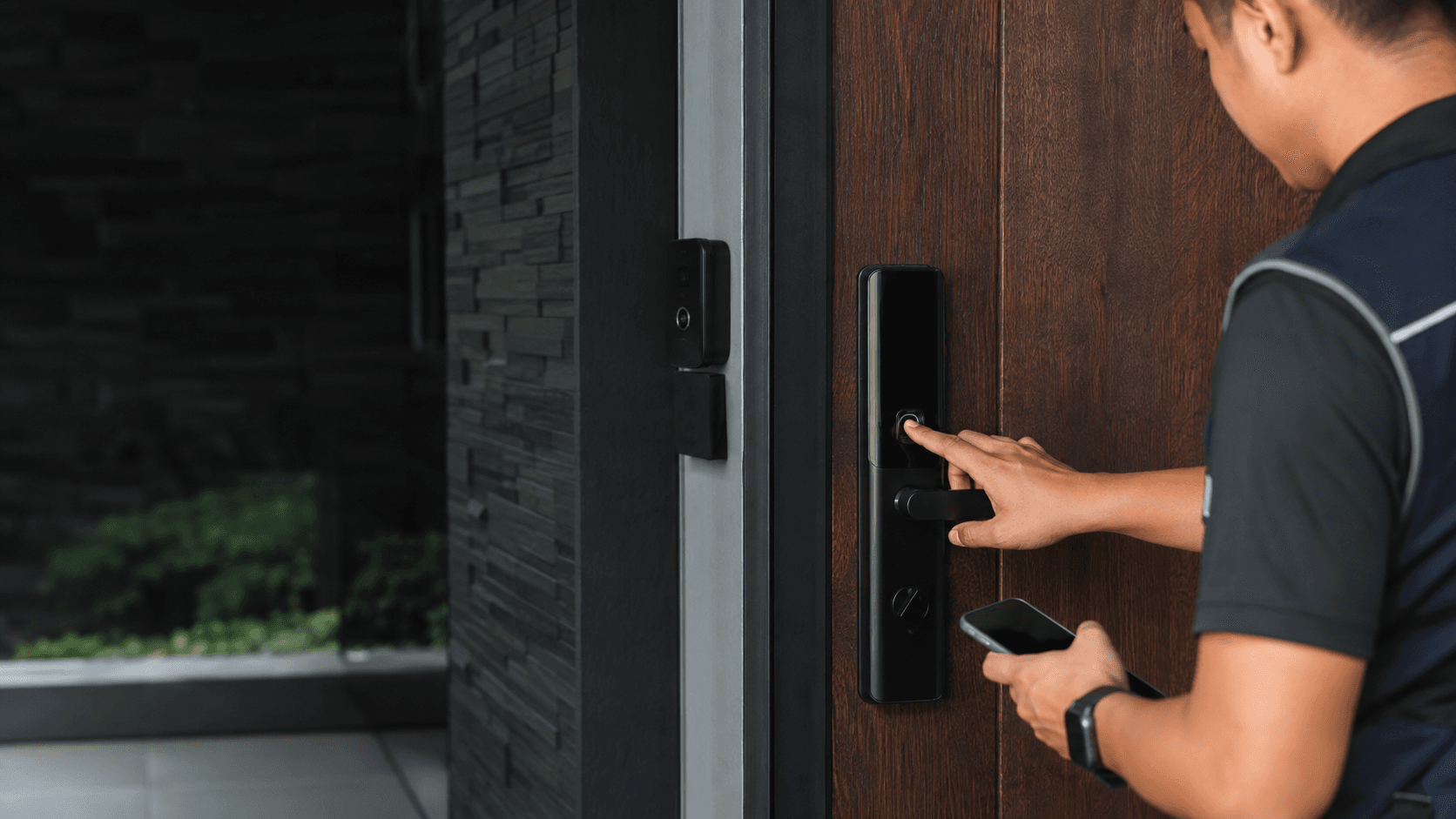
The exact-match query electric door lock front door describes a decision rather than a single product. In Malaysia, that decision usually starts with the door already hanging in the frame, which means the practical questions are about power, release mechanism, who gets access, and what happens when the usual entry route fails.
Eyonic Sdn Bhd is a security system supplier in Sarawak that plans, supplies and installs CCTV and ELV systems for homes, offices, shops and industrial sites. Its product review library lists Smart Lock Door Access as multi-brand access control, described as good for controlled convenience when user permissions and backup entry are planned properly.
Electric Door Lock Front Door. What the Choice Actually Involves
An electric door lock front door decision sits between two broad approaches. One is a standalone smart lock, which handles entry at the door itself. The other is an access control panel, which manages entry centrally and is usually considered when several doors, several users, or a business needs to be managed together.
Eyonic's own review guidance states that smart locks work best when door condition, user roles and backup method are reviewed before installation, and that for business use the company usually checks whether a standalone smart lock or an access-control panel is more appropriate. That check is the fork in the road: a single front door on a home points one way, while a front door that is one of several controlled openings points the other.
Before any of that, three checks matter most:
- Door condition — whether the existing door and frame can accept the lock hardware without replacement.
- User roles — who needs entry, how often, and whether access should be revocable per person.
- Backup method — how entry is granted if the primary method fails.
Those three items come from Eyonic's smart lock door access review, and they are the same three items that determine whether a quote is straightforward or whether the door itself becomes part of the job.
How an electric door lock front door is powered and released
Power and release are separate questions, and mixing them up is a common source of disappointment. Power is about how the lock or its controller receives energy. Release is about the mechanism that actually lets the door open.
Two release approaches appear repeatedly in the wider market. A lock can be a self-contained unit at the door, with its own keypad or touchscreen and its own power source. Alternatively, an electric strike can be fitted into the frame so the existing latch is released electrically while the door keeps its original lock body. The second approach is common where the door hardware should stay visually unchanged, and it is the approach most often paired with an access control panel.
Entry is then granted through a keypad or touchscreen code, a credential, or a command from a controller. The choice between these is a user-permissions question as much as a hardware question: a household may only need one shared code, while a shopfront may need individual codes that can be added and removed as staff change.
What the supplied evidence does not establish is voltage, wiring type, current draw, holding force, IP rating, battery life, standby duration, or fail-safe versus fail-secure behaviour for any specific lock. Those are model-specific facts that belong on a manufacturer datasheet, and they should be confirmed against the exact model under consideration rather than assumed from a category description.
Door condition, frame and existing hardware checks
The door is usually the constraint, not the lock. A front door that is hollow, thin, warped, or fitted with hardware that cannot be adapted may not accept a given lock without modification or replacement. A metal frame and a timber frame present different fitting conditions. A door that already closes poorly will not be fixed by adding electronics.
This is why Eyonic's review guidance places door condition first. It is cheaper to discover that a door needs work before the lock is ordered than after. The same review notes that for business use, the choice between a standalone smart lock and an access-control panel is a real decision rather than a formality — a panel can manage multiple users and doors in ways a single lock cannot.
Existing hardware matters too. If the front door already has a deadbolt, a handle set, or a mortise lock, the new device has to coexist with or replace that hardware. Where the door must keep its original appearance, an electric strike that releases the existing latch is often the more conservative route. Where the door can accept new hardware, a self-contained lock with its own keypad or touchscreen keeps the installation local to the door.
Entry methods, user permissions and backup entry
Entry method and user permissions are usually decided together. A keypad or touchscreen entry method allows codes to be issued, changed and withdrawn without rekeying anything physical. That is the main practical advantage over a mechanical key, and it is also the main thing to plan properly: a shared code that never changes is convenient but tells nothing about who entered.
User permissions determine whether the system distinguishes between people. A home may not need that distinction. A business front door usually does, because staff turnover means access has to be removed as well as granted. This is the point at which a standalone smart lock and an access control panel diverge most clearly, and it is the reason Eyonic's guidance treats business use as a separate case.
Backup entry is the question readers most often leave until after installation. The supplied evidence does not state battery life, standby duration, or fail-safe versus fail-secure behaviour for any specific lock, so no claim can be made here about how long a given unit will continue to operate or what it does when power is lost. What can be said is that the backup method should be chosen deliberately before installation, because it determines whether a failed primary method is an inconvenience or a lockout. A mechanical key override, a second credential type, or a documented manual release are the kinds of options that belong in that conversation, and the right one depends on the door and the model.
Where an electric door lock front door suits Malaysian homes and premises
The fit depends on how the door is used rather than on the property type alone. A home front door used by a household that wants to stop carrying keys is a different case from a shopfront that needs to know who entered and when.
Homes generally benefit from the convenience side: keypad or touchscreen entry, no rekeying when a code is shared too widely, and a single door to manage. The trade-off is that a single door also means a single point of failure, which is why backup entry matters more in a home than the marketing usually suggests.
Offices, shops and industrial sites tend to benefit from the permissions side. Eyonic's completed work in Sarawak includes the Kuching Immigration Office, where the focus was arrival flow, staff areas, visitor movement and dependable daily operation, and the KTA Sarawak Sdn Bhd project, which needed a practical office setup in Kuching to support staff movement, visitor handling, tidy cabling and clearer daily site control. Both are examples of access being treated as part of how a site operates rather than as a standalone gadget.
Two constraints deserve honesty. First, the supplied evidence does not describe Malaysian regulatory or strata requirements for front door lock modification, so any building-specific rule — particularly for apartments, condominiums and fire doors — should be confirmed with the relevant management or authority before work begins. Second, the supplied evidence does not state certification, standards compliance or accreditation for any lock or installer, so no compliance claim is made here.
Supply, installation and handover in Sarawak
Eyonic's installation process, documented for its CCTV work, runs through site survey, system proposal, installation and handover. The same sequence applies to lock work: the survey establishes door condition and user roles, the proposal sets out whether a standalone smart lock or an access control panel is the better fit, installation fits and configures the hardware, and handover covers the entry methods and backup method in practice.
- Site survey — door condition, frame, existing hardware and user roles are checked on site.
- System proposal — a standalone smart lock or an access control panel is recommended based on what the survey found.
- Installation — the lock or strike, entry method and any supporting wiring are fitted and configured.
- Handover — entry methods, user permissions and the backup entry method are explained and tested.
Eyonic is based in Sarawak and its published project work is in Kuching, so supply and installation enquiries are best framed around that coverage. The company's founder, Eric Yong, has been in the industry for more than ten years and is described as experienced in technical installation of digital security solutions for commercial businesses in Sarawak.
Pricing for lock supply and installation is not stated in the supplied evidence. What is published is package pricing for other systems — a Hikvision CCTV package at RM 1,599, a Hikvision alarm system at RM 1,599, and an autogate package at RM 1,599 — along with two project budget ranges: RM 12,000 to RM 28,000 for the Kuching Immigration Office work and RM 8,000 to RM 18,000 for the KTA Sarawak Sdn Bhd work. Those figures relate to those projects and systems, not to lock work, and should not be read as a lock price.
For an electric door lock front door enquiry, the useful starting information is the location, the property type, and the required system. Sharing those three details with Eyonic on WhatsApp at +60 11-5111 7959 gives the next practical step without a site visit being arranged blind.