
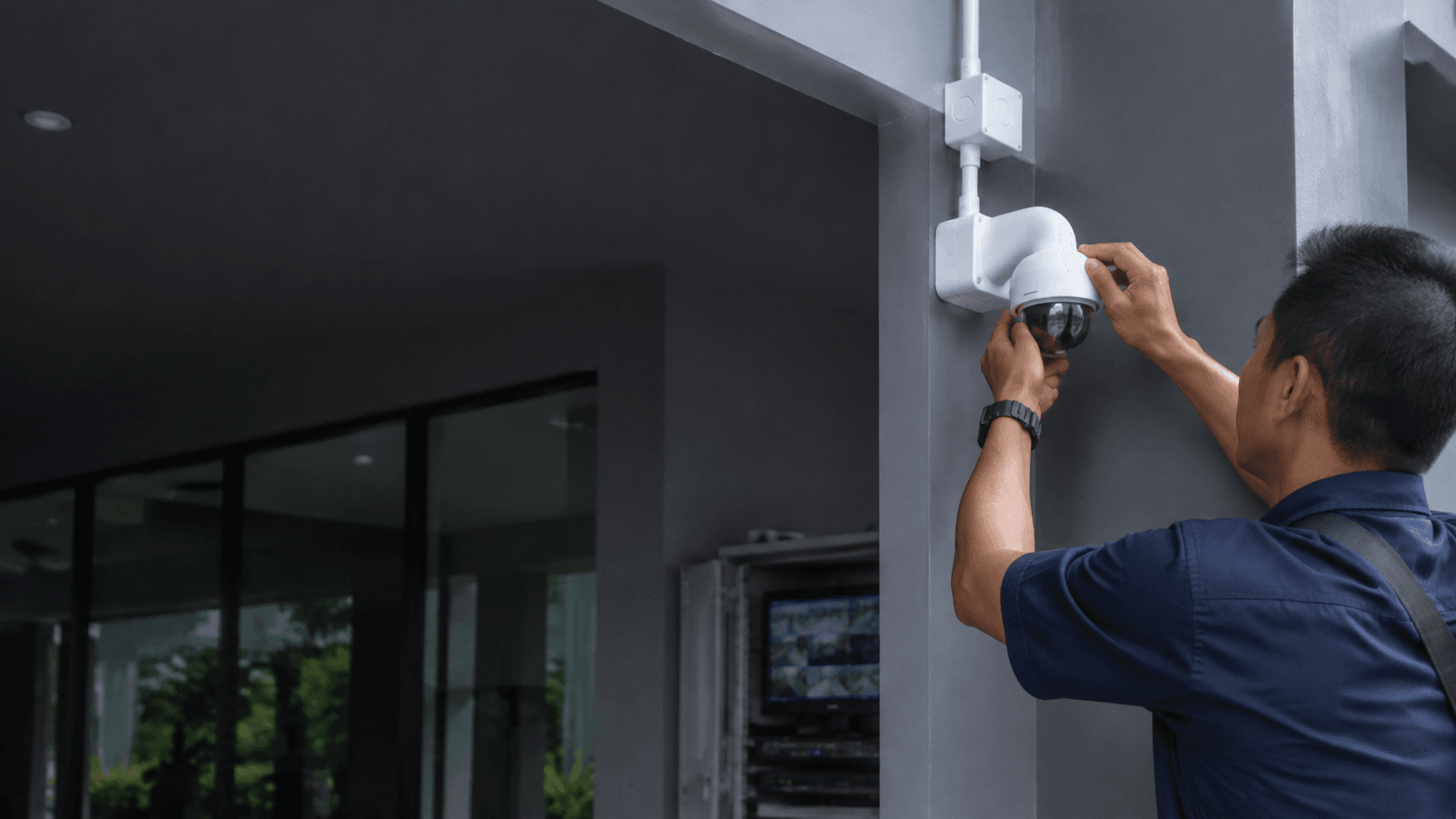
The exact phrase home cctv security systems describes a package of decisions rather than a single boxed product. A house setup normally covers where cameras sit, how footage is recorded, how the footage is viewed away from the property, and who carries out the work. Eyonic Sdn Bhd plans, supplies and installs monitoring systems with camera placement, recording and remote viewing for homes, offices, shops and industrial sites.
Most Malaysian buyers arrive with a camera count in mind. The more useful starting point is the house itself: which entries are exposed, how light falls across each approach after dark, and where cabling can run without damaging finishes. Those three answers shape the rest of the plan.
Home CCTV Security Systems. what a house setup covers
A house setup has four working parts. Cameras capture the scene. A recorder stores the footage. A network path carries video to a phone or screen. Installation ties the three together and hands the system over in a usable state.
Eyonic's CCTV service line lists camera placement, recording and remote viewing as the core of the work, alongside planning and supply. That framing matters because a camera on its own records nothing useful without storage and a viewing method attached to it.
Scope also depends on property type. A single-storey terrace house, a double-storey semi-detached unit and a shoplot with living quarters above it present different entry points, different cable routes and different lighting. The same camera count can produce very different coverage across those three buildings.
What the basic package covers
Eyonic lists a Hikvision CCTV Package at RM 1,599 covering camera supply and setup, basic recording configuration, and mobile viewing handover. The published package description does not state a camera count, resolution, lens type or storage capacity, so those details need to be confirmed against the actual property rather than assumed from the price.
Two other Eyonic packages sit at the same RM 1,599 level: a Hikvision Alarm System covering control panel and sensors, siren and zone setup, and user testing and handover; and an Autogate Package covering motor recommendation, remote-control setup, and safety testing and handover. A house project can combine categories, but each is priced and scoped separately.
Camera placement decisions that follow real lighting and entry points
Placement is the decision that most affects whether footage is usable months later. A camera aimed at a bright wall or a streetlight will wash out the subject walking beneath it. A camera tucked under a deep eaves overhang may see nothing of the approach at all.
Eyonic's guidance on ColorVu-style cameras is to check actual lighting conditions before confirming placement. ColorVu is a camera family built around low-light colour imaging, and its behaviour depends on how much ambient light reaches the scene. A position that looks adequate in daylight can behave differently once the porch light is off.
Entry points worth covering first
Typical Malaysian houses have a small number of predictable approaches: the front gate or car porch, the main door, the side or back lane access, and any rear service yard. These are the positions where a camera earns its place, because they are the routes a person must use to reach the house.
Coverage should also account for what happens after the gate. A camera that captures a vehicle entering the porch but loses the driver's face at the door leaves a gap. Overlapping fields of view between the gate and the entrance close that gap more effectively than adding a camera pointed at the same spot from a different angle.
Constraints that change the plan
Cable routes are the most common constraint. Existing conduit, ceiling voids and wall construction determine whether a run is straightforward or requires surface trunking. Tidy cabling was an explicit part of the KTA Sarawak Sdn Bhd office project in Kuching, which suggests the practical route matters as much as the camera position.
Privacy and neighbour-facing angles are a second constraint. A camera that sweeps across a neighbouring window or a shared corridor creates a problem that no amount of resolution solves. Placement should be narrowed to the property's own approaches.
Recording, NVR setup and remote viewing in daily use
Recording is what turns a camera into evidence. An NVR, or network video recorder, receives video from the cameras and stores it for later playback. NVR setup covers bringing the recorder online, confirming each camera is writing to it, and checking that recorded footage can actually be found and exported.
Remote viewing is the second half of daily use. It lets the footage be checked from a phone rather than from a monitor inside the house. Eyonic includes mobile viewing handover in the basic CCTV package, which means the viewing setup is demonstrated rather than left for the owner to configure.
What to confirm before handover
Three checks make the difference between a working system and a system that only appears to work. First, that each camera is recording to the recorder and not just streaming live. Second, that playback can be searched by time and the relevant clip exported. Third, that remote viewing works from outside the home network, not only on the same Wi-Fi.
Retention is the practical question most owners ask later. How far back footage can be reviewed depends on storage capacity and how the recorder is configured, and Eyonic's published package description does not state a storage figure. That is a detail to settle during the proposal stage, when the recorder and drive are specified for the property.
installation from survey to handover
Eyonic's installation process runs through four stages. The sequence below reflects the published service description.
- Site survey. The property is inspected to establish entry points, lighting conditions, cable routes and where the recorder will sit.
- System proposal. The survey findings are turned into a proposed system covering camera positions, recording and viewing.
- Installation. Cameras, cabling and the recorder are installed and brought online.
- Handover. Recording, playback and mobile viewing are checked and explained before the job closes.
The survey stage is where most of the risk sits. A proposal built from a phone description of the house will guess at cable routes and lighting. A proposal built from a walk-through can name the positions and the constraints.
Who carries out the work
Eyonic Sdn Bhd is a security system supplier based in Sarawak, Malaysia, specialising in CCTV and ELV systems. The company plans, supplies and installs monitoring systems for homes, offices, shops and industrial sites. Eric Yong founded Eyonic Security Systems and has worked in the industry for more than 10 years, with experience in technical installation of digital security solutions for commercial businesses in Sarawak.
Completed work includes the Kuching Immigration Office, where the focus was arrival flow, staff areas, visitor movement and dependable daily operation. That project carried an approximate budget of RM 12,000 to RM 28,000. A second project for KTA Sarawak Sdn Bhd, an engineering consultancy, covered a practical office setup in Kuching supporting staff movement, visitor handling, tidy cabling and clearer daily site control, with an approximate budget of RM 8,000 to RM 18,000.
Those figures describe commercial and office work, not a typical house. They are useful as a sense of how scope scales, not as a home price guide. The published home package sits at RM 1,599.
What a package includes at RM 1 599
The RM 1,599 Hikvision CCTV Package covers camera supply and setup, basic recording configuration, and mobile viewing handover. It is a defined starting scope rather than a whole-house specification.
Homes that need more than the basic scope will move above that figure. Additional cameras, longer cable runs, a larger recorder or a property with difficult access all change the work involved. Eyonic's published pricing does not state a figure for larger homes, so the proposal stage is where that number appears.
It is worth separating what the package includes from what it does not. The published description does not name a camera count, resolution, lens, storage capacity or warranty term. Any of those details should be confirmed in writing before work begins rather than inferred from the package price.
Practical questions before confirming a plan
A few questions resolve most of the uncertainty before a plan is confirmed.
How many cameras does the house actually need? The answer follows the entry points identified in the survey, not a round number. A house with one gate and one main door needs fewer positions than a corner unit with side and rear access.
Where will the recorder live? The recorder needs power, ventilation and a cable path from the cameras. A cupboard with no airflow or a location far from the cable routes adds cost and can shorten equipment life.
Will remote viewing work on the home internet? Remote viewing depends on the home network carrying video out. A weak or unstable connection affects the experience regardless of camera quality.
What happens after handover? The published package description does not state warranty terms, monitoring subscriptions or response times. Those are commercial terms to confirm directly rather than assume.
Does the plan suit the property type? Eyonic's published evidence is Sarawak-based, covering homes, offices, shops and industrial sites. Buyers outside Sarawak should confirm coverage before planning around it.
For the next practical step, share the location, property type and required system with Eyonic on WhatsApp at +60 11-5111 7959.