
The exact-match query cop cctv is ambiguous, and that ambiguity is the single most useful thing to resolve before comparing products. One set of results describes a business-to-business manufacturer that has been building surveillance hardware since the 1990s. Another describes a small consumer gadget marketed on television. A third set describes police body cameras and wearable recorders. Each answers a different question, and mixing them leads to mismatched expectations about price, installation and support.
Cop Cctv. What Matters Before You Choose
Before comparing any product, decide which category the search actually belongs to. The three categories below rarely overlap in buyer, budget or installation method.
- Confirm whether the search refers to COP Security System Corp. hardware, a Cop Cam consumer device, or police-style body cameras.
- Match the category to the site. a shop, office or industrial building needs fixed cameras and recording; a household gadget suits casual indoor monitoring.
- Check whether recording is continuous or motion-triggered, because that determines storage and review effort.
- Verify night performance against the actual lighting at the location rather than the marketing description.
- Confirm who handles installation, cabling and handover, since consumer devices and professional systems differ sharply here.
That sequence matters because the failure mode is almost always category mismatch. A buyer expecting a monitored multi-camera system and receiving a single battery-powered gadget will be disappointed regardless of product quality, and the reverse is equally true.
Choosing the Right Cop Cctv
COP Security System Corp. states that it was established in 1992 to design, develop and manufacture security products, and a separate company description states that Cop Security was established in 2007 to provide CCTV and networking solutions. Both statements appear on the manufacturer's own site, which suggests the organisation describes an earlier manufacturing origin alongside a later solution-provider positioning. The product catalogue covers network cameras, bullet and dome cameras, LPR cameras, IP modules, explosion-proof cameras, thermal cameras, IP speed domes, PTZ cameras, NVRs, HD-SDI equipment, lenses, alarm systems, sirens, sensors, housings and brackets.
That breadth is the defining characteristic of this category. A manufacturer with explosion-proof housings, stainless steel housings and thermal cameras is serving industrial and commercial integrators, not households looking for a single plug-in camera. Buyers in that segment typically care about compatibility between cameras, recorders and existing cabling, which is why the same site publishes material on NVR compatibility, EoC transceivers for extending network devices beyond the basic 100m distance limit, and the problem of different brands leading to incompatibility.
Cop Cam sits at the opposite end. Retail listings describe it as a compact, cordless, motion-activated HD security camera that records day and night, supports loop recording, and can be used indoors or outdoors. Listings also note that it can function as a dash cam or action camera and that footage can be uploaded to a computer. The same listings reference state and local video recording laws, which is a genuine constraint rather than a formality: recording in spaces where people expect privacy carries legal exposure that varies by jurisdiction.
Police body cameras form the third category. Retail listings describe body-mounted recorders with audio and video, built-in storage, screens, night vision and IP65 ratings, positioned for law enforcement, security and personal use. These are wearable evidence-capture devices, not fixed surveillance infrastructure, and they are usually bought in small quantities for individuals or teams.
What is cop cctv?
Cop cctv is not one product line. It is a search phrase that surfaces a Taiwanese manufacturer of professional surveillance hardware, a consumer camera sold through television retail, and wearable body cameras used by police and security staff. The correct interpretation depends entirely on which of those three the searcher intends.
COP USA Security Cameras - Surveillance-video.com
A company profile for COP-USA, Inc. states that the business has sold over ten million cameras worldwide, that its corporate headquarters in Taiwan and China design, produce and manufacture the COP-USA brand, and that most PTZ cameras are assembled and quality-control tested in the United States. The same profile lists locations in City of Industry, California and Doral, Florida. These are the company's own published claims and should be treated as such rather than independently verified figures.
The practical implication for a buyer is regional availability. A brand with United States assembly and distribution may have different support, warranty and spare-part pathways than a Taiwan-direct manufacturer, and buyers outside North America should confirm which entity handles their region before committing to a product family.
Practical Considerations for Cop Cctv
Lighting is the most common source of disappointment in any camera purchase. Eyonic, a security system supplier in Sarawak, Malaysia, advises checking actual lighting conditions before confirming placement for ColorVu-style cameras, because low-light performance depends on the real environment rather than the specification sheet. The same principle applies to any camera described as offering night vision: the useful question is what the camera sees at the specific location after dark, not whether the feature exists.
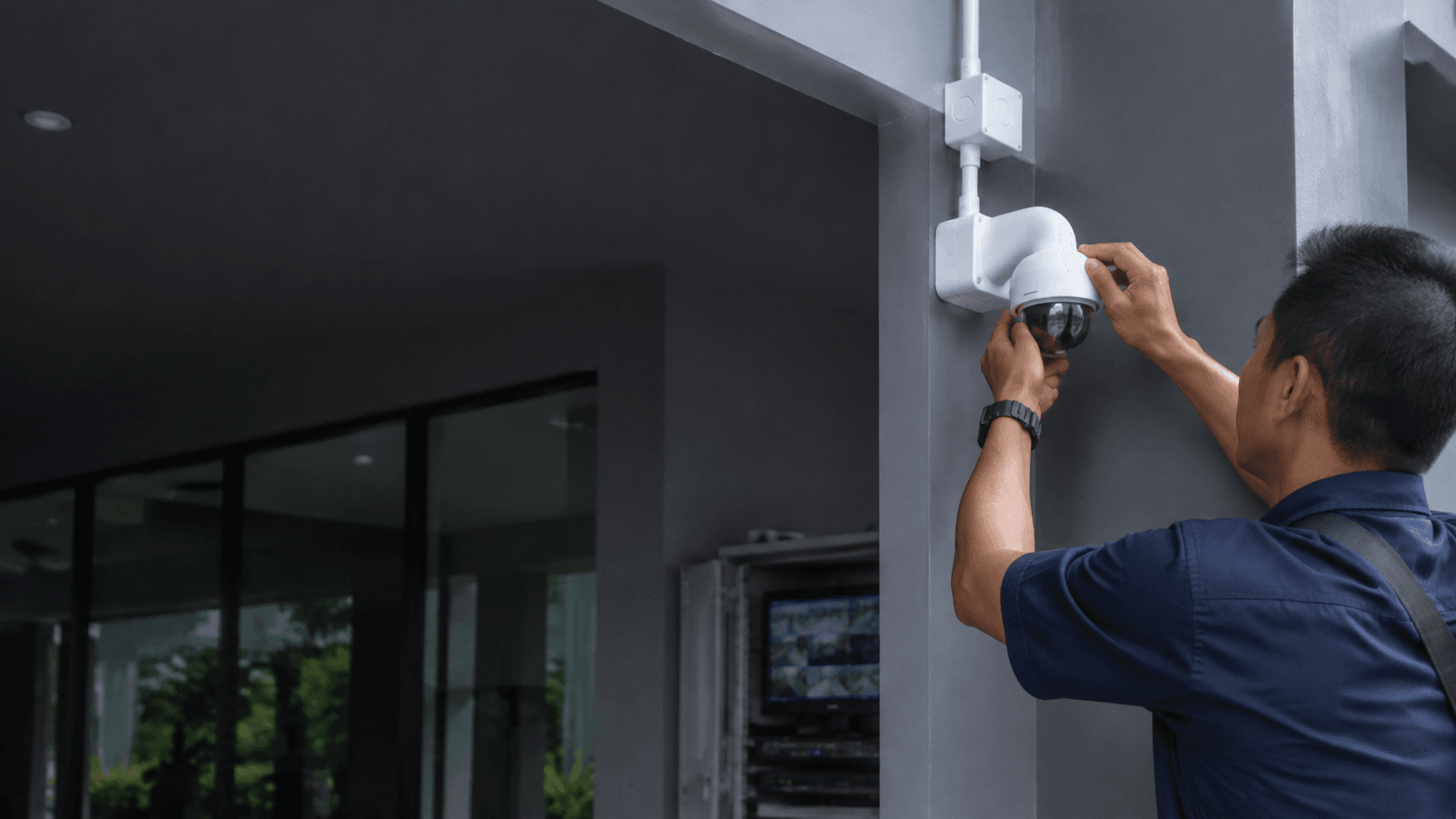
Installation responsibility is the second consideration. Eyonic's CCTV installation process covers site survey, system proposal, installation and handover, which reflects how professional deployments actually run. A consumer device skips all four stages, which is faster and cheaper but leaves cabling, placement and recording configuration to the buyer. Neither approach is wrong; they simply suit different situations.
Recorded evidence from completed projects shows what professional installation looks like in practice. Eyonic's work for the Kuching Immigration Office focused on arrival flow, staff areas, visitor movement and dependable daily operation, with an approximate budget of RM 12,000 to RM 28,000 for that type of work. A separate project for KTA Sarawak Sdn Bhd supported staff movement, visitor handling, tidy cabling and clearer daily site control, with an approximate budget of RM 8,000 to RM 18,000. Those figures illustrate the scale difference between a single consumer camera and a multi-camera commercial deployment.
For smaller requirements, Eyonic publishes a Hikvision CCTV package at RM 1,599 covering camera supply and setup, basic recording configuration and mobile viewing handover. That sits between a single gadget and a full commercial system, and it is the range most shops and small offices actually need.
Making an Informed Choice About Cop Cctv
The decision usually comes down to three questions. Does the site need continuous recording with retained footage, or is motion-triggered capture sufficient? Is there someone available to install and maintain the system, or is a self-contained device the only realistic option? And does the location have lighting, power and network conditions that match what the chosen product assumes?
Where the answer points to a fixed multi-camera system, the practical next step is a site survey, because placement decisions made on assumptions about lighting and coverage tend to be revised later at additional cost. Where the answer points to a single consumer camera, the constraint to check first is recording law in the relevant jurisdiction, followed by whether the device's storage and battery approach matches how often footage will actually be reviewed.
For buyers in Sarawak, Malaysia, Eyonic provides planning, supply and installation for homes, offices, shops and industrial sites, and can be reached on WhatsApp at +60 11-5111 7959 with the location, property type and required system.