
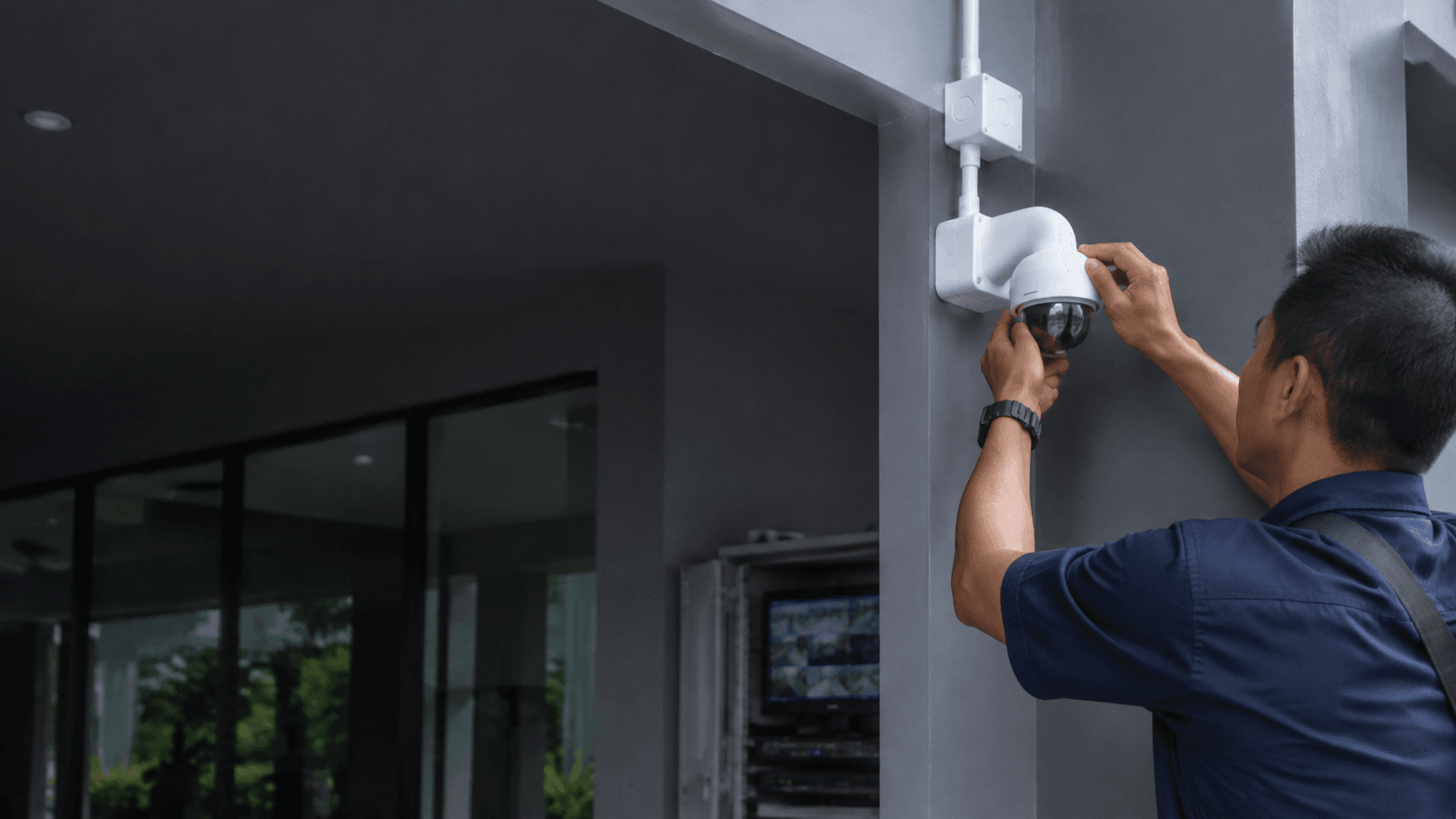
The exact-match query avigilon cctv describes a video security platform rather than a single boxed product. Buyers in Malaysia usually meet the name through two routes: a specification written into a tender, or a consultant recommending analytics-led surveillance for a site where basic recording is not enough.
Avigilon is a video security brand within Motorola Solutions. Its published portfolio covers IP cameras, network video recorders, video management software, video analytics, license plate recognition, and access control. The company describes two deployment families: Avigilon Unity for on-premise systems and Avigilon Alta for cloud-native systems.
What an Avigilon Cctv system is made of
An Avigilon Cctv deployment is assembled from four functional layers. Each layer can be sized independently, which is why two sites with the same camera count can end up with very different system costs.
- Site survey — walk the property, confirm camera positions, lighting, cabling routes, and recording points before any equipment is specified.
- System proposal — match camera types, recorder capacity, and software licensing to the surveyed site and the required retention.
- Installation — mount cameras, run cabling, configure the recorder and software, and set up remote viewing.
- Handover — test the system with the people who will use it daily and confirm they can review footage and export clips.
That sequence is the documented process Eyonic follows on CCTV installation work in Sarawak, and it applies to any IP-based system regardless of brand.
Cameras, recorders and video management software
Cameras capture. Recorders store. Software decides what the footage is worth. Avigilon publishes dome, bullet, box, panoramic, PTZ, and specialty camera categories, and separates its recorder line into AI NVR models, standard NVR models, and video appliances.
The software layer is where Avigilon differentiates itself. Avigilon Unity Video is the on-premise platform, and Avigilon Alta Video is the cloud-native platform. Both are documented as supporting video analytics, and Avigilon publishes analytics features including appearance search and license plate recognition.
Analytics change the hardware requirement. A camera that only records needs enough resolution to identify a face after the fact. A camera feeding analytics needs a scene where the analytics can actually work — adequate light, a stable angle, and a field of view that is not crowded by moving objects the system will misread.
Video analytics and what they change
Analytics move surveillance from review to response. Instead of an operator scrubbing through hours of footage, the software filters events by type, time, or appearance. Avigilon documents this as accelerated video search and reduced information overload.
The practical constraint is scene quality. Analytics perform poorly in scenes with heavy backlight, constant motion in frame, or camera angles that compress depth. A site survey that ignores lighting will produce a system that records well and analyses badly.
Eyonic's own guidance on low-light camera selection makes the same point in simpler terms: check the actual lighting conditions on site before confirming camera placement, rather than trusting a specification sheet.
Storage, bandwidth and retention
Storage is the cost that surprises buyers. Retention period, camera count, resolution, frame rate, and how much motion each camera sees all feed into the recorder specification. Avigilon documents storage and bandwidth optimisation as a VMS function, including the ability to manage how video is stored and streamed.
Bandwidth matters most on multi-site deployments. If cameras at a remote site stream continuously to a central recorder, the network link becomes the bottleneck. Local recording with central review avoids that, at the cost of managing hardware in more places.
Where Avigilon Cctv fits in Malaysia
Avigilon Cctv suits sites where footage has to be searched, not just stored. That usually means a specific operational need: identifying vehicles at a gate, tracing a person's path across a building, or giving a control room a filtered view instead of a wall of live feeds.
Typical fit scenarios include.
- Commercial buildings and offices where visitor and staff movement needs to be reviewed after an incident.
- Industrial and warehouse sites with multiple entry points and vehicle traffic.
- Retail environments where analytics can flag specific events rather than recording everything equally.
- Public-facing offices where arrival flow and visitor movement need dependable daily coverage.
Eyonic's Kuching Immigration Office project is an example of that last category. The work focused on arrival flow, staff areas, visitor movement, and dependable daily operation for a public office. The approximate budget for that type of work was RM 12,000 to RM 28,000. A separate office project for KTA Sarawak Sdn Bhd covered staff movement, visitor handling, tidy cabling, and clearer daily site control, with an approximate budget of RM 8,000 to RM 18,000.
Those figures describe Eyonic's completed office and public-sector work, not Avigilon pricing. No supplied evidence states Avigilon equipment, licensing, or installation costs in Malaysia.
Availability and support in Malaysia
Avigilon is distributed internationally, and the brand's own site lists compliance and certification programmes including ONVIF conformance, NDAA compliance, SOC 2 Type II, and ISO 27001. Those are vendor-published programme listings, not local availability guarantees.
What matters for a Malaysian buyer is narrower: who holds stock, who can service the recorder, and who handles software licensing renewals. Those questions belong in the procurement conversation, not in a product page. No supplied evidence confirms authorised Avigilon distributors or local support channels in Malaysia.
Eyonic's documented product range is Hikvision cameras and smart locks, and its published packages are Hikvision-based. Whether a specific supplier carries Avigilon should be confirmed directly with that supplier before a specification is finalised.
What to compare before choosing
Avigilon competes on analytics and integration depth. The comparison that matters is not brand against brand in the abstract, but whether the site's actual problems need what the platform provides.
Three comparisons decide most projects.
Analytics versus recording. If the requirement is simply to have footage available after an incident, a conventional IP system with a network video recorder meets it. If the requirement is to find a specific event quickly across many cameras, analytics earn their cost. The gap between those two needs is usually the largest single driver of system price.
On-premise versus cloud. Avigilon Unity runs on-premise, with recorders on site and footage under local control. Avigilon Alta is cloud-native, with video managed through cloud services. On-premise suits sites with reliable equipment rooms and a preference for local data custody. Cloud suits multi-site operators who want consistent management without hardware in every location. The trade-off is between local control and central convenience.
Open integration versus single-vendor stack. Avigilon documents ONVIF conformance, which allows third-party cameras to work with its software, and documents integration with access control and other security systems. A site that already has cameras from another brand may be able to keep them and add Avigilon software rather than replacing everything.
Access control integration
Avigilon's portfolio includes access control alongside video, and the company documents unifying video and access control within the same platform. For a site that wants door events and camera footage in one timeline, that integration is the reason to consider the platform rather than a standalone CCTV system.
The constraint is planning. Access control integration requires the door hardware, credentials, and user roles to be defined before installation, not after. Eyonic's own guidance on smart locks makes the same point: door condition, user roles, and backup entry method should be reviewed before installation, and for business use the choice between a standalone lock and an access-control panel should be settled first.
Planning and installation questions to settle first
Most Avigilon Cctv projects that go wrong do so before installation, at the specification stage. Settling these points early avoids rework.
What has to be identified, and at what distance? Recognition distance drives camera choice more than any other factor. A camera that covers a wide area well may not identify a face at the gate.
How long must footage be kept? Retention period multiplies storage requirements directly. A site that needs 30 days of footage needs roughly twice the storage of one that needs 15.
Who reviews footage, and how often? A system reviewed daily needs a different interface and training approach than one reviewed twice a year.
What happens when the network drops? Recording should continue locally even if remote viewing is unavailable. This is a design decision, not a default.
Who maintains the system after handover? Software updates, licence renewals, and hardware replacement all need an owner.
Eyonic's documented installation process covers site survey, system proposal, installation, and handover, which places the survey before any equipment commitment. That ordering matters more on analytics-led systems than on basic recording, because camera placement determines whether the analytics work at all.
For sites in Sarawak, Eyonic can be reached on WhatsApp at +60 11-5111 7959 with the location, property type, and required system. Eyonic's founder, Eric Yong, has worked in technical installation of digital security solutions for commercial businesses in Sarawak for more than 10 years.
Questions buyers ask before committing
Does Avigilon CCTV work without internet? IP cameras and recorders operate on a local network, so recording continues without an internet connection. Remote viewing requires connectivity.
Can existing cameras be reused? Avigilon documents ONVIF conformance, which supports integration with conformant third-party cameras. Compatibility should be confirmed against the specific camera models in place.
Is cloud or on-premise better? Cloud suits multi-site operations that want central management. On-premise suits single sites that prefer local control of footage and hardware.
What drives the cost most? Camera count, retention period, and whether analytics are required. Analytics and storage typically account for more of the total than the cameras themselves.
What should be confirmed before signing? Local stock availability, service arrangements, software licensing terms, and who handles support after handover.