
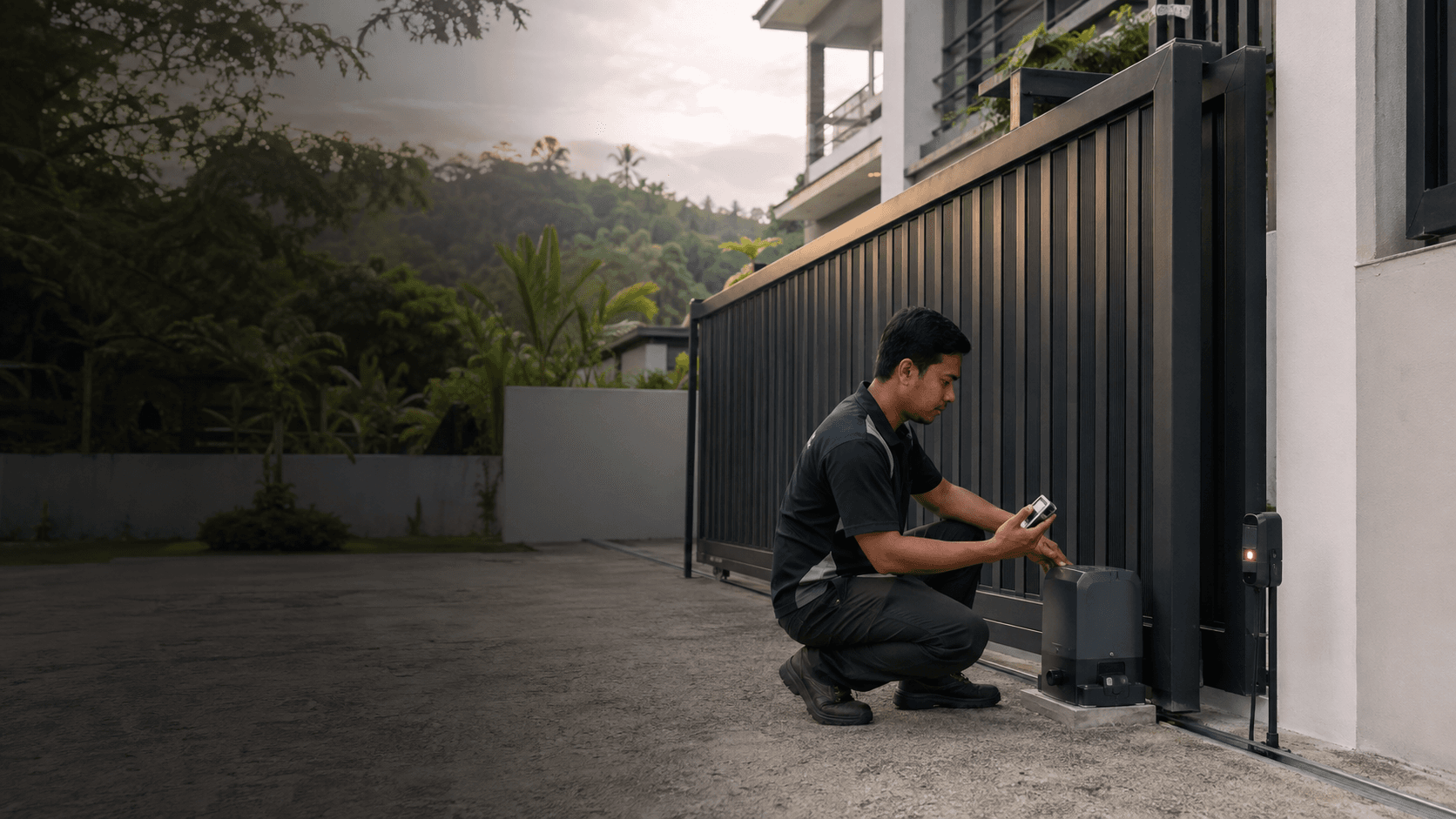
Remote Gate Installation. What Matters Before You Choose
Remote gate installation involves more than mounting a motor. The complete setup includes the gate opener, a receiver, remote transmitters or keypads, safety sensors, and the wiring that links them. Each component must match the gate's weight, size, and operating style, whether swing or sliding.
The decision process for remote gate installation follows a practical sequence that most reputable suppliers use:
- Confirm the gate type, dimensions, and weight to determine the required opener capacity.
- Check the power source availability at the gate location, including solar options for remote sites.
- Assess the distance between the gate and the building where the control panel will sit.
- Review safety requirements such as obstacle detection sensors and manual release mechanisms.
- Verify local regulations or community rules that may govern automatic gate operation.
- Schedule a site survey so the installer can confirm placement, cabling routes, and ground conditions.
Eyonic's installation process for security systems follows a similar structure: site survey, system proposal, installation, and handover. This same discipline applies when planning a remote gate installation, because the survey stage catches issues that would otherwise surface after the equipment arrives.
Choosing the Right Remote Gate Installation
The correct remote gate installation depends on matching the opener to the physical gate. Swing gates need an arm-type opener rated for the gate leaf length and weight. Sliding gates require a different mechanism, usually a gear rack or chain drive, sized to the gate's travel distance.
Power supply is the next major decision. Mains-powered openers suit properties with existing wiring near the gate. Solar-ready systems, like those offered by Mighty Mule, work where trenching for power cables is impractical or costly. A solar setup still needs battery storage and a controller, which adds components to the remote gate installation scope.
The control method also shapes the installation. A basic remote gate installation uses a dedicated radio transmitter. Smart systems, such as Remootio, add Wi-Fi or Bluetooth connectivity so a smartphone can operate the gate, and these units typically connect to the existing gate motor's terminals rather than replacing the whole opener.
What is remote gate installation?
Remote gate installation is the process of fitting an automatic gate opener and connecting its control components so the gate responds to signals from a remote device. The work covers mechanical mounting, electrical wiring, programming of remotes or keypads, and testing of safety features.
A complete remote gate installation differs from simply attaching a motor. The installer must position safety photocells so the gate stops if something blocks its path, program the open and close limits, and confirm the manual release works in case of power failure. These details determine whether the system operates dependably over years of daily use.
Practical Considerations for Remote Gate Installation
Site conditions influence how a remote gate installation performs. Ground that shifts with rain can misalign sliding gate tracks. Gate posts that are not plumb place stress on swing gate arms. A site survey before installation reveals these problems while they are still easy to correct.
Eyonic's project work illustrates the value of understanding the site before committing to a system. For the Kuching Immigration Office, the focus was on arrival flow, staff areas, visitor movement, and dependable daily operation. That project, with an approximate budget of RM 12,000 to RM 28,000, required planning around how people would use the entrance throughout the day. A residential remote gate installation follows the same logic on a smaller scale: the system must suit how the property is actually used.
The table below compares common remote gate installation scenarios:
| Gate Type | Typical Opener | Power Consideration | Best Fit |
|---|---|---|---|
| Single swing gate | Arm-type opener | Mains or solar | Residential driveways |
| Dual swing gates | Dual arm openers | Mains preferred | Wider residential or commercial entries |
| Sliding gate | Rack or chain drive | Mains or solar | Limited clearance sites |
| Heavy commercial gate | Heavy-duty operator | Mains with backup | Industrial or office entrances |
Wiring distance matters in remote gate installation. The control panel needs a reliable signal path to the gate motor, and long cable runs may require thicker gauge wire to prevent voltage drop. Wireless options reduce cabling but depend on signal strength at the gate location, which a site survey can verify.
Automatic Gate Openers & Gate Opener Kits
Automatic gate openers and gate opener kits bundle the essential components for a remote gate installation into one package. Kits typically include the motor unit, mounting hardware, remote transmitters, and a control board. Some kits, such as those from Mighty Mule and Ghost Controls, are marketed for DIY installation and are solar-optimized for locations without easy mains access.
A kit simplifies procurement but does not remove the need for correct sizing. The gate's weight and length determine whether a residential-grade opener or a heavy-duty unit is required. Undersized openers fail prematurely, while oversized units add unnecessary cost. A supplier that offers installation services can match the kit to the gate during the survey phase.
Making an Informed Choice About Remote Gate Installation
The decision between DIY and professional remote gate installation depends on the property, the gate, and the available skills. DIY kits work for straightforward swing gates on level ground with accessible power. Professional installation becomes sensible when the gate is heavy, the site has challenging ground conditions, or the system must integrate with access control, intercoms, or CCTV.
Eyonic's approach to related security work shows the value of a structured handover. After installation, the user should understand how to operate the system, how to add or delete remotes, and what maintenance the opener requires. A proper handover prevents the common frustration of a system that works but is not understood by the people who use it daily.
For properties in Sarawak, a remote gate installation can be combined with other security measures. Eyonic supplies CCTV systems, alarm systems, and intercom installations, and the same site survey can identify how these systems work together. A gate that opens remotely pairs naturally with a camera that shows who is waiting at the entrance, and an intercom that lets the occupant verify the visitor before releasing the gate.
The practical next step is to gather the property details: gate type and size, power availability, and how the gate will be used. Sharing this information with a supplier allows a realistic proposal that matches the equipment to the site rather than selling a generic package. Eyonic's autogate package is priced at RM 1,599, and the site survey determines whether that package fits the gate or whether a different configuration is needed.
Remote gate installation succeeds when the equipment, the site, and the user's habits are aligned from the start. A gate that opens reliably for years is the result of correct sizing, careful mounting, proper wiring, and a user who knows how the system works. Those four elements, confirmed before the first component is ordered, make the difference between a convenience and a recurring problem.