
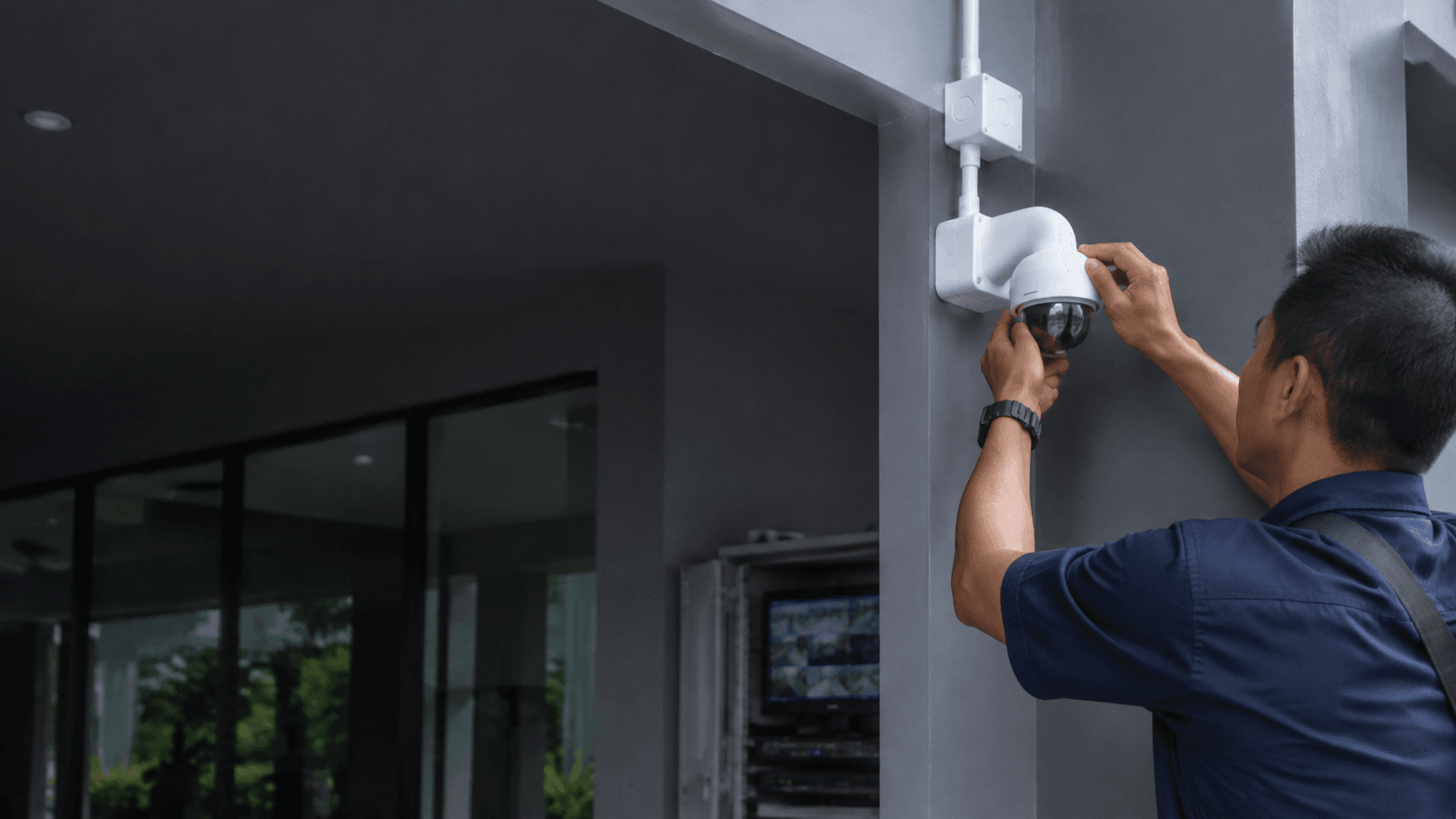
Eyonic Sdn Bhd plans, supplies, and installs monitoring systems with camera placement, recording, and remote viewing for homes, offices, shops, and industrial sites. The company works from Sarawak and has completed projects for a public office in Kuching and for engineering consultancy sites there.
Most buyers arrive with a rough idea: a few cameras around the outside of a building. The harder questions come later, once the perimeter is walked and the light is checked. This guide covers what an exterior camera system includes, when it suits a site, what to compare, how placement and lighting are checked, and how installation and handover run.
What an Exterior Camera System Covers
An exterior camera system is the outdoor half of a monitoring setup. It covers the cameras mounted outside a building, the cabling or wireless link that carries video back, the recorder that stores it, and the viewing method used to check footage later.
Eyonic's CCTV work is built around four parts: camera placement, recording, remote viewing, and the NVR setup that ties them together. Placement decides what the system can actually see. Recording decides how long footage survives. Remote viewing decides who can check the site without being there.
Exterior coverage usually means entrances, gates, driveways, walkways, and the sides of a building that face a road or a neighbouring lot. Interior cameras answer a different question, so the two are often planned together but quoted separately.
When an Exterior Camera System Is the Right Choice
Outdoor coverage earns its cost when the risk sits outside the building. A shop with a back lane, a house with a long driveway, or an office with a visitor entrance all have movement that happens before anyone reaches a door.
The Kuching Immigration Office project is a useful example of the pattern. That work focused on arrival flow, staff areas, visitor movement, and dependable daily operation. Those are exterior and semi-exterior concerns: who arrives, where they go, and whether the system keeps working every day.
A second pattern comes from the KTA Sarawak Sdn Bhd project, which needed a practical office setup in Kuching to support staff movement, visitor handling, tidy cabling, and clearer daily site control. Tidy cabling matters more than buyers expect, because exposed runs along a wall are both a maintenance problem and an easy target.
Exterior coverage is a weaker fit when the concern is entirely inside a building, when a site has no fixed power or network path to the camera positions, or when the property is rented and the owner will not approve drilling and cabling. Those cases usually need a different conversation before any hardware is chosen.
What to Compare Before Choosing an Exterior Camera System
Comparison should start with the site, not the product list. Two properties on the same street can need different camera counts because of gate position, wall height, tree cover, and where the power and recorder can sit.
Four things are worth comparing directly:
Coverage plan. Which points does each camera watch, and does the plan leave a gap between two cameras that someone could walk through?
Recording and storage. Where footage is stored, and how far back it can be reviewed.
Remote viewing. Which devices can check the site, and who is given access.
Cabling and routing. Where cable runs, how it is protected, and whether the route is practical for the building.
Budget is part of the comparison, but it should follow the coverage plan. Eyonic lists a Hikvision CCTV package at RM 1,599 covering camera supply and setup, basic recording configuration, and mobile viewing handover. Larger sites cost more. the Kuching Immigration Office project carried an approximate budget of RM 12,000 to RM 28,000, and the KTA Sarawak Sdn Bhd project an approximate RM 8,000 to RM 18,000. Those ranges reflect scope, not camera count alone.
One comparison trap is treating a package price as a full quote. A package covers a defined scope. A site with long cable runs, multiple buildings, or a gate far from the recorder sits outside that scope, and the difference shows up in the survey rather than the listing.
Lighting and Placement Checks for an Exterior Camera System
Placement and lighting are checked together, because a position that looks correct in daylight can fail after dark. Eyonic recommends checking actual lighting conditions before confirming placement for ColorVu-style cameras, which are chosen for low-light colour images. The check is done on site, at the hours that matter, not from a floor plan.
Practical checks during a survey include:
Where street lighting, porch lights, or security lights already fall, and whether they point toward or away from a camera position.
Whether a proposed position faces a bright source that would wash out the image at night.
How much of the frame is taken up by a wall, pillar, or roof edge that blocks the view.
Whether trees, signage, or parked vehicles would sit in the line of sight at different times of day.
How high a camera can be mounted while still capturing faces rather than the tops of heads.
Height is a genuine trade-off. A higher mount is harder to reach and less likely to be tampered with, but it looks down at a steeper angle and captures less detail at the gate. A lower mount captures better detail but needs protection. The right answer depends on what the camera is there to record.
Malaysian conditions add two constraints. Heavy rain and direct afternoon sun affect how much useful image a camera returns, and lightning-prone areas make surge protection and earthing part of the installation rather than an optional extra. Neither is solved by choosing a camera alone.
How Installation and Handover Work
Eyonic's CCTV installation process runs through four stages. The sequence matters, because each stage depends on the one before it.
Site survey. The property is walked to check camera positions, lighting, cable routes, power, and where the recorder can sit.
System proposal. The survey findings become a scope covering camera positions, recording, and remote viewing.
Installation. Cameras are mounted, cabling is run and protected, and the recorder is configured.
Handover. Recording and mobile viewing are set up and explained, so the system can be used from day one.
Handover is where most of the practical value sits. A system that records correctly but cannot be reviewed by the people who need it is only half finished. Handover should cover how to open live view, how to find footage from a specific time, and who to contact when something stops working.
Two edge cases are worth raising before installation begins. If the recorder and cameras sit on different electrical circuits, a power interruption can leave part of the system offline without an obvious cause. If the site has no reliable internet path, remote viewing will be limited regardless of the cameras chosen, and that is better known before mounting than after.
Practical Questions Before Committing
How many cameras are needed? The count follows the coverage plan. Each entrance, gate, and exposed side is a separate viewing problem, and a single camera rarely covers two of them well.
Can the system be expanded later? This depends on the recorder's channel capacity and whether spare cable routes were left during installation. Asking at survey stage costs nothing; asking after the walls are closed costs more.
What happens during a power cut? Recording stops unless the recorder is backed by a power source. This is a planning decision, not a camera feature.
Who reviews the footage? For a business, more than one person usually needs access, and permissions should be agreed at handover rather than shared informally later.
What is the realistic budget? Eyonic's listed packages start at RM 1,599 for a defined scope, while larger office and public-building projects have run in the RM 8,000 to RM 28,000 range depending on size and requirements.
Eric Yong, founder of Eyonic Security Systems, has worked in the industry for more than 10 years and is experienced in technical installation of digital security solutions for commercial businesses in Sarawak.
Share your location, property type and required system with Eyonic on WhatsApp at +60 11-5111 7959 for the next practical step.