
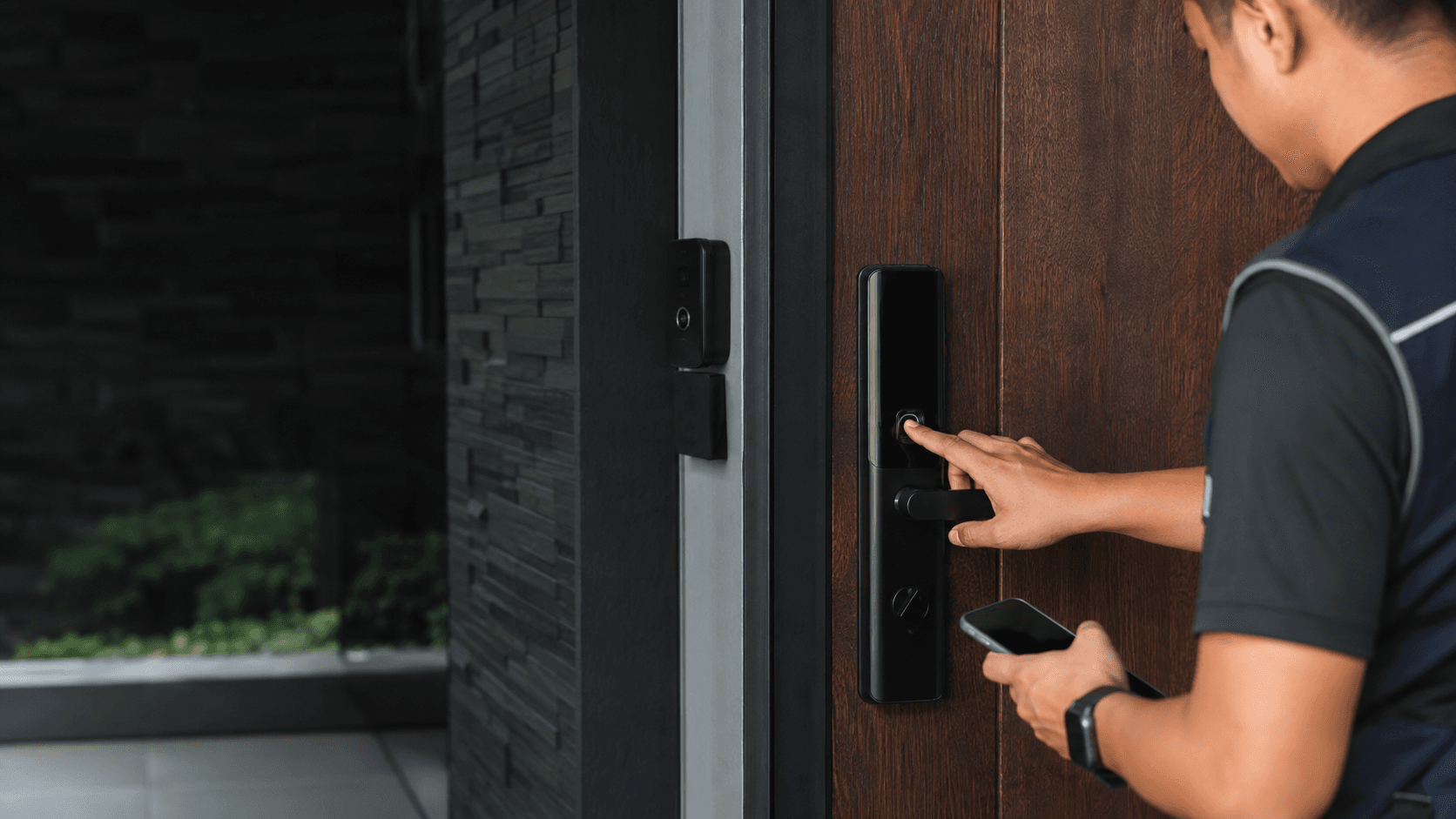
The feature is a convenience layer on top of a motorised deadbolt. It removes the habit of reaching for a key or a phone on the way out, but it also means the lock acts on its own schedule. That shift matters most on doors that are used by several people, doors that swell in humid weather, and doors where a failed lock cycle would leave a building open overnight.
This article covers what the feature does, how automatic locking is configured and timed, what to confirm about the door and its users, and how a Sarawak property can move from interest to a working installation.
August Auto Lock. what the feature does on a door
August Auto Lock is a setting that tells a compatible August smart lock to throw the deadbolt by itself after a set period has passed. The lock does not need a person to press anything, and it does not need a phone to be present. Once the delay elapses, the motor drives the bolt home.
That is the whole mechanism. The value is not the motor; it is the removal of a human decision. On a rental unit, a small office, or a family home where the last person out is often carrying bags or a child, the automatic cycle closes a gap that a manual habit leaves open.
The trade-off is equally simple. A lock that acts on a timer can act while a door is still open, while a visitor is still standing in the frame, or while a tradesperson is moving equipment through. Automatic locking is dependable when the door and the people using it are understood before the setting is switched on.
How automatic locking is configured and timed
Configuration happens in the lock's companion app, where the automatic locking behaviour is switched on and the delay is chosen. The delay is the core control. a short delay locks almost immediately after the door closes, while a longer delay gives people time to move through with hands full.
Two practical constraints shape that choice. A short delay suits a door that is closed firmly and quickly, such as a main entrance with a self-closing mechanism. A longer delay suits a door used for loading, deliveries, or movement of equipment, where a person may still be in the doorway when the timer runs out.
Timing also interacts with how the lock knows the door state. Some August locks use a door-position sensor to distinguish an open door from a closed one, which changes whether the automatic cycle is appropriate at that moment. Where that sensing is not present or not reliable, the delay itself becomes the only protection against locking a door that is still open.
Readers researching August Auto Lock should treat the delay setting as a decision about the door's daily traffic, not as a preference to be copied from a review. A setting that suits a single-occupant apartment can be wrong for a shop entrance with staff arriving in shifts.
What to confirm before switching it on
Confirm the lock model supports the behaviour, confirm the app shows the setting for that lock, and confirm the delay matches the slowest regular user of that door. If any of those three is unclear, the automatic cycle should stay off until it is resolved.
Door condition, user roles and backup entry
Smart locks work best when the door condition, user roles and backup method are reviewed before installation. That sequence is not administrative padding; each item removes a specific failure mode.
Door condition covers alignment, strike plate position, hinge wear, and whether the existing deadbolt moves freely by hand. A bolt that already needs a shoulder to turn will strain a motor, and an automatic cycle removes the human feedback that would normally reveal the problem. A door that binds in wet weather is a particular concern in Sarawak, where humidity and rain are routine rather than seasonal.
User roles decide who can lock, unlock, and change settings. A household with one or two adults needs a different arrangement from an office where staff, cleaners, and visitors pass through the same door. Where several people share a door, the automatic cycle should be paired with clear rules about who holds permanent access and who receives temporary access.
Backup entry is the item most often skipped. Every automatic lock needs a way in that does not depend on the app, the phone battery, or the network. A physical key, a keypad code, or a second entrance all qualify. The test is whether the backup works when the primary method does not.
Standalone lock or access control
For business use, the choice between a standalone smart lock and an access-control panel is a scope decision. A standalone lock suits a single door with a small, stable group of users. An access-control panel suits multiple doors, staff records, time-based permissions, and a need to review who entered and when. Choosing the wrong one usually shows up as manual workarounds within the first few months.
What Eyonic checks before recommending a smart lock
Eyonic Sdn Bhd plans, supplies, and installs security and ELV systems in Sarawak, and its smart lock work follows the same review sequence used across its other installations. The company's stated position is that smart locks work best when door condition, user roles, and backup method are reviewed before installation, and that business use requires a check on whether a standalone lock or an access-control panel is more appropriate.
The review sequence below reflects that approach. It is written as a sequence because each answer changes the next question.
- Inspect the door and existing deadbolt, including alignment, strike plate, hinge condition, and how freely the bolt moves by hand.
- Map the user roles, separating permanent users from temporary ones and identifying who needs to change settings rather than just open the door.
- Agree the backup entry method, confirming it works without the app, the phone, or the network.
- Decide between a standalone smart lock and an access-control panel based on door count, user count, and whether entry records are needed.
Eyonic's wider installation process runs through site survey, system proposal, installation, and handover, and the same four stages apply to a smart lock job. The survey is where door condition and user roles are settled. The proposal is where the standalone-versus-panel decision is recorded. Installation is where the lock is fitted and the automatic locking delay is set. Handover is where the users are shown how the lock behaves and how the backup entry works.
Two completed projects show the kind of environment where this planning matters. The Kuching Immigration Office project focused on arrival flow, staff areas, visitor movement, and dependable daily operation, with an approximate budget of RM 12,000 to RM 28,000 for that type of work. The KTA Sarawak Sdn Bhd project covered a practical office setup in Kuching to support staff movement, visitor handling, tidy cabling, and clearer daily site control, with an approximate budget of RM 8,000 to RM 18,000. Both are office environments where a door is used by many people and where an unreliable lock cycle would be noticed quickly.
Eyonic's founder, Eric Yong, has worked in the industry for more than ten years, with experience in technical installation of digital security solutions for commercial businesses in Sarawak. That background is relevant to the door-condition question, because a lock that performs well on a display board can behave differently on a door that has moved in its frame.
questions readers ask before deciding
Most remaining questions are about fit rather than features. The answers below stay within what can be confirmed about the behaviour and the installation review.
Does work without Wi Fi
The automatic locking cycle is a local behaviour of the lock and does not depend on a remote connection to throw the bolt. Remote access, notifications, and app control from outside the home are separate functions that depend on connectivity. The distinction matters because a household that loses internet should still expect the door to lock on its normal cycle.
Can the delay be changed later
The delay is a setting rather than a fixed property, so it can be adjusted after installation. The practical advice is to change it only after observing how the door is actually used for a week or two, because the busiest moment of the day is often not the one people describe in advance.
What happens if the door is left open
This is the main edge case. Where the lock can detect door position, the automatic cycle can be held back while the door is open. Where it cannot, the delay is the only safeguard, and a door left open past the delay may be locked against the frame. That is a door-condition and setting issue, not a reason to abandon the feature.
Is automatic locking suitable for a shop or office
It can be, provided the user roles and backup entry are settled first. A single entrance with a small staff group is a reasonable fit. Multiple entrances, shift changes, and a need to review entry records point toward an access-control panel instead, because a standalone lock does not provide that oversight.
What should be checked on the door itself
Alignment, strike plate position, hinge wear, and how freely the existing bolt moves by hand. A bolt that already needs force to turn will put strain on a motor that cycles several times a day.
Practical next step for a Sarawak property
The decision that matters is not whether automatic locking is convenient, but whether the specific door can support it. A door that closes cleanly, a clear set of user roles, and a backup entry method that works without power or network are the three conditions that make the feature dependable.
For a property in Kuching or elsewhere in Sarawak, the practical route is a site survey that examines the door before any lock is specified. Eyonic's smart lock review covers door condition, user roles, backup method, and the standalone-versus-panel question, and its installation process runs through survey, proposal, installation, and handover. Package pricing for related systems starts at RM 1,599 for the Hikvision CCTV package, the Hikvision alarm system, and the autogate package, each of which includes supply, setup, and handover.
Share your location, property type and required system with Eyonic on WhatsApp at +60 11-5111 7959 for the next practical step.