
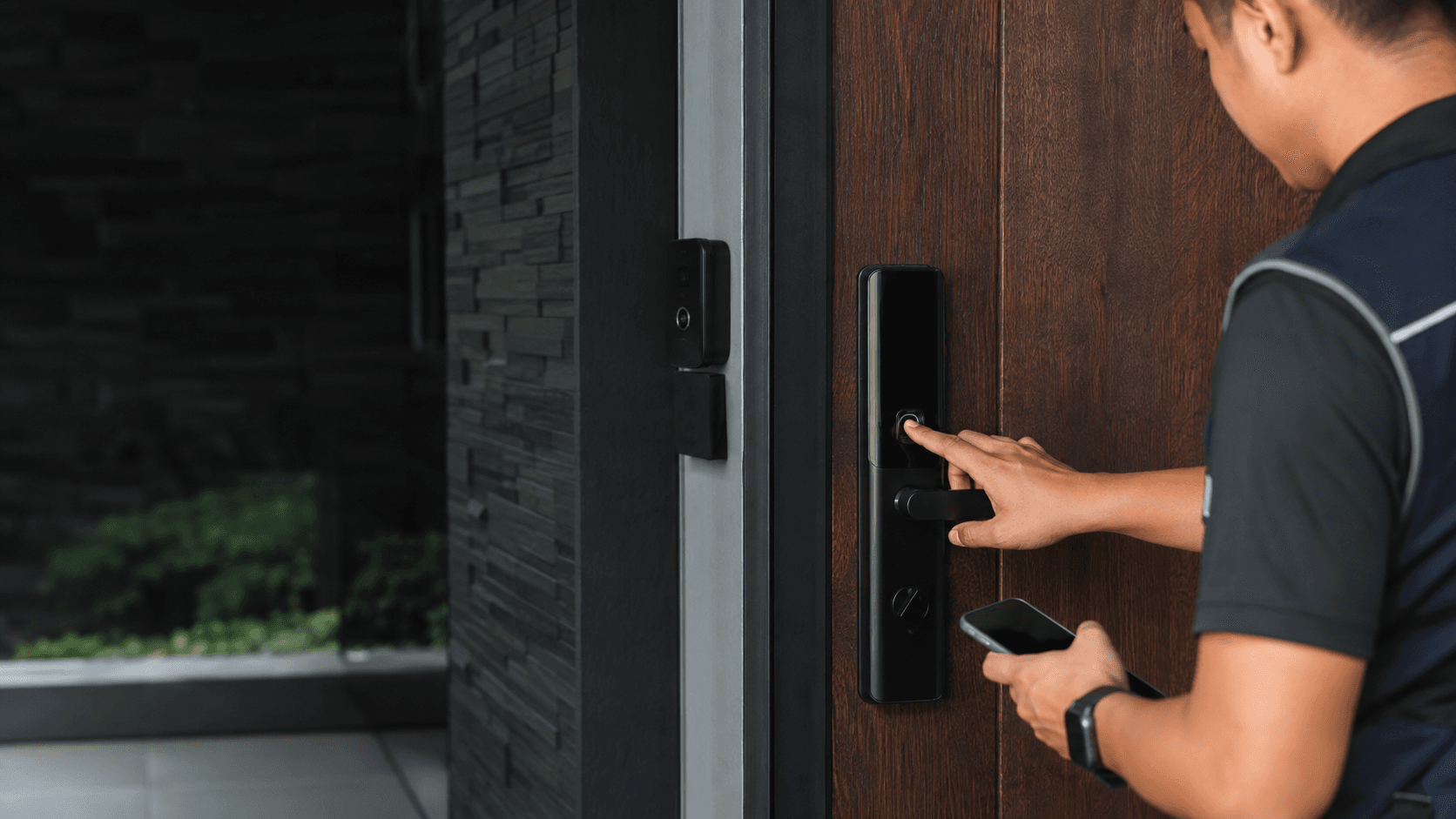
The name is most often attached to the Kwikset Halo Touch, a Wi-Fi enabled deadbolt with fingerprint access. Buyers in Malaysia searching for a halo fingerprint door lock are usually weighing one question: will fingerprint entry work on the door in front of them, for the people who actually use it every day. That question is answered before purchase, not after installation.
Halo Fingerprint Door Lock. What Buyers in Malaysia Should Confirm First
Fingerprint entry is a convenience layer on top of a lock, not a replacement for the lock itself. The reader identifies a person; the deadbolt or latch still has to fit the door, throw cleanly, and survive daily use. A lock that reads a finger perfectly but sits on a warped door will still jam.
Three confirmations matter most before any commitment:
- Whether the door is a suitable host for a smart lock at all.
- Who needs entry, and whether they need it permanently, temporarily, or only during set hours.
- What happens when the fingerprint does not read, the battery is flat, or the phone is lost.
None of those three depend on brand. They depend on the property. That is why a specification sheet alone rarely settles the decision, and why a site visit usually does.
Where Fingerprint Entry Fits in a Malaysian Property
Fingerprint entry suits doors that a small, known group of people passes through repeatedly. A family home's main entrance, a shop's staff door, an office's internal access point, and a clinic's consultation room door all share that pattern: the same people, the same door, many times a day.
It fits less well where the user group is large, rotating, or unknown. A main gate serving dozens of daily visitors, a rental unit with short-stay tenants, or a door used by contractors and delivery staff creates a management problem rather than a convenience. Every new user is an enrolment task, and every departure is a removal task that someone has to remember.
Eyonic's own product guidance makes the same distinction: smart lock door access is described as good for controlled convenience when user permissions and backup entry are planned properly. The word controlled is doing real work there. Fingerprint entry rewards a defined user list and punishes an open one.
For business premises, the practical fork is between a standalone smart lock and an access control panel. A standalone lock is simpler, cheaper to install, and needs no central system. A panel-based setup costs more but handles larger user lists, time-based rules, and audit trails. Eyonic's smart lock review notes that for business use, the choice between the two is usually checked before installation rather than assumed.
Door Condition and User Roles Before Any Fingerprint Lock Decision
Door condition is the constraint that most often decides the outcome. A smart lock replaces or augments existing hardware, so the door has to accept that hardware. Alignment, thickness, the existing bore, the frame's condition, and whether the door is timber, metal, or glass all affect what can be fitted and how reliably it will work.
A door that already needs a shoulder to close is a poor candidate. So is a frame that has swollen with moisture, or a strike plate that no longer lines up. These are not lock faults; they are door faults that a lock will expose. Fixing them first is usually cheaper than replacing a lock that was never the problem.
User roles are the second constraint, and they are a design question rather than a hardware one. The useful exercise is to list every person who needs entry and mark how each one should be handled:
- Permanent users who should always have access.
- Temporary users who need access for a defined period.
- Occasional users who need access only at certain times.
- Service users such as cleaners or contractors who should not retain access afterwards.
If that list is short and stable, fingerprint entry is straightforward. If it is long, changing, or hard to audit, the honest answer may be that a different access method fits better. Saying so early avoids an installation that satisfies nobody.
What Eyonic Checks During a Site Survey
Eyonic's installation process runs through site survey, system proposal, installation, and handover. For door access work, the survey stage is where the decisions that matter are actually made, because the surveyor can see the door, the frame, and the traffic pattern rather than inferring them.
- Site survey — the door, frame, existing hardware, and how people move through the entrance are reviewed on site.
- System proposal — the recommended setup is put in writing, including whether a standalone smart lock or an access control panel is the better fit.
- Installation — the lock or panel is fitted and configured, with users enrolled and tested.
- Handover — access methods, backup entry, and day-to-day operation are explained to the people who will use them.
The survey is also where the awkward questions get asked. Is the door exposed to rain? Does the entrance have shade or direct sun? Is there power nearby, or does the lock rely on its own batteries? Eyonic applies the same principle to camera placement, checking actual conditions on site rather than confirming a position from a plan, and door hardware rewards the same caution.
Eyonic's completed work includes the Kuching Immigration Office, where the focus was arrival flow, staff areas, visitor movement, and dependable daily operation. That is the same set of concerns a fingerprint lock raises at a smaller scale: who arrives, where they go, and whether the system still works on an ordinary Tuesday.
Backup Entry, Power and Daily Operation
Every fingerprint lock needs a second way in. Fingerprint readers fail for ordinary reasons: a wet hand, a worn ridge pattern, a cut finger, a cold morning, or a reader that simply misreads. A lock with no fallback turns a minor inconvenience into a lockout.
The backup method should be decided before installation, not discovered during one. Common fallbacks are a mechanical key, a keypad code, or an app-based unlock. Each has a weakness worth naming. A mechanical key can be lost or copied. A shared code can be passed on. An app unlock depends on a charged phone, a working network, and an account that still has permission.
Power is the other daily-operation question. A lock that runs on batteries will eventually need them changed, and the warning usually arrives before the failure. The practical routine is to treat a low-battery alert as a task rather than a notification, and to keep the mechanical backup accessible from outside the property rather than locked inside it.
For a business, the handover stage matters as much as the hardware. Staff need to know how to add and remove a user, what to do when someone leaves, and who to call when the door will not open. A lock that only one person understands is a single point of failure regardless of how good the reader is.
Halo Fingerprint Door Lock Questions to Settle Before Installation
These are the questions that change the answer, and they are worth settling in writing before any hardware is ordered.
Does the door physically accept a smart lock? This is a survey question, not a specification question. Alignment, thickness, existing bore, and frame condition decide it.
How many users, and how often does that list change? A stable list of a few people is a good fit. A rotating list of many is a management burden that a standalone lock handles poorly.
What is the backup entry method, and who holds it? Decide the fallback and its custodian before installation, and keep at least one backup reachable from outside.
Is a standalone lock or an access control panel the better fit? Standalone suits homes and small offices. A panel suits larger user lists, time rules, and audit needs.
Who maintains the lock after handover? Battery changes, user changes, and fault reporting need an owner. Without one, the system degrades quietly.
One limit is worth stating plainly. Technical specifications for a Halo Fingerprint Door Lock, including fingerprint capacity, battery type and life, connectivity, finish options, door thickness limits, and certification, are not established here. Those details belong to the manufacturer's documentation for the specific model, and they should be checked against the actual product before purchase rather than assumed from the name.
For properties in Sarawak, Eyonic plans, supplies, and installs security and ELV systems for homes, offices, shops, and industrial sites, and reviews door access as part of that work. Share the location, property type, and required system on WhatsApp at +60 11-5111 7959 to move the decision forward.