
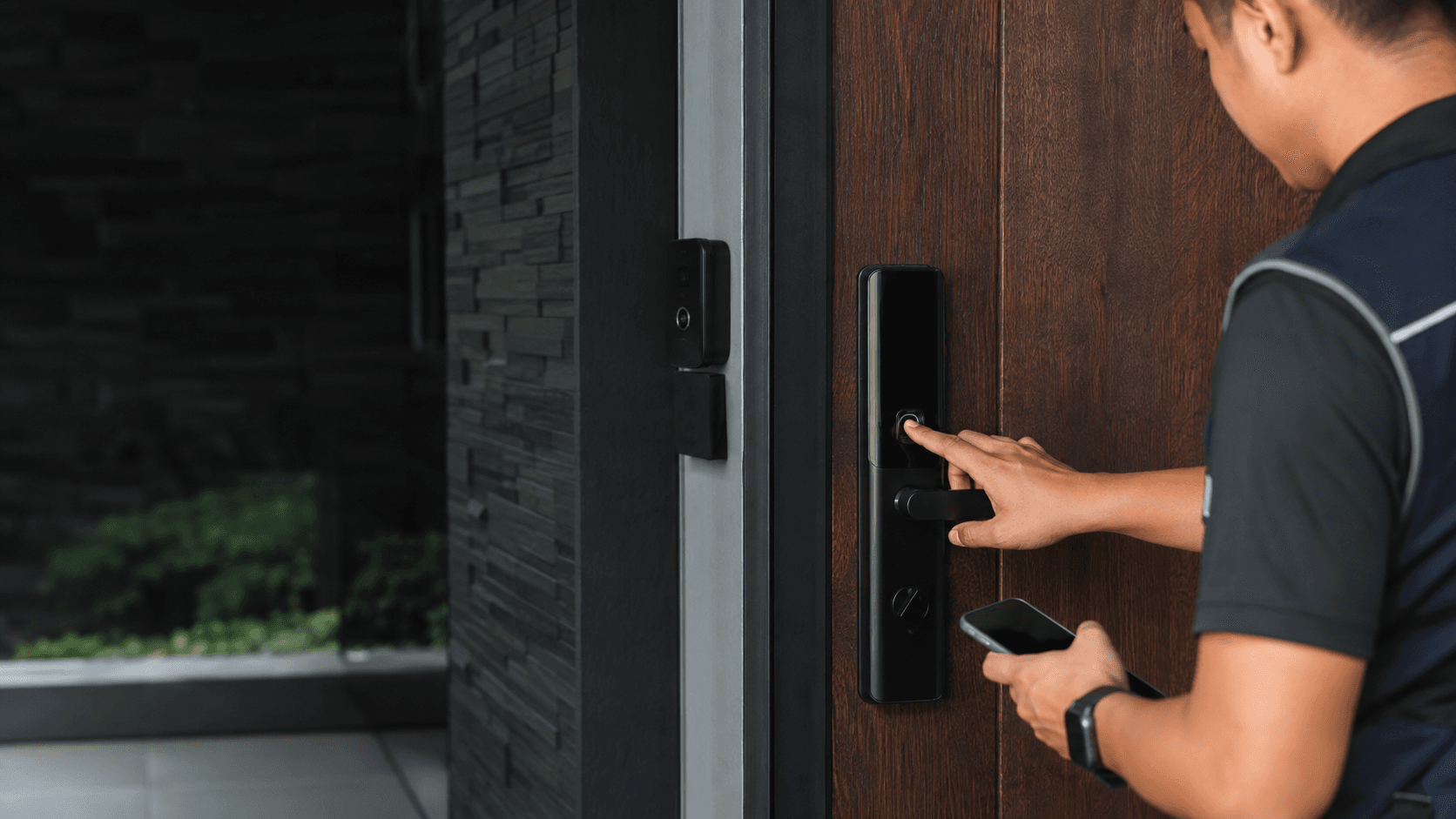
The exact-match query keypad door lock with deadbolt describes a lock that replaces a standard keyed deadbolt with a keypad, so a door can be opened by code instead of a key. In Malaysia, this matters most on main entrance doors, office doors and rental units where several people need access and keys are inconvenient to copy or track.
Eyonic Sdn Bhd is a security system supplier in Sarawak that plans, supplies and installs security and ELV systems for homes, offices, shops and industrial sites. Its smart lock guidance states that smart locks work best when door condition, user roles and backup method are reviewed before installation, and that for business use it usually checks whether a standalone smart lock or an access-control panel is more appropriate.
What a keypad door lock with deadbolt combines
A keypad door lock with deadbolt combines two functions in one unit: a keypad that accepts a numeric code, and a deadbolt that throws a solid bolt into the door frame. The keypad replaces the key cylinder as the everyday entry method, while the deadbolt provides the physical locking action.
Most units keep a mechanical backup so the door can still be opened if the code is forgotten or the electronics fail. That backup is usually a physical key, and in some models it is a hidden keyway or an external power point. The backup method is the part most often overlooked during purchase and the part that decides whether a lockout becomes an inconvenience or a real problem.
Because the deadbolt is the locking element, the strength of the installation depends on the door and frame, not only on the lock body. A keypad door lock with deadbolt on a hollow or warped door will not hold as well as the same lock on a solid door with a sound frame and a properly aligned strike plate.
When a keypad door lock with deadbolt fits a property
A keypad door lock with deadbolt fits a property when more than one person needs regular access and issuing keys is impractical. That covers family homes with domestic helpers or elderly parents, offices with staff and visitors, and rental units where tenants change.
It also fits when a record of who entered matters. Codes can be assigned to individuals and removed when someone leaves, which is simpler than collecting a key. For a business, the same question leads to a fork: a standalone smart lock may be enough for a single door, while an access-control panel is more appropriate when several doors, time rules or central records are involved.
Where it fits less well
A keypad door lock with deadbolt is a weaker fit on doors that are rarely used, on gates exposed to direct rain without any shelter, and on doors where the frame cannot take a deadbolt cut. It is also a poor fit where the only entry point must never depend on batteries or electronics, unless the backup key is stored somewhere genuinely accessible.
Rental properties add a constraint: the lock may need to be removed or re-coded at the end of a tenancy, so the installation should avoid irreversible damage to the door.
What to compare before choosing a keypad door lock with deadbolt
Comparison should start with the door and the people using it, not with the feature list. The practical checks below are the ones that decide whether the lock works in daily use.
- Door condition and thickness, including whether the existing cut-out matches the new deadbolt and whether the frame can hold the strike plate.
- Entry methods offered, such as keypad code, fingerprint, card, app or physical key, and which of these works without a phone or network.
- Backup entry method and where the backup key or external power point is kept.
- User roles, meaning how many codes are needed and whether access can be limited by person, time or day.
- Power source and how the lock behaves when power runs low, including whether a low-battery warning is given before entry fails.
- Whether a standalone smart lock is sufficient or an access-control panel is needed for multiple doors and central records.
- Who installs and hands over the lock, and what is explained at handover about adding and removing users.
Two of these deserve more weight than the rest. Door condition decides whether the lock can be fitted at all without extra carpentry, and user roles decide whether a simple keypad lock or a managed system is the honest answer.
Standalone lock or access-control panel
A standalone keypad door lock with deadbolt suits one door with a handful of users. An access-control panel suits a site where several doors must follow the same rules, where entry records must be kept centrally, or where staff turnover is frequent enough that managing codes door by door becomes a chore.
The trade-off is cost and complexity against control. A standalone lock is quicker to install and easier to live with; a panel gives more oversight but needs more planning, more cabling and a clearer owner for administration.
What cannot be confirmed without the actual product
Specifications such as security grades, battery life, ingress protection and warranty terms vary by model and are not confirmed by general guidance. Those details should come from the manufacturer documentation for the specific unit being considered, not from a category description.
How installation and handover work
Eyonic's installation process runs through site survey, system proposal, installation and handover. The same sequence applies to door access work, because the survey is where door condition, user roles and backup method get checked before anything is ordered.
During the survey, the existing lock and door edge are inspected, the number of users and the access rules are discussed, and the choice between a standalone smart lock and an access-control panel is settled. The proposal then sets out what will be supplied and fitted. Installation follows, and handover covers how codes are added and removed, what the backup method is, and what to do when the lock reports low power.
Handover is not a formality. A keypad door lock with deadbolt that nobody knows how to administer tends to end up with one shared code, which defeats the purpose of individual access.
Where Eyonic fits in Sarawak
Eyonic Sdn Bhd is based in Sarawak and works on security and ELV systems across Kuching and the surrounding areas. Its project work includes the Kuching Immigration Office, where the focus was arrival flow, staff areas, visitor movement and dependable daily operation, and KTA Sarawak Sdn Bhd, an engineering consultancy office in Kuching that needed support for staff movement, visitor handling, tidy cabling and clearer daily site control.
Those projects show the kind of question that comes up before hardware is chosen: how people arrive, where they should and should not go, and how the setup keeps working on an ordinary busy day. Door access sits in the same conversation as CCTV, alarm systems, autogate and intercom work, which is why a single survey often covers more than one system.
Eyonic's founder, Eric Yong, has more than 10 years in the industry and works on technical installation of digital security solutions for commercial businesses in Sarawak. Package pricing published by Eyonic covers a Hikvision CCTV package at RM 1,599, a Hikvision alarm system at RM 1,599 and an autogate package at RM 1,599; door access pricing depends on the door, the lock and whether a panel is required, so it is quoted after the survey rather than from a list.
For a first practical step, share the location, property type and required system with Eyonic on WhatsApp at +60 11-5111 7959.