
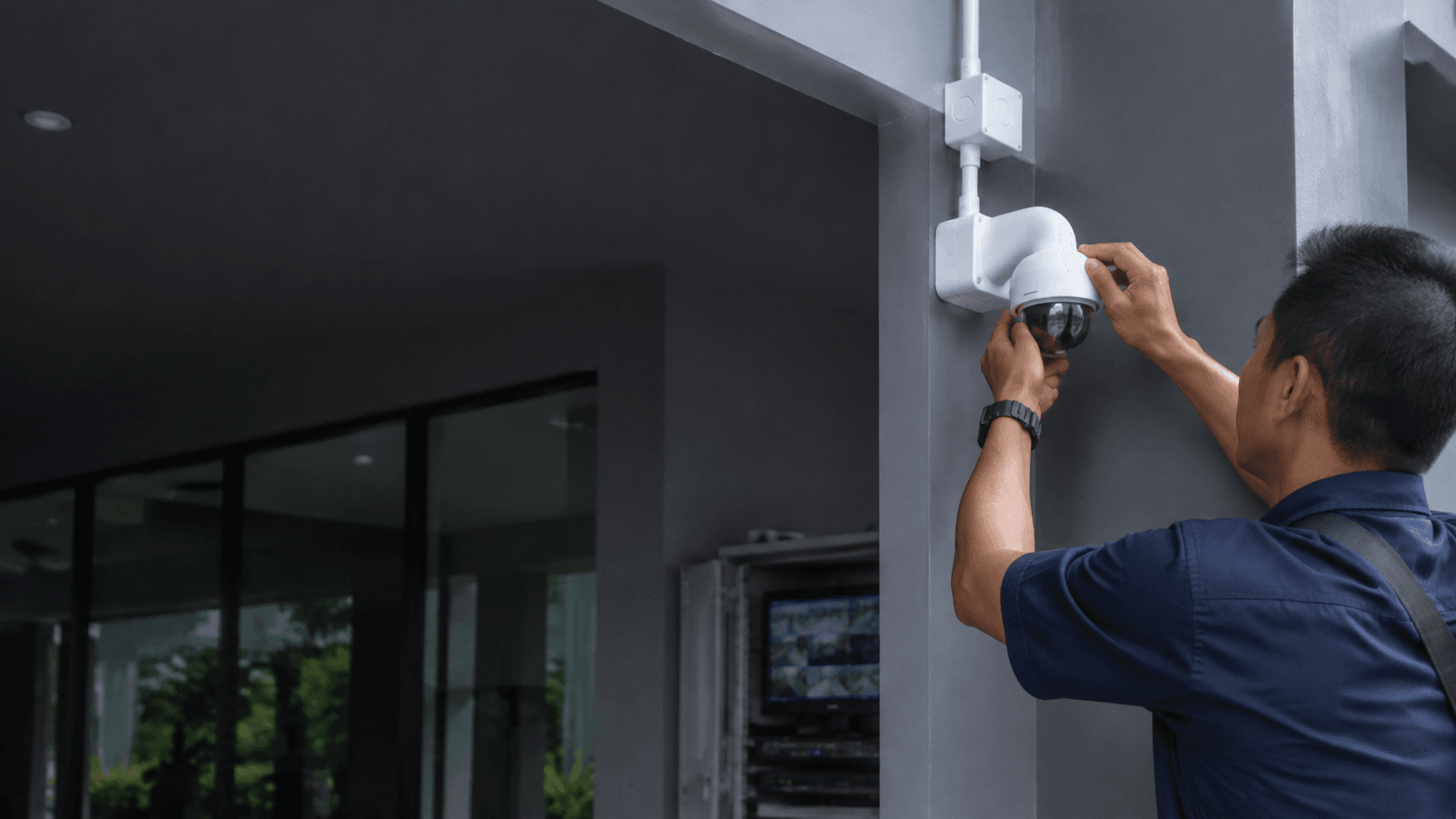
The appeal is simple. no trenching, no new power point, and no cable run across a wall. The trade-off is that the camera's uptime now depends on how much daylight reaches its panel, which is why placement decisions matter more than the product box.
Solar Security Cameras Wireless Outdoor: what the category covers
The category describes outdoor cameras that draw power from a small solar panel and store charge in an internal battery. Video still travels over Wi-Fi or a mobile network, so "wireless" refers to the power and signal path rather than the absence of any mounting hardware.
Most units in this class share a common feature set: a rechargeable battery, a panel that trickle-charges it through the day, motion-triggered recording, night visibility, and app-based remote viewing. Some add two-way audio, a spotlight, or pan-and-tilt movement. Those extras raise power draw, which in turn raises the importance of panel placement.
Two practical distinctions separate this category from a standard wired setup. First, a solar camera is usually installed where cabling is difficult or expensive, such as a gate, a perimeter wall, a rooftop corner, or a rented premises where drilling and rewiring are restricted. Second, because the camera is not tied to a recorder by cable, storage and connectivity have to be planned deliberately rather than assumed.
Eyonic's wider CCTV work covers camera placement, recording and remote viewing for homes, offices, shops and industrial sites, and the same planning discipline applies when the power source changes.
How solar charging and battery backup work across a Malaysian day
A solar panel converts daylight into electrical current, and a charge controller feeds that current into the battery. The camera then runs from the battery, not directly from the panel. That buffer is what allows recording to continue after sunset and through periods of heavy cloud.
Malaysia's position near the equator means daylight hours stay fairly consistent through the year, which suits solar charging. The variable is not day length but cloud cover, rain, and shade. A panel that sits under a tree canopy, an awning, or a north-facing wall recess will collect far less energy than one in open sky, even on a bright day.
Battery backup matters most in three situations:
- Overnight hours, when the panel produces nothing and the camera runs entirely on stored charge.
- Extended overcast or monsoon periods, when daily recharge may not fully replace daily consumption.
- High-activity periods, when frequent motion triggers and spotlight use drain the battery faster than a quiet week would.
The practical consequence is that a solar camera's reliability is a placement question before it is a specification question. A well-sited panel on a modest camera can outperform a high-draw camera with a shaded panel. Eyonic's own guidance for low-light camera models is to check actual lighting conditions at the site before confirming placement, and the same logic applies to checking actual sunlight conditions before confirming a panel position.
Where a position cannot get reliable daylight, the honest options are to move the camera, add a separate panel on an extension mount, or accept a wired power run instead. Choosing the wrong one shows up months later as a camera that keeps going offline.
Placement checks before confirming a camera position
Placement decides both what the camera sees and whether it stays powered. The checks below are the ones that change the outcome most often.
Sun exposure across the day. A position should be assessed at more than one time of day. A spot that looks bright at mid-morning may fall into shadow by mid-afternoon, which is when the panel does much of its charging.
Coverage versus purpose. A camera aimed at an entrance, a gate, a driveway, or a cash-handling area serves a different purpose from one covering a long perimeter. Wide coverage reduces detail; tight coverage leaves gaps. The right answer depends on what the footage needs to show.
Night visibility conditions. Outdoor lighting, street lamps, and reflective surfaces all change how a camera performs after dark. A position that looks ideal in daylight can produce glare or a washed-out image at night.
Mounting height and angle. Higher mounting reduces tampering risk but can flatten facial detail. Angle matters as much as height.
Signal path. A wireless camera still needs a stable connection to the network or recorder. Thick walls, metal roofing, and distance from the router or access point all affect that link.
Physical access for maintenance. Batteries, panels, and lenses need occasional attention. A position that requires a ladder and a harness for every check is a position that will be neglected.
For a shop or office, the useful exercise is to list the specific areas that need coverage, then test each candidate position against the checks above. For a home, the list is usually shorter but the same conflicts appear: the best view is rarely the sunniest spot.
What a site survey, proposal, installation, and handover involve
Eyonic's CCTV installation process runs through four stages, and a solar camera project follows the same sequence.
- Site survey. The property is reviewed on location, covering the areas needing coverage, candidate camera positions, daylight and lighting conditions, network or signal availability, and any cabling constraints.
- System proposal. The survey findings are turned into a proposed setup, covering camera positions, recording and remote viewing arrangements, and the equipment required.
- Installation. Cameras, panels, mounting hardware, and recording equipment are installed and configured on site.
- Handover. The system is tested with the user, and mobile viewing access is set up so the footage can be checked remotely.
The survey stage carries the most weight in a solar project because it is where panel positions are confirmed or rejected. A proposal built without a site visit is a guess about daylight, and daylight is the one input that cannot be corrected after installation without moving hardware.
Handover is where remote viewing is set up and where the practical limits of the system should be explained plainly: which areas are covered, which are not, and what happens during a prolonged cloudy spell.
Eyonic has completed work for the Kuching Immigration Office, covering arrival flow, staff areas, visitor movement and dependable daily operation, and for KTA Sarawak Sdn Bhd, covering staff movement, visitor handling and tidy cabling. Both projects show the same pattern: the value comes from matching coverage to how the site is actually used, not from the number of cameras installed.
Costs and packages for a Sarawak installation
Eyonic's published packages are priced at RM 1,599 each. The Hikvision CCTV Package covers camera supply and setup, basic recording configuration, and mobile viewing handover. The Hikvision Alarm System covers a control panel and sensors, siren and zone setup, and user testing and handover. The Autogate Package covers motor recommendation, remote-control setup, and safety testing and handover.
Larger projects sit in a different range. The Kuching Immigration Office project had an approximate budget of RM 12,000 to RM 28,000, and the KTA Sarawak Sdn Bhd project had an approximate budget of RM 8,000 to RM 18,000. Those figures reflect multi-area commercial installations rather than a single camera.
What drives cost in a solar setup is site complexity rather than the camera itself. Long cable-free positions reduce wiring cost but may need additional panels or mounts. Positions with marginal daylight may need a larger panel or a different power approach. Multi-camera systems add recording and configuration work. A single figure quoted without a site visit cannot account for any of that.
For a property in Sarawak, the practical next step is to share the location, the property type, and the areas that need coverage, so the survey can be scoped against real conditions. Eyonic can be reached on WhatsApp at +60 11-5111 7959 for that purpose.
Common questions about solar security cameras wireless outdoor
Will a solar camera keep recording through a cloudy week? It depends on the battery capacity, the camera's daily power draw, and how much diffuse daylight reaches the panel. A panel in open sky recovers faster than one under cover. Where a site has long shaded periods, the survey should flag it before installation rather than after.
Does a wireless camera need Wi-Fi? It needs a connection to carry video to a recorder or an app. That can be Wi-Fi, a network cable to a recorder, or a mobile network, depending on the model and the site. Signal strength at the camera position should be checked during the survey.
Can a solar camera work at night? Yes, running on stored battery charge. Night image quality depends on the camera's low-light capability and on any lighting already present at the site, which is why actual lighting conditions should be checked before a position is confirmed.
Is a solar camera suitable for a shop or office? It suits positions where running power is difficult, such as a gate, a rear perimeter, or a rooftop corner. For high-traffic indoor areas with reliable power, a wired camera is usually the simpler choice.
What happens if the battery runs flat? The camera stops recording until the battery recovers enough charge. That gap is the main risk of a poorly sited panel, and it is the reason placement is reviewed on site rather than decided from a floor plan.
Can footage be viewed remotely? Remote viewing is part of Eyonic's standard handover, and mobile viewing access is configured before the system is handed over.
Solar security cameras wireless outdoor solve a real problem for properties where cabling is impractical, but they trade a cable for a dependency on daylight. The properties that get the best results are the ones where the panel position was tested on site, the coverage was matched to how the site is used, and the limits were explained at handover rather than discovered later.