
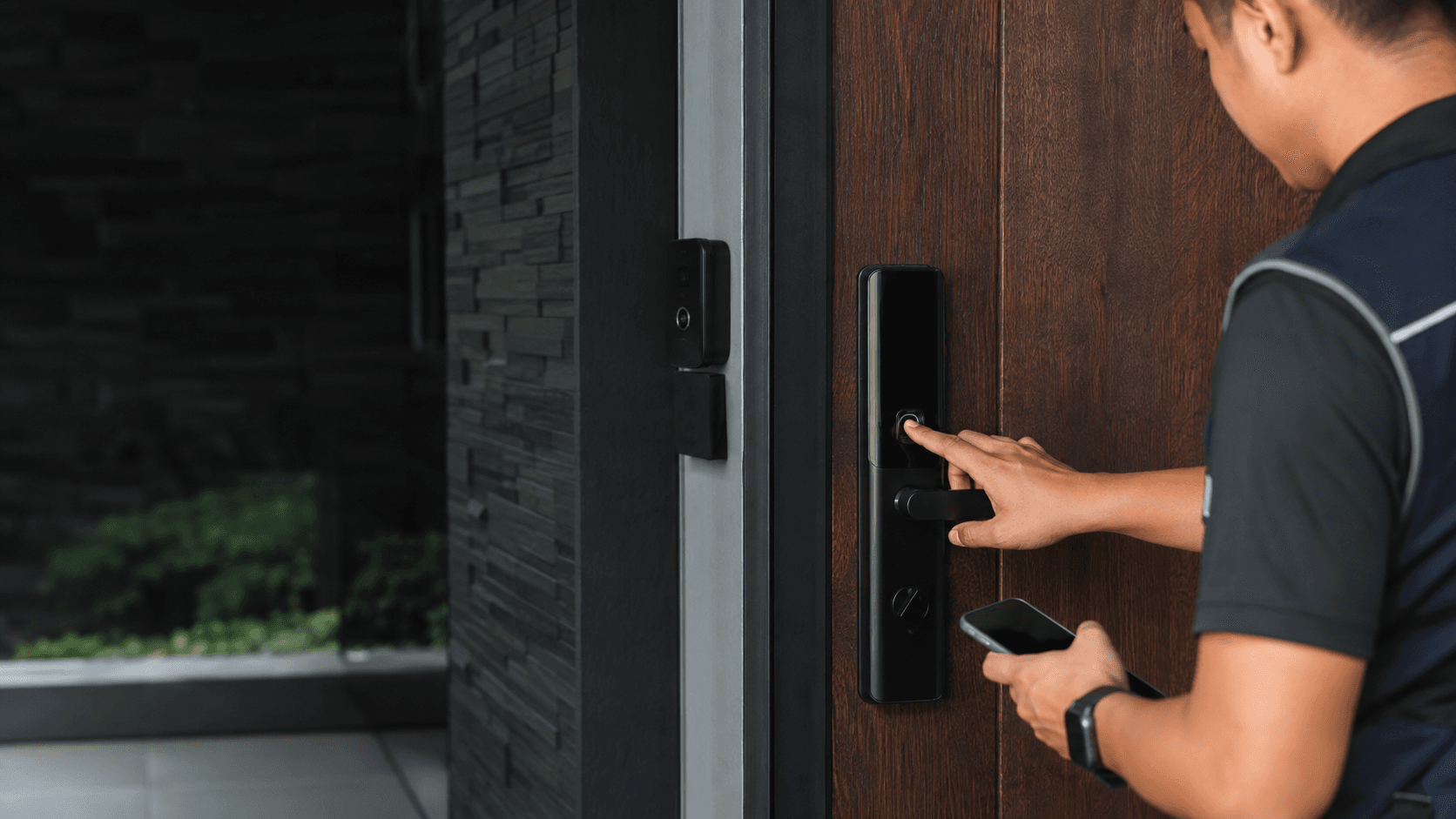
Eyonic Sdn Bhd, a security system supplier in Sarawak, treats smart lock door access as a controlled-convenience product rather than a universal replacement for every commercial door. The company's own product review notes that smart locks work best when the door condition, user roles and backup method are reviewed before installation, and that for business use the usual check is whether a standalone smart lock or an access-control panel is more appropriate.
That distinction matters in Malaysia because most commercial premises mix doors that see heavy daily traffic with doors that are opened a few times a week. A single hardware decision applied across both usually ends up either over-specified for the storeroom or under-specified for the main entrance.
Smart Lock For Business. What Malaysian Sites Should Check First
Three checks decide most of the outcome before any hardware is chosen: the physical door, the people who need entry, and what happens when the lock loses power or connectivity.
Door condition comes first because a smart lock is a mechanism fitted to an existing door, not a door replacement. Alignment, frame condition, existing cut-outs and how the door currently closes all affect whether a retrofit is straightforward or whether the door itself needs work first. A door that already sticks, drops on its hinges or has been re-drilled several times is a poor candidate for any lock that depends on precise alignment.
User roles come second. A business door is rarely opened by one person. Staff, management, cleaners, contractors, delivery drivers and visitors may all need different levels of access at different times. The practical question is not how many people need a code, but whether access needs to be granted and withdrawn without physically visiting the door.
Backup entry comes third, and it is the check most often skipped. Every powered or connected lock needs a defined way in when the battery is flat, the network is down or a credential fails. For a business, that fallback has to be usable by someone who is not the person who installed the lock.
Door Condition, User Roles And Backup Entry
These three factors interact. A door in poor condition limits which lock types can be fitted at all. A high number of user roles pushes toward a system with central management rather than a lock programmed at the keypad. A weak backup plan turns a convenience upgrade into a daily operational risk.
What door condition actually rules out
Doors that are out of alignment, have thin or hollow frames, or rely on a closing mechanism that no longer pulls the door fully shut will cause problems for any lock that expects the door to sit in a consistent position. Glass doors, roller shutters and fire-rated doors each carry their own constraints, and a fire-rated door assembly generally cannot be modified without affecting its rating.
The honest answer for a badly aligned door is often that the door should be repaired or replaced before lock selection, not after. Fitting hardware to a door that does not close properly produces a lock that reports as locked while the door remains physically openable.
Why user roles decide the product category
A standalone smart lock is programmed at the door or through a phone app, and it manages a limited set of credentials. That works when the people needing access are a small, stable group.
Once access needs to be granted and revoked across multiple doors, tied to staff joiners and leavers, or reviewed after an incident, the requirement has moved beyond a standalone lock. That is the point at which an access-control panel becomes the more appropriate route, because the management function sits in a system rather than in each individual lock.
Backup entry as an operational requirement
Backup entry should be decided by asking who needs to get in during a failure and what they will physically carry or know. A mechanical key override, a keypad code held by a nominated person, or a second independent entry route are all valid answers, but the choice has to be made deliberately and documented for the people who will need it.
For sites with staff arriving before opening hours, the backup method also has to work in the dark, at the door, without a phone call to the installer.
Where A Standalone Smart Lock Fits And Where It Does Not
A standalone smart lock fits a single door with modest traffic, a small and stable group of users, and a clear fallback. Typical fits include an office side entrance, a shop's staff door, a small clinic's consultation room, a server or utility room, and a rented unit where the door cannot be permanently modified.
It fits less well where the door is the primary public entrance with continuous traffic, where dozens of credentials change frequently, where multiple doors must be managed together, or where an audit trail of who entered and when is a requirement rather than a convenience.
The trade-off is straightforward. A standalone lock is simpler to install, simpler to explain to staff and does not depend on a central system staying online. A managed access-control setup costs more in planning and installation but handles change, scale and record-keeping that a standalone lock was never designed for.
There is also a middle case worth naming: a site that starts with one or two standalone locks and later needs central management. Choosing hardware with that possibility in mind avoids replacing everything at the second stage.
Planning Sequence
The sequence below follows the same four-stage process Eyonic uses for its installation work, from site survey through to handover. It applies to a single door as much as to a multi-door site.
- Site survey. Inspect the actual door, frame, closing behaviour and existing hardware, and confirm how the door is used through a normal working day.
- System proposal. Set out whether a standalone smart lock or an access-control panel matches the door and the user roles, and define the backup entry method before any hardware is ordered.
- Installation. Fit and configure the hardware, set up credentials for each user role, and test the door through its full range of normal use rather than a single open-and-close.
- Handover. Walk through normal operation, the backup entry procedure and what to do when the lock reports a fault, with the people who will actually use the door.
The survey stage is where most avoidable problems are caught. A lock specified from a photograph or a description frequently meets a door that behaves differently in person.
What Eyonic Reviews Before Recommending Hardware
Eyonic's stated approach for business smart lock work is to check door condition, user roles and backup method first, then decide between a standalone smart lock and an access-control panel. That order keeps the hardware decision tied to how the door is actually used.
The company's completed work in Sarawak shows the kind of site context that shapes these decisions. At the Kuching Immigration Office, the focus was arrival flow, staff areas, visitor movement and dependable daily operation. At KTA Sarawak Sdn Bhd, an engineering consultancy office in Kuching, the requirement centred on staff movement, visitor handling, tidy cabling and clearer daily site control.
Both projects point to the same practical lesson for door access: the value comes from how people and vehicles move through a site, not from the hardware in isolation. A door that staff avoid using, or that visitors cannot work out, creates its own security problem regardless of what is fitted to it.
Eyonic's founder, Eric Yong, has worked in technical installation of digital security solutions for commercial businesses in Sarawak for more than 10 years. The company plans, supplies and installs security systems for homes, offices, shops and industrial sites, and publishes product reviews covering access control and smart lock door access alongside CCTV, alarm, autogate and intercom work.
Questions Worth Settling Early
Several questions are cheaper to answer before installation than after.
Does the door need to stay compliant? Fire-rated and some exit doors carry constraints on modification. If the door is part of a fire compartment or an emergency escape route, that has to be established before hardware is selected.
Who holds the master credential? A business lock should not depend on one person's phone. The master access route needs to belong to the organisation, with a documented handover if that person leaves.
What happens during a power or network failure? This is the backup entry question in its operational form. The answer should be a procedure that staff know, not a feature that exists on paper.
Will the site grow? If more doors are likely to be added, the first lock choice should not lock the site into a dead end.
Who maintains it? Batteries, firmware and credential changes are ongoing tasks. Someone at the site needs to own them.
For sites in Kuching and across Sarawak, the practical next step is to have the actual door assessed rather than to choose a model from a catalogue. Share the location, property type and required system with Eyonic on WhatsApp at +60 11-5111 7959 to arrange that assessment.