
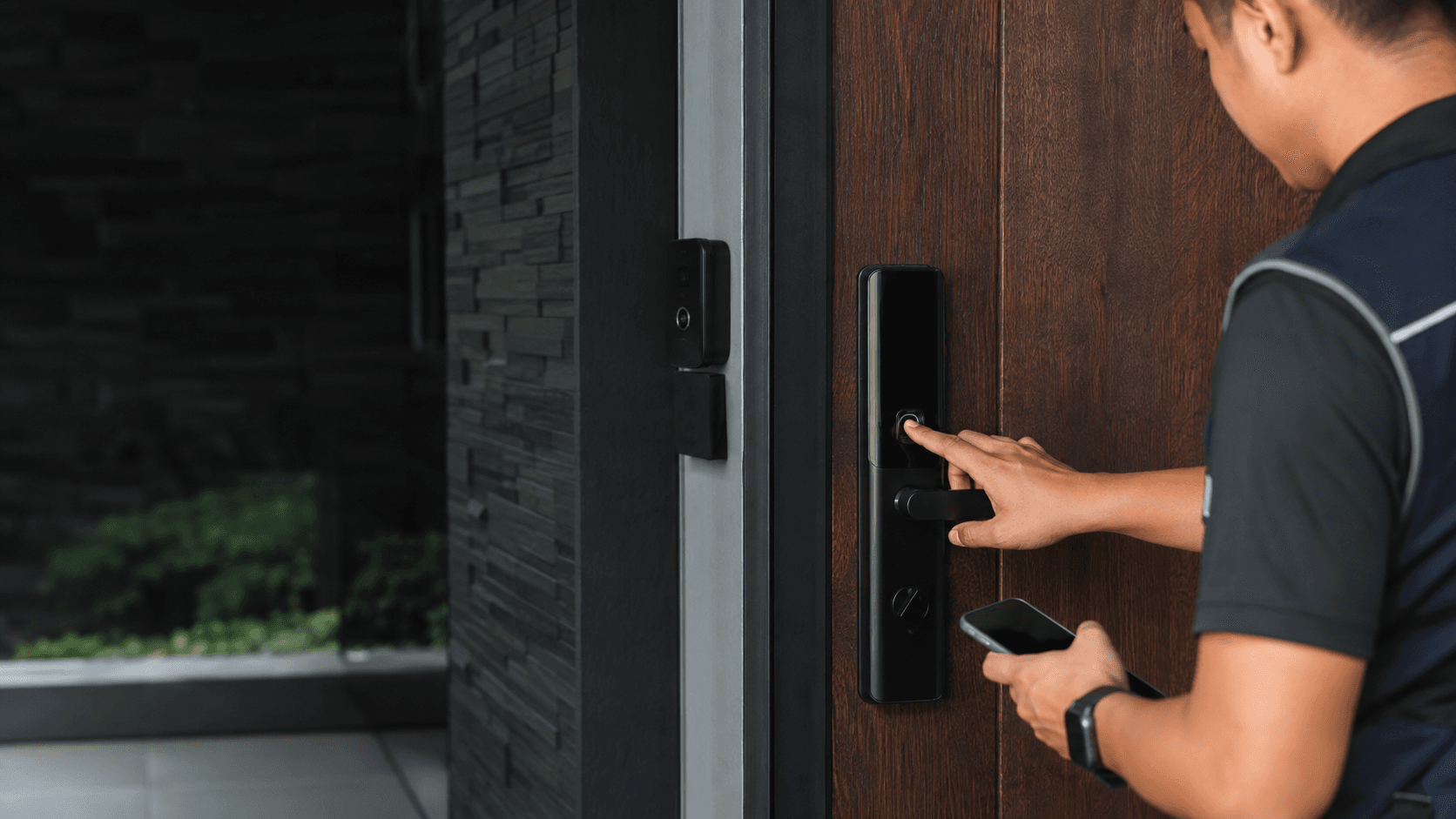
The exact-match query commercial smart lock system describes a category rather than one product. A single door can carry a battery-powered keypad lock, or the same door can sit on a networked access-control panel that also manages CCTV, alarms and intercoms. The difference decides cost, wiring, who administers permissions, and what happens during a power cut or a lost phone.
Eyonic Sdn Bhd is a security system supplier in Sarawak, Malaysia, working on CCTV and ELV systems for homes, offices, shops and industrial sites. Its published product review guidance states that smart locks work best when the door condition, user roles and backup method are reviewed before installation, and that for business use the choice between a standalone smart lock and an access-control panel is usually checked first.
Commercial Smart Lock System. What Matters Before You Choose
Most buying mistakes happen before any hardware is named. Four conditions decide whether a commercial smart lock system behaves well in daily use.
- Confirm the door itself. Frame material, leaf weight, existing mortise or cylindrical preparation, and whether the door is a fire door all constrain which lock bodies fit.
- Map who needs entry and when. Staff, cleaners, contractors, delivery drivers and visitors rarely need the same schedule or the same door.
- Decide the administration model. A standalone lock is programmed at the door; a networked system is programmed from a phone, browser or panel.
- Agree the backup method before installation. Mechanical key override, a printed code, a physical card, or a staffed reception desk each solve a different failure.
- Check power and network reality. Battery locks avoid cabling but need a replacement routine; wired locks need a power path and, if networked, a data path.
The Kuching Immigration Office project shows why this sequence matters in public buildings. Eyonic's published project note describes support focused on arrival flow, staff areas, visitor movement and dependable daily operation, which is the same set of concerns that shapes door-by-door access decisions.
What Is a Commercial Smart Lock System?
A commercial smart lock system is electronic door hardware plus the means to issue, change and revoke entry credentials without rekeying a cylinder. Credentials are typically a code, card, fob, phone or fingerprint, and the lock either stores its own user list or reports to a central controller.
Two architectures dominate. Standalone electronic locks hold users locally and suit a handful of doors where each door can be managed separately. Networked or panel-based systems centralise permissions, schedules and event logs, and suit sites where access records need to be reviewed together with other building systems.
Commercial use also raises questions that residential locks rarely face. Staff turnover means credentials must be removed quickly. Contractors need time-limited access. Fire doors must keep their closing and latching behaviour. Multi-tenant buildings need separation between tenants' user lists. None of these are hardware features alone; they are administration decisions that the hardware must support.
Commercial Wireless & Electronic Door Lock Systems
Wireless locks remove the data cable, not the decision. A Wi-Fi or wireless lock can be administered remotely, which helps where cabling a door is impractical, but it still depends on a stable network at that door and a defined behaviour when the network is unavailable.
Electronic locks that are wired into an access-control panel trade installation effort for centralised control and audit trails. The practical split is usually door count and turnover: a few low-traffic doors often suit standalone electronic locks, while a site with many doors, many staff changes and a need for records usually justifies a panel-based approach.
Choosing the Right Commercial Smart Lock System
Selection is easier when the site is described in operational terms rather than product terms. The table below maps common situations to the architecture that usually fits, based on the trade-offs described in Eyonic's published smart lock guidance and the door and credential factors above.
| Site situation | Architecture that usually fits | Main trade-off |
|---|---|---|
| One to three doors, stable staff list | Standalone electronic or keypad lock | Lower installation effort, but permissions are managed door by door |
| Office with reception and visitor flow | Panel-based access control with electronic locks | Central records and schedules, in exchange for wiring and setup work |
| Retail or shopfront with shift changes | Keypad or card entry with time-limited credentials | Fast credential changes, but staff must be trained on the entry method |
| Industrial or warehouse doors | Heavy-duty electronic hardware on a controlled panel | Durability and weather exposure drive hardware choice more than software |
| Mixed-use building with tenants | Networked system with separated user groups | Clearer separation of access rights, with more administration to maintain |
Eyonic's own review guidance notes that for business use the check is whether a standalone smart lock or an access-control panel is more appropriate, which matches the split above. The KTA Sarawak Sdn Bhd project illustrates the same logic in an office setting, where the published note describes support for staff movement, visitor handling, tidy cabling and clearer daily site control.
Practical Considerations for Commercial Smart Lock System Projects
Installation quality decides whether a commercial smart lock system stays reliable after handover. Eyonic's published CCTV installation process runs through site survey, system proposal, installation and handover, and the same four stages apply to door access work.
During survey, the useful checks are door alignment, frame condition, existing lock preparation, and whether the door is used as a fire escape route. A door that does not latch cleanly will not be fixed by a smarter lock. Cabling routes, power availability and network coverage at the door are confirmed at the same visit rather than discovered on installation day.
During handover, the practical items are user enrolment, schedule setup, backup entry testing and a short briefing for whoever administers permissions. A lock that nobody can administer confidently tends to be bypassed, which defeats the purpose of the system.
Cost, Scale and Maintenance Realities
Budget depends on door count, hardware grade, wiring and whether a panel is involved. Eyonic's published project budgets give a sense of scale for commercial security work in Sarawak: the Kuching Immigration Office project is listed at approximately RM 12,000 to RM 28,000, and the KTA Sarawak Sdn Bhd office project at approximately RM 8,000 to RM 18,000. Those figures cover broader security and ELV scope rather than door locks alone, so they indicate project scale rather than a per-lock price.
Maintenance splits into three routines. Battery-powered locks need a scheduled replacement cycle so a door never fails unexpectedly. Wired hardware needs occasional checks on alignment and latch engagement. Software or panel administration needs user lists reviewed when staff join or leave, because stale credentials are the most common weakness in any access system.
Edge Cases That Change the Plan
Fire-rated doors are the clearest constraint. Any electronic hardware fitted to a fire door must preserve the door's closing and latching behaviour, and the requirement is set by the door's certification rather than by the lock vendor.
Outdoor gates and exposed doors add weather and temperature exposure, which pushes hardware selection toward rated units and away from consumer-grade locks. Sites with unreliable power need a defined behaviour for outages, whether that is a fail-safe or fail-secure state, and the choice depends on whether the door is an escape route or a secure store.
Multi-tenant buildings need user separation from the start. Retrofitting separated permissions after installation is more disruptive than planning them during the survey.
Making an Informed Choice About
The decision narrows to three questions. How many doors need controlled entry, who administers permissions day to day, and what happens when the primary entry method fails. Answers to those three determine whether a standalone lock or a networked system is the better fit, and they also determine the installation work required.
For sites in Sarawak, Eyonic Security Systems plans, supplies and installs security and ELV systems, and its founder Eric Yong has worked in technical installation of digital security solutions for commercial businesses in Sarawak for more than 10 years. A site survey is the point where door condition, user roles and backup method are confirmed together, which is the sequence Eyonic's published smart lock guidance recommends.
Share your location, property type and required system with Eyonic on WhatsApp at +60 11-5111 7959 for the next practical step.