
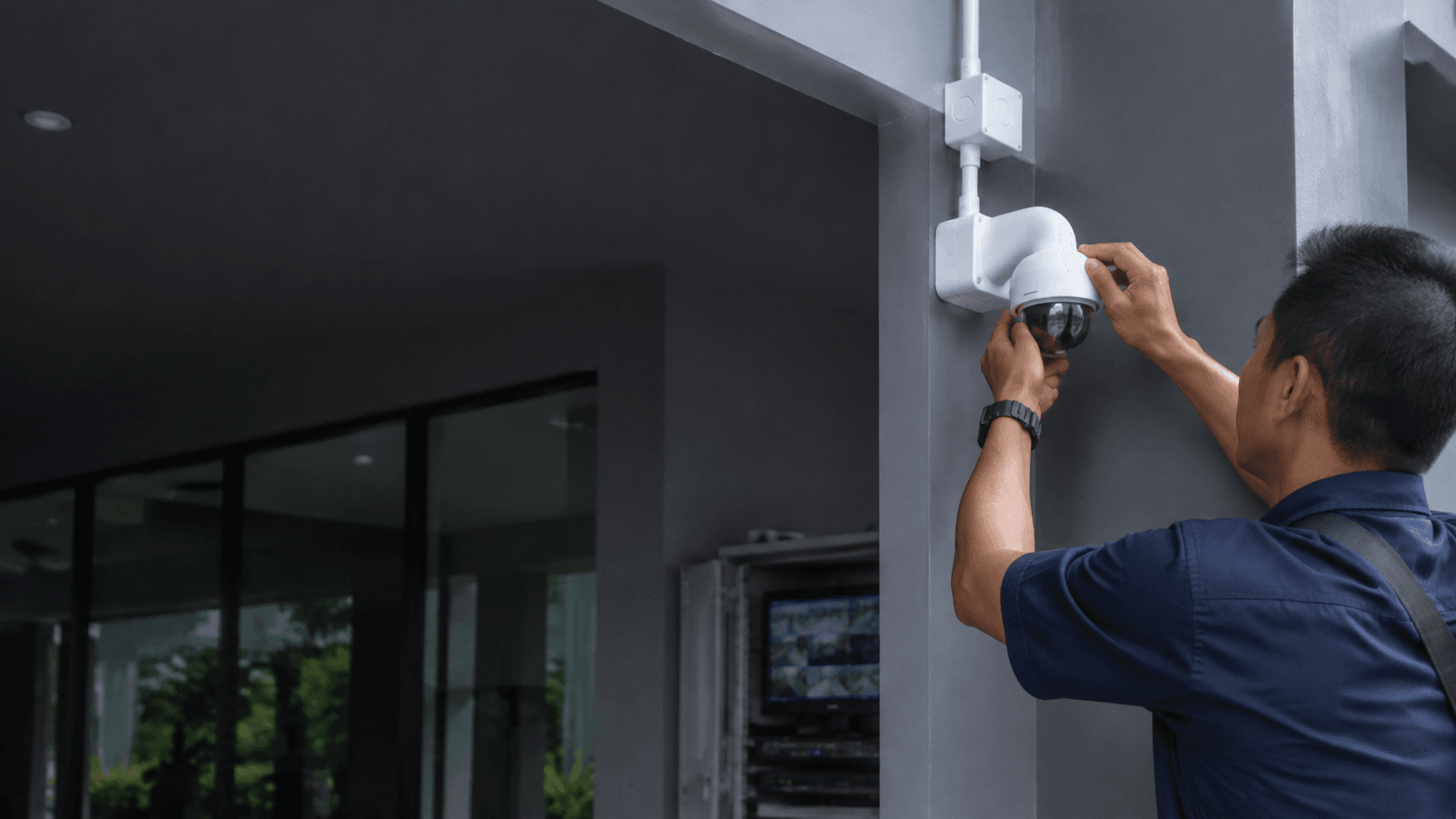
Night footage is where most camera installations are judged. A camera that reads number plates and faces in daylight can still return a washed-out centre and black edges once the sun drops, because the infrared emitters sit close to the lens and throw light in a narrow cone. Hikvision Exir is the company's answer to that specific problem, and it is the reason the term appears so often in camera model names.
This page explains what Hikvision Exir changes, how it differs from earlier infrared designs, what to check on site before committing to Exir-equipped cameras, and where the public evidence still runs thin.
Hikvision Exir and the problem it was built to reduce
Infrared illumination exists because image sensors cannot see in the dark on their own. A camera switches to infrared when visible light falls away, and the quality of that infrared determines whether the resulting image is usable or merely present.
Older designs placed infrared LEDs in a ring around the lens. Light from a ring arrives at the scene from several slightly different angles, which produces a bright hotspot in the middle of the frame and a dark tunnel around it. Objects close to the camera also reflect light straight back into the lens, creating the flare and haze that make night images look foggy.
Hikvision Exir addresses both effects by changing where the emitters sit and how their output is shaped. The practical result is a wider, more even spread of infrared across the frame rather than a single concentrated pool of light.
How Exir differs from earlier infrared lighting approaches
The clearest way to understand the difference is to compare the two arrangements directly.
With a conventional ring of LEDs, the emitters surround the lens at roughly the same distance from the optical axis. Each LED points forward, and their beams overlap in the centre of the scene. That overlap is what creates the hotspot. Because the LEDs are packed tightly around the lens, heat also concentrates in one small area, and sustained heat shortens LED life.
Exir moves the emitters into a separate block, typically positioned above or beside the lens rather than encircling it. The beam is then shaped so that the infrared pattern matches the camera's field of view more closely. A wider, flatter light pattern means the edges of the frame receive useful illumination instead of falling into shadow.
Two consequences follow. The first is image quality. faces and objects near the frame edge stay readable rather than dissolving into noise. The second is thermal. Spreading the same emitters over a larger physical area reduces the heat concentrated at any one point, which is the mechanism behind the longer rated LED life that Hikvision associates with Exir.
Hikvision later introduced Exir 2.0, a refinement of the same idea. Public Hikvision material describes it as an advance over traditional infrared LEDs, but the specific technical differences between the first Exir generation and Exir 2.0 are not documented in the sources available for this page, so no figures are quoted here.
What to check on site before choosing Exir cameras
Exir changes how infrared is delivered. It does not change the physics of the site, and a specification sheet cannot tell anyone whether a particular wall, gate or corridor will produce a usable night image.
Eyonic's own guidance on low-light cameras makes the same point in a different context: actual lighting conditions should be checked before placement is confirmed. That principle applies with equal force to Exir. The relevant questions are about the scene, not the datasheet.
- Site survey — walk the property at night, note existing light sources, reflective surfaces, and the areas that genuinely need coverage.
- System proposal — match camera type, lens and position to what the survey found, rather than to a standard package.
- Installation — mount, cable and configure the cameras, then confirm the night image on the recorder rather than on a phone screen.
- Handover — walk through live and recorded footage, remote viewing, and what to do when something needs attention.
That sequence is the one Eyonic follows for camera systems, and it is deliberately front-loaded. Most night-image problems are placement problems, and placement is decided during the survey.
Lighting conditions that change the answer
A site with steady ambient light at night behaves differently from a site that goes completely dark. Where some light already exists, infrared output matters less, and the camera's low-light sensor performance matters more. Where the site is genuinely unlit, infrared range and spread become the deciding factors.
Reflective surfaces are the other common complication. Shiny metal, wet tarmac and glass can bounce infrared back toward the lens, and no emitter design fully removes that. Moving a camera a short distance or changing its angle often solves what a different model would not.
Layout and coverage
Wide, open areas suit cameras whose infrared spread matches a wide field of view. Long, narrow areas such as corridors, driveways and perimeter fences suit a narrower field of view with more reach. Choosing a wide lens for a long corridor produces a frame full of wall and very little of the thing that matters.
Overlapping coverage is worth planning deliberately. Two cameras covering an approach from different angles give a better chance of a usable image than one camera covering it twice as widely.
Hikvision Exir in Malaysian premises: lighting, layout and coverage
Malaysian sites bring a few recurring conditions that affect how infrared performs.
Rain and haze scatter infrared light. During heavy rain, effective infrared reach drops, and images soften at distance. Cameras rated for outdoor use handle the water itself, but no rating restores range lost to atmospheric scatter.
Heat and humidity are the second factor. Sustained high ambient temperature adds to whatever heat the emitters already produce, which is one reason the thermal behaviour of the emitter design matters over years rather than weeks.
Mixed lighting is the third. Many Malaysian commercial premises keep some lighting on overnight — corridor lights, signage, street lighting through a window. That ambient light can help or hurt depending on angle, and it is another reason a night-time survey beats a daytime one.
Eyonic's work for the Kuching Immigration Office illustrates the kind of requirement that shapes these decisions: a public office where arrival flow, staff areas and visitor movement all needed coverage, and where dependable daily operation mattered more than any single specification. Public buildings rarely have the luxury of a single clean sightline, and coverage has to be planned around how people actually move through the space.
A similar pattern appears in Eyonic's work for KTA Sarawak Sdn Bhd, an engineering consultancy office in Kuching where staff movement, visitor handling and tidy cabling were the stated needs. In both cases the camera choice followed the layout, not the other way round.
Where evidence is still thin on
Several things commonly claimed about Hikvision Exir cannot be verified from the sources available here, and it is worth being explicit about them.
No primary Hikvision datasheet was supplied for this page, so no infrared range figures, wavelengths or model-specific performance claims are quoted. Where a retailer lists a range in feet or metres for a particular model, that figure belongs to that model and that listing, not to Exir as a technology.
No verified list of Exir-equipped models for the Malaysian market was supplied, and no firmware or regional distributor detail was available. Anyone comparing specific model numbers should confirm the specification against Hikvision's own documentation for that exact model.
No measured before-and-after night footage comparison between Exir and non-Exir cameras was supplied. Claims that Exir produces a specific percentage improvement in night image quality are therefore not repeated here.
Pricing is also model-specific. Eyonic publishes a Hikvision CCTV package at RM 1,599 covering camera supply and setup, basic recording configuration and mobile viewing handover, but that figure is a package price and not an Exir-specific camera price.
Warranty and regulatory terms for Exir products in Malaysia were not supplied either. Those should be confirmed with whoever supplies the equipment.
What this means for a buying decision
Exir is a genuine design difference in how infrared is delivered, and it addresses a real problem with hotspotting and uneven night coverage. Whether it matters for a specific site depends on how dark that site gets, how wide the area is, and how much of the frame needs to stay readable.
The honest position is that the technology is one input among several. Sensor performance, lens choice, camera position, ambient light and the recorder's settings all affect the final night image, and a well-placed camera without Exir will often outperform a poorly placed one with it.
That is why the survey comes first. A night-time walk of the property, a clear view of what needs covering, and a placement plan that accounts for reflections and ambient light will do more for night footage than any single feature on a specification sheet.
For sites in Sarawak and across Malaysia, Eyonic handles that survey, proposal, installation and handover sequence directly. Sharing the location, property type and required system on WhatsApp at +60 11-5111 7959 is the practical starting point.