
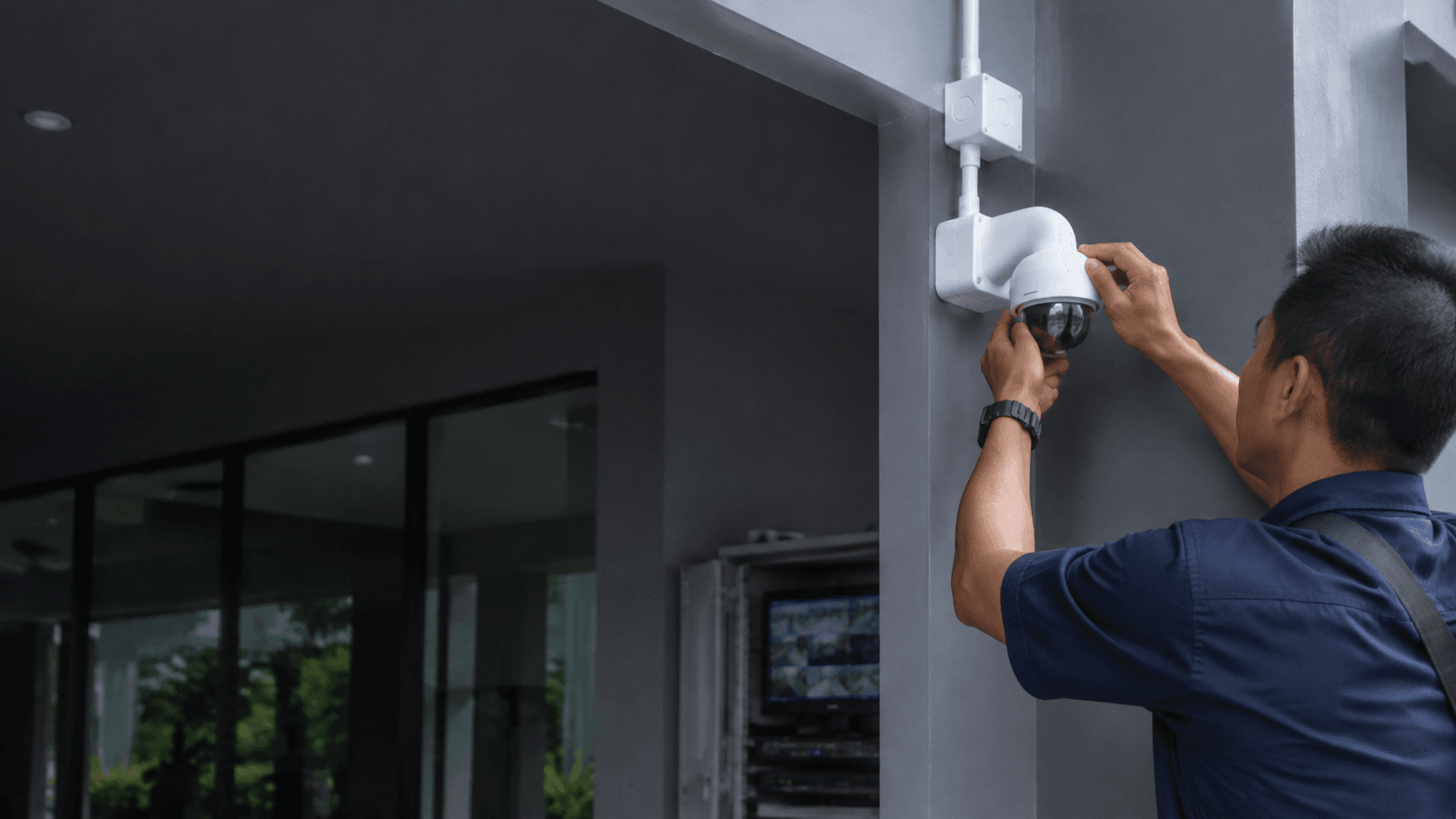
The exact-match query home security system without internet describes a real category of equipment, not a compromise. Cameras can write footage to a recorder on the premises, alarm panels can trigger sirens and dial out over a mobile network, and access control can run on a closed local network. The trade-off is remote convenience: live viewing from another state or country depends on some outbound path, whether that is cellular data, a landline, or a network the owner controls.
Eyonic Sdn Bhd plans, supplies, and installs CCTV and ELV systems in Sarawak, Malaysia, for homes, offices, shops, and industrial sites. Its founder, Eric Yong, has worked in technical installation of digital security solutions for commercial businesses in Sarawak for more than 10 years. That background matters here because offline systems are decided at the wiring and placement stage, not at the app store.
Home Security System Without Internet: What Matters Before Choosing
Four decisions shape everything else: how footage is stored, how alerts leave the building, how the system is powered, and who can reach the recorder. Get those four right and the absence of a home broadband line stops being a limitation.
- Decide what must keep working during an internet outage — recording, sirens, door release, or all three.
- Choose the storage location. a DVR or NVR on site, a memory card in each camera, or a recorder plus a backup drive.
- Choose the alert path. local siren only, cellular dialler, landline, or a hybrid that falls back when the primary route fails.
- Confirm power. mains supply with battery backup, or solar and battery for sites with no reliable electricity.
- Walk the site for camera placement, checking actual lighting conditions before confirming positions.
- Test the finished system with the internet deliberately disconnected, then hand over user access and recovery steps.
Eyonic's CCTV installation process follows a comparable sequence: site survey, system proposal, installation, and handover. The survey stage is where offline requirements should be stated, because recorder capacity, cabling routes, and camera models are fixed in the proposal.
How Offline Security Systems Actually Work
Most confusion around a home security system without internet comes from treating "internet" and "network" as the same thing. They are not. A recorder, cameras, and a monitor can sit on a local network that never touches the public internet. The system still communicates; it simply does not route through a broadband connection.
Local recording and closed networks
A DVR or NVR receives video from the cameras and writes it to an internal drive. Viewing happens on a monitor plugged into the recorder, or on a phone connected to the same local network. Nothing leaves the building. This is the most common offline arrangement for shops, offices, and homes that want footage retained on site.
Power over Ethernet cameras simplify this further: one cable carries both power and data back to the recorder, so camera count is limited mainly by recorder channels and switch capacity rather than by wireless signal strength.
Cellular and landline alert paths
Alarm panels can report intrusions over a cellular module or an existing landline instead of broadband. A cellular path needs a SIM and a data or messaging plan, so it carries an ongoing cost that a purely local system does not. Landline reporting depends on that line remaining active and is vulnerable to line cuts.
Local-only alarm systems skip remote reporting entirely. The siren sounds, and anyone nearby responds. That suits secondary properties, storage areas, and sites where a monitoring contract is unwanted.
Power and continuity
Offline systems still need power. Mains supply with a battery backup keeps a recorder and panel running through short outages. Remote sites without reliable electricity typically use solar panels and rechargeable batteries, which shifts the design question from bandwidth to battery capacity and panel orientation.
Choosing the Right Home Security System Without Internet
The right configuration depends less on brand than on what the site can supply and what the owner needs to see. A home with fibre broadband but a preference for local storage is a different problem from a farm building with no line at all.
| Approach | How it connects | Best fit | Main constraint |
|---|---|---|---|
| Recorder with local storage | Wired cameras to DVR or NVR on site | Homes, shops, and offices wanting footage retained on the premises | Remote viewing needs a network path; recorder needs a secure location |
| Cellular camera or panel | Mobile data over a SIM | Sites with no broadband but usable mobile coverage | Ongoing data plan and signal-dependent reliability |
| Landline alarm reporting | Existing telephone line | Properties that already keep an active landline | Line cuts and the declining availability of landlines |
| Local-only alarm | Siren and panel, no outbound reporting | Secondary homes, stores, and outbuildings | No remote notification when nobody is nearby |
| Hybrid with backup path | Primary route plus cellular or battery fallback | Businesses and homes where downtime is unacceptable | Higher equipment and configuration cost |
Two practical checks narrow the choice quickly. First, confirm whether mobile coverage reaches the exact camera or panel position, not just the street. Second, confirm where the recorder will live — it needs ventilation, a locked enclosure, and a power point that is not the first thing an intruder unplugs.
Practical Considerations for
Offline design changes maintenance habits. Firmware updates, time synchronisation, and health checks that a cloud platform would push automatically become manual tasks. A recorder with the wrong clock produces footage that is hard to use as evidence, so time and date settings deserve a place in the handover checklist.
Storage sizing is the other routine calculation. Retention depends on camera resolution, frame rate, motion activity, and drive capacity, so the honest answer is that retention is estimated at survey and confirmed after the first weeks of real recording. Anyone promising an exact number of days before installation is guessing.
Lighting deserves the same care. Eyonic advises checking actual lighting conditions before confirming placement for ColorVu-style cameras, because a position that looks adequate in daylight can behave differently at night. For offline systems this matters more, since a poorly lit camera cannot be compensated for by cloud-side processing.
Access control and intercoms follow similar logic. Smart locks work best when door condition, user roles, and a backup entry method are reviewed before installation. For business premises, the choice between a standalone smart lock and a full access-control panel usually turns on how many people need different permissions.
Where offline systems fit in Sarawak and similar settings
Coverage gaps, remote plots, and buildings where the owner wants footage kept in-country all push toward local recording. Eyonic's project work includes the Kuching Immigration Office, where the focus was arrival flow, staff areas, visitor movement, and dependable daily operation, and KTA Sarawak Sdn Bhd, where the requirement was a practical office setup supporting staff movement, visitor handling, and tidy cabling. Both are examples of security design driven by how a site is actually used rather than by app features.
Budget expectations vary with scope. Eyonic's published packages for a Hikvision CCTV package, a Hikvision alarm system, and an autogate package are each listed at RM 1,599, covering supply, setup, and handover. Larger project work sits in a different range: the Kuching Immigration Office project carried an approximate budget of RM 12,000 to RM 28,000, and the KTA Sarawak Sdn Bhd project an approximate budget of RM 8,000 to RM 18,000.
Making an Informed Choice About
The decision usually comes down to one question: does the site need remote awareness, or only reliable local evidence? If footage on site and a loud local alarm are enough, a recorder-based system is simpler, cheaper to run, and unaffected by broadband outages. If someone must know about an event while away, a cellular path or a hybrid design is the honest requirement, and the data plan becomes part of the running cost.
Edge cases worth naming before committing: a recorder placed in an unlocked room can be removed along with its footage; a cellular system in a poor-signal area may report late or not at all; a solar-powered camera in prolonged heavy cloud may need a larger battery than first estimated; and a local-only alarm gives no notification if nobody is within earshot.
For readers in Sarawak, the practical next step is a site survey that records coverage, lighting, power, and the intended alert path in writing before any equipment is ordered. Eyonic can be reached on WhatsApp at +60 11-5111 7959 with the location, property type, and required system.