
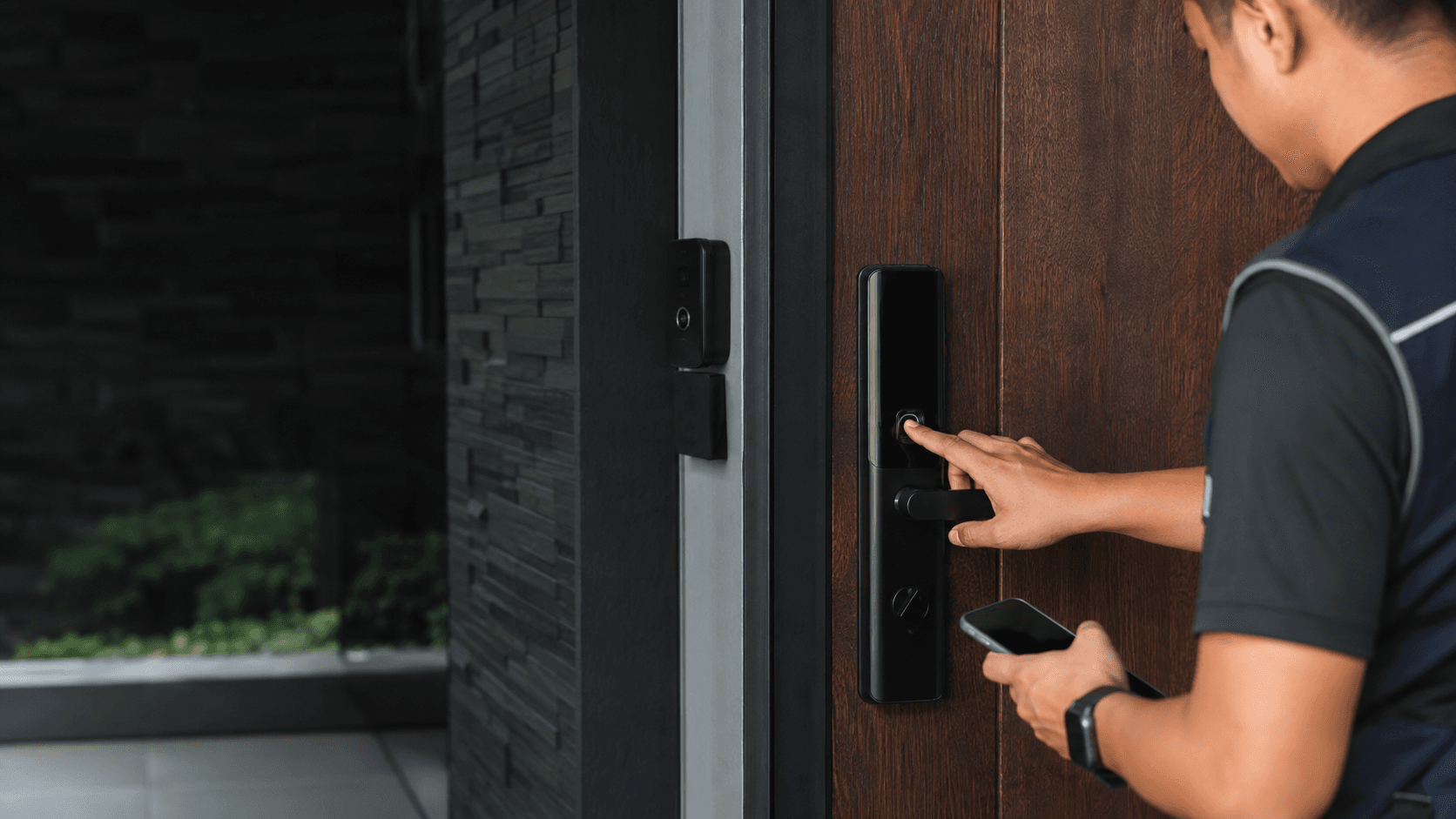
Bluetooth alone reaches only a short distance, which is why a lock that opens fine from a phone at the door can be invisible from an office across town. The Hornbill G2 Gateway sits between the lock and the home network, holding that connection open so the lock appears online inside a compatible app. This article covers what the bridge does, when one is actually needed, how pairing and network checks work, and where the local limits sit for buyers in Malaysia.
Hornbill G2 Gateway: what the Wi-Fi bridge does
A smart door lock that talks over Bluetooth is a local device. It answers a phone that is close by, and it stops answering once that phone walks away. The Hornbill G2 Gateway changes that by staying powered near the lock, maintaining a Bluetooth link to it, and relaying commands and events over Wi-Fi to a server the app can reach from anywhere.
That relay is the whole job. The gateway does not replace the lock, the keypad, the fingerprint reader, or the mechanical key. It adds a network path. Once that path exists, three things become possible that Bluetooth alone cannot deliver:
- Remote lock and unlock commands sent from outside Bluetooth range.
- Status and event notifications pushed to a phone when the door is used.
- Voice assistant control, where the assistant platform and the lock app both support it.
Product listings for this device describe it as a 2.4 GHz Wi-Fi bridge that works with the TTLock app and supports remote unlock, remote passcode generation and modification, and Alexa and Google Home voice control. Those are listing-level descriptions rather than a manufacturer specification sheet, so they should be treated as the advertised function set rather than a verified technical datasheet.
Why a Bluetooth smart lock needs a gateway
Bluetooth is a short-range radio. It was designed for a phone in a pocket or a hand near a reader, not for a lock that must be reachable from a different building. Two consequences follow from that design, and both are practical rather than theoretical.
The first is range. A lock mounted on a metal door frame, inside a recessed entrance, or behind a gate pillar can lose Bluetooth signal well before the nominal distance is reached. Metal, concrete, and the lock's own housing all absorb or reflect the radio path. The second is presence. Even with a strong Bluetooth link, remote access requires something to be listening at the lock at all times. A phone is not that something, because phones sleep, leave, and run out of battery.
A gateway solves both by being a fixed, powered listener. It stays in place, keeps the link alive, and converts local Bluetooth traffic into internet traffic. The trade-off is that the gateway itself becomes a dependency: if it loses power or drops off Wi-Fi, remote features stop even though the lock still works locally with a code, card, fingerprint, or key.
When a gateway is not required
Not every installation needs one. A lock used only by people who arrive at the door and use a code, card, or fingerprint does not need an internet path at all. A property where every user is physically present at the entrance gains little from remote unlock. The gateway earns its place when someone must open the door without being there, when entry events must be visible to an absent owner or manager, or when temporary access has to be issued and revoked remotely.
Hornbill G2 Gateway setup: pairing, network, and app access
Setup follows a fixed order, and skipping a step is the usual reason a gateway appears to fail. The sequence below reflects the advertised pairing model for this class of device: the lock and the gateway must be introduced to each other through the app before any remote feature will work.
- Confirm the lock model and the app it uses. The gateway is advertised as working with the TTLock app, so the lock must be one that app already manages.
- Confirm a 2.4 GHz Wi-Fi signal reaches the door. The device is advertised as a 2.4 GHz bridge, and 5 GHz-only networks are a common cause of pairing failure.
- Power the gateway within Bluetooth range of the lock, then add it in the app and pair it to the lock.
- Test remote unlock and notifications from outside Bluetooth range, with mobile data on and Wi-Fi off, to prove the internet path works.
The fourth step matters more than it looks. A test performed while standing at the door proves nothing, because the phone may still be talking to the lock directly over Bluetooth. Turning Wi-Fi off on the phone and relying on mobile data forces the command through the gateway, which is the only way to confirm the bridge is doing its job.
Network and power constraints
Two constraints apply to almost every device in this category. The first is the 2.4 GHz band, which travels further through walls than 5 GHz but carries more interference from neighbouring networks and household devices. The second is continuous power. A gateway that is unplugged, switched off at the wall, or sharing a socket that gets used for something else will silently disable remote access while leaving local entry untouched.
Placement follows from those constraints. The gateway should sit close enough to the lock for a stable Bluetooth link and close enough to the router for a stable Wi-Fi link, which in a long house or a shop with a rear entrance may mean the two requirements pull in different directions. A Wi-Fi access point nearer the door is often the more reliable fix than moving the gateway further from the lock.
Remote control, notifications, and voice assistant use
Once the bridge is online, the lock behaves like any other connected device in the app. Remote unlock sends a command through the gateway to the lock. Event notifications travel the other way, so an entry can be reported to a phone that is nowhere near the property. Remote passcode generation and modification, as advertised for this device, allow temporary access to be issued without visiting the door.
Voice control depends on more than the gateway. The assistant platform must support the lock's app, the account must be linked, and the lock must be exposed to the assistant as a controllable device. Where any of those links is missing, voice commands will not work even though remote unlock in the app does. Voice control is therefore best treated as a convenience layer on top of the app rather than a replacement for it.
Notifications also depend on the phone, not just the gateway. Battery optimisation on Android and notification permissions on iOS can suppress alerts that the gateway has successfully delivered. If events appear in the app history but no alert arrives, the gateway is working and the phone settings are the place to look.
limits compatibility and evidence gaps
Several things about this device cannot be confirmed from a primary source, and buyers should know which questions remain open rather than assume an answer.
- No verified manufacturer specification covering supported lock models, radio bands beyond the advertised 2.4 GHz, power input, or operating limits.
- No verified compatibility list naming which lock brands and apps the gateway supports beyond the advertised TTLock association.
- No verified pricing or availability for the device in Malaysia.
- No verified local warranty, support, or after-sales terms.
- No verified range, performance, or reliability measurement.
The practical consequence is that compatibility should be confirmed against the specific lock already installed, not against the gateway's general description. A lock that uses a different app ecosystem will not gain remote features from this bridge. The safest check is to identify the lock's app first, then confirm the gateway is listed as compatible inside that app before purchase.
There is also a security dimension worth stating plainly. A gateway turns a local lock into an internet-reachable device. That is the point of it, but it means the app account becomes the weak link. A strong, unique password on the lock app account, and care about who is granted remote access, matter more once a gateway is in place than they do for a purely local lock.
Local installation and support in Sarawak and Malaysia
Eyonic Sdn Bhd is a security system supplier in Sarawak that plans, supplies, and installs CCTV and ELV systems for homes, offices, shops, and industrial sites, and its product range includes smart locks. Its published installation process runs through site survey, system proposal, installation, and handover, which is the same sequence that suits a gateway deployment: check the door, check the network at the door, then install and test.
That survey step is where gateway projects usually succeed or fail. Eyonic's own guidance on smart locks notes that locks work best when door condition, user roles, and backup entry are reviewed before installation, and that for business use the choice between a standalone smart lock and an access-control panel should be checked first. A gateway decision sits inside that same review, because remote access only makes sense once the entry method and the people who need it are settled.
Eyonic's completed work includes the Kuching Immigration Office, where the focus was arrival flow, staff areas, visitor movement, and dependable daily operation, and KTA Sarawak Sdn Bhd, an engineering consultancy office in Kuching needing support for staff movement, visitor handling, tidy cabling, and clearer daily site control. Both are examples of entry and movement planning rather than lock hardware alone, which is the relevant experience when a gateway is being considered as part of a wider access setup.
Whether Eyonic supplies, installs, or supports the Hornbill G2 Gateway specifically is not confirmed by any published source, so that question should be asked directly rather than assumed. Where a gateway is part of a broader access-control or smart lock scope, the practical next step is to share the location, property type, and required system with Eyonic on WhatsApp at +60 11-5111 7959.
For a single home door, the realistic path is simpler: identify the lock's app, confirm the gateway is compatible with that lock, confirm a 2.4 GHz signal reaches the door, and test remote unlock from outside Bluetooth range before relying on it. For a shop, office, or site with several entry points and staff who need different levels of access, the gateway is one component inside a wider access-control decision, and the survey should come before the purchase.