
Most pages ranking for this query are foreign review roundups. They compare brands sold overseas and rarely explain what fits a Malaysian door, who installs it, or what happens when the battery dies. That gap matters more than any ranking list, because a lock that does not suit the door frame or the people using it becomes a daily problem rather than a convenience.
What the latest door lock options look like for Malaysian buyers
The current market splits into three practical groups. Standalone smart locks replace or sit over an existing deadbolt and handle a single door. Access-control panels manage several doors, staff groups and entry records from one place. Retrofit adapters keep the existing deadbolt and add electronic control on the inside face.
Eyonic's own product review notes that smart locks work best when door condition, user roles and backup method are reviewed before installation, and that business premises usually need a check on whether a standalone smart lock or an access-control panel is the better fit. That is a different starting point from a review site asking which model has the nicest app.
Malaysian homes add their own variables. Metal gates, grille doors, timber main doors and condominium fire doors all present different mounting surfaces and thicknesses. A lock chosen from a foreign list may assume a hollow-core American door with a standard bore hole, which is not what most local buyers have.
What changes between older and newer door locks
The shift is less about the bolt and more about how entry is granted. Older mechanical locks give one key to everyone, and that key is copied without record. Newer electronic locks separate the credential from the hardware, so a PIN, card, fingerprint or phone can be issued and withdrawn individually.
Three changes drive most of the difference:
- Site survey to check door condition, frame, thickness and existing hardware.
- System proposal covering lock type, user roles, backup entry and whether a panel is needed.
- Installation of the lock, reader or panel and its wiring or power source.
- Handover covering user setup, credential issuing and what to do when power or battery fails.
That sequence comes from Eyonic's documented installation process, which runs site survey, system proposal, installation and handover. The same order applies to lock work because the survey decides whether the door can take the hardware at all.
The trade-off is real. Electronic entry adds convenience and an audit trail, but it also adds a power dependency and a configuration step that someone has to own. A mechanical lock fails predictably; an electronic one fails in ways that depend on how it was set up.
Door condition and user roles before choosing a lock
Door condition decides the shortlist. A door that is warped, swollen from moisture or fitted with a non-standard mortise will not accept every lock body, and forcing one in creates alignment problems that show up months later as a lock that will not throw cleanly.
User roles decide the rest. A family home needs a handful of credentials and a simple way to add a helper or a relative temporarily. An office, shop or industrial site needs grouped permissions, a record of who entered, and a way to revoke access the same day someone leaves.
Backup entry is the question most buyers skip. Every electronic lock needs a defined path in when the battery is flat, the network is down or the credential fails. That path might be a mechanical key, an external power point or a second entrance, but it has to be decided before installation rather than after a lockout.
Eyonic's work for the Kuching Immigration Office focused on arrival flow, staff areas, visitor movement and dependable daily operation. Public buildings and commercial premises tend to need that same separation between staff and visitor movement, which is where an access-control panel earns its place over a single smart lock.
Latest door lock features worth comparing
Compare features against the door and the people using it, not against a specification sheet. The features that change daily experience are the ones tied to entry, exit and recovery.
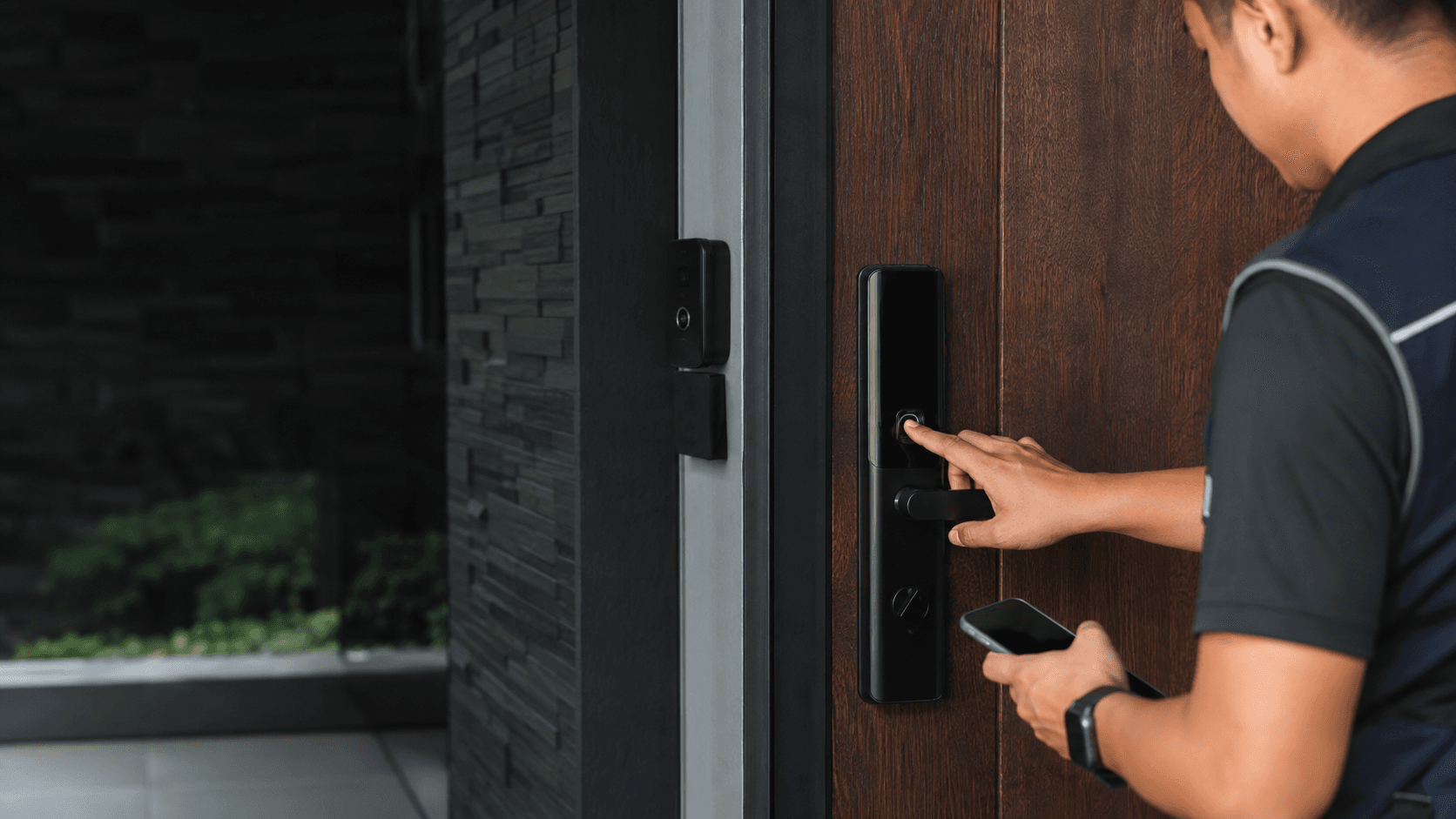
Entry method matters most. Keypad entry suits shared doors where codes can be changed. Fingerprint entry suits a small number of regular users. Card or fob entry suits staff who already carry an access card. Phone-based entry suits households where everyone carries a phone and accepts the app dependency.
Permission management separates home-grade from business-grade hardware. A lock that only stores a fixed number of codes will struggle in a shop with rotating staff. A system that supports grouped users and scheduled access will cost more but removes the manual work of reissuing credentials.
Power and connectivity are the constraints that decide long-term satisfaction. Battery-powered locks avoid wiring but need a replacement routine. Wired locks and panels avoid battery changes but need a power route to the door, which is a construction question rather than a product question.
Physical security still sits with the door, frame and strike. A well-configured electronic lock on a weak frame does not improve the door's resistance, and no amount of app features changes that.
Installation and handover for a newer lock
Installation quality decides whether the lock feels reliable. A lock body that is slightly out of alignment with the strike will work when new and start sticking within months, and the fault will look like a product problem rather than a fitting problem.
Handover is where most installations are won or lost. It should cover how to add and remove a user, how to check entry records if the system supports them, what the low-battery warning looks like, and who to contact when something fails. Without that, the first lockout becomes a support call that could have been avoided.
For multi-door sites, handover also covers the panel or software side: which doors are grouped, which schedules apply, and how a temporary visitor credential is issued and expired. Eyonic's project work for KTA Sarawak Sdn Bhd covered staff movement, visitor handling, tidy cabling and clearer daily site control, which is the same set of concerns a multi-door lock installation raises.
One practical limit applies to every electronic lock: it depends on something else working. Power, battery, network or the credential itself can fail, so the backup entry plan is part of the installation, not an optional extra.
Practical next step with Eyonic
Eyonic Sdn Bhd plans, supplies and installs security and ELV systems in Sarawak, covering homes, offices, shops and industrial sites. The founder, Eric Yong, has worked in technical installation of digital security solutions for commercial businesses in Sarawak for more than ten years.
For lock work, the useful starting information is the door itself: how many doors, what material, whether the frame is sound, and who needs to enter. That determines whether a standalone smart lock is enough or whether an access-control panel is the better route.
Share your location, property type and required system with Eyonic on WhatsApp at +60 11-5111 7959 for the next practical step.