
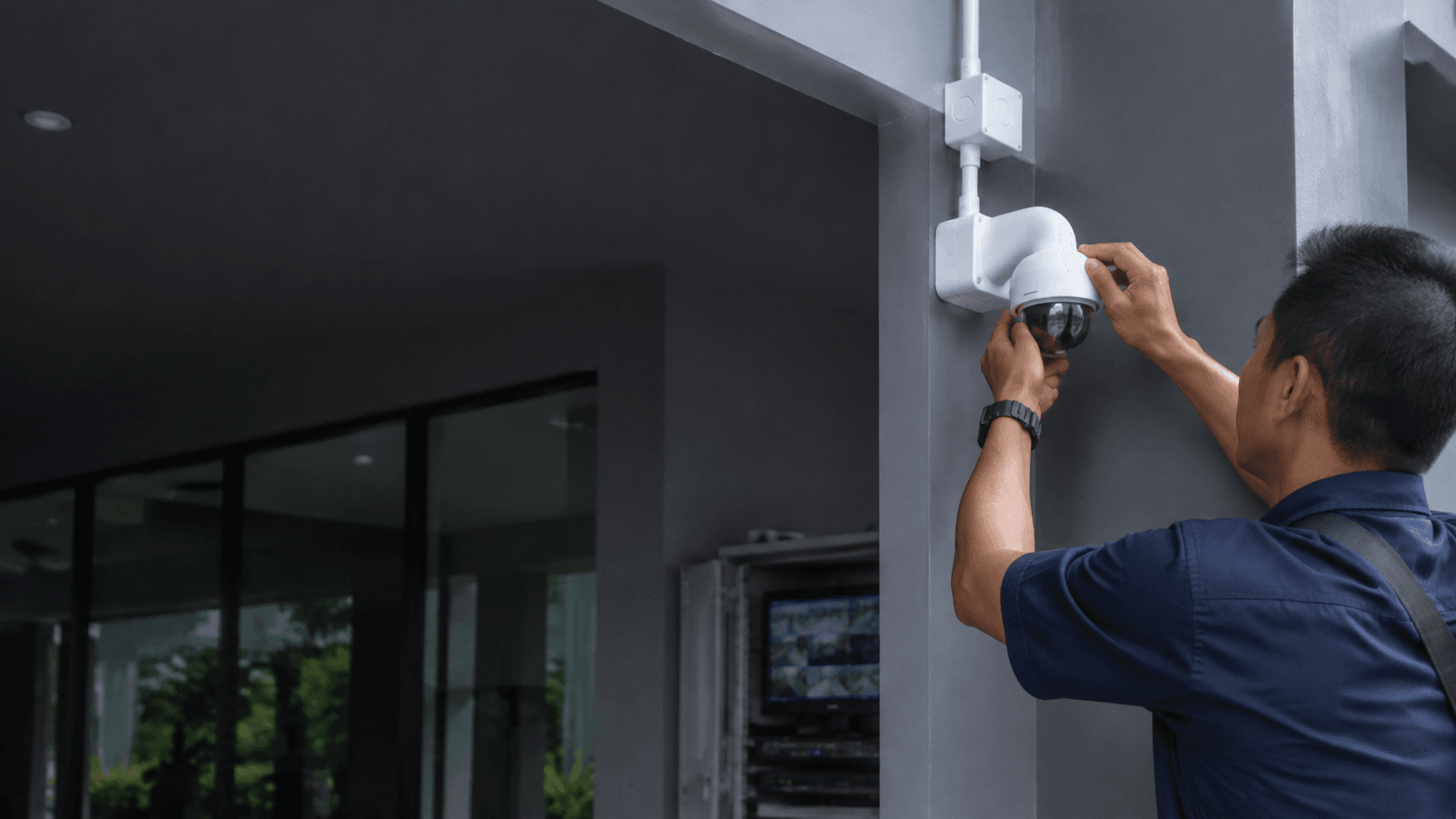
The housing shape is the whole point. A long, narrow body holds a lens with real reach, so a single unit can watch a gate, a driveway, a back lane or a warehouse perimeter from one mounting point. That reach is why the format survives alongside domes and turrets rather than being replaced by them.
Eyonic Sdn Bhd plans, supplies and installs monitoring systems with camera placement, recording and remote viewing for homes, offices, shops and industrial sites. The company is based in Sarawak, Malaysia, and its founder Eric Yong has worked in the industry for more than 10 years, with a focus on technical installation of digital security solutions for commercial businesses in Sarawak.
Bullet Cctv Camera. What Matters Before You Choose
Four things decide whether the format fits: how far the subject sits from the mounting point, what the light does after dark, whether the camera will be reachable by hand, and how the cable will run. Get those four right and the rest is detail.
Distance comes first because it drives lens choice. A camera watching a gate 4 m away and a camera watching a yard 30 m away are different products even when both are labelled 1080p. Resolution describes how much detail is captured across the frame; the lens decides how much of the scene lands in that frame at all.
Light comes second. Infrared illumination renders a monochrome image in near-total darkness. Full-colour night vision depends on some ambient light being present, which is why Eyonic recommends checking actual lighting conditions before confirming placement for ColorVu-style cameras. A street lamp, a porch light or a neighbour's security light can change the answer.
Reachability comes third. A bullet camera mounted at 2.5 m to 3 m is awkward to grab without a ladder, but it is not vandal-resistant in the way a domed unit is. Where tampering is a realistic concern, that trade-off matters more than image quality.
Cable routing comes last but often costs the most. A long run to a distant pole needs planning for power and signal, and the tidy-cabling question is one Eyonic addressed directly on the KTA Sarawak Sdn Bhd project, which needed a practical office setup in Kuching to support staff movement, visitor handling, tidy cabling and clearer daily site control.
Choosing the Right Bullet Cctv Camera
A short sequence keeps the decision grounded in the site rather than the catalogue.
- Walk the site and mark every point that needs coverage, then measure the distance from each proposed mounting position to its subject.
- Check the light at each position after dark, including whether any ambient source reaches the target area.
- Decide the recording and viewing arrangement, since camera placement, recording and remote viewing are planned together rather than separately.
- Confirm where the recorder will sit and how cable will reach it without exposed runs.
- Agree the handover, including how footage is reviewed and how mobile viewing is set up.
Eyonic's CCTV installation process follows site survey, system proposal, installation and handover. The survey stage is where the first two steps above get settled, and it is cheaper to change a mounting height on paper than after drilling.
What is bullet cctv camera?
A bullet cctv camera is a fixed security camera in a cylindrical housing, usually mounted on a wall or pole bracket and aimed at one direction. It does not pan, tilt or zoom on its own. The long body houses the lens and, on many models, the infrared illuminators that light the scene after dark.
The format is typically chosen for outdoor work where the subject is some distance away. It is also visibly a camera, which some sites treat as useful and others treat as a reason to choose something less obvious.
HD-TVI Camera, Ultra Wide 180 Degree View, 1080p CCTV Security Camera
These three labels describe different things and are often confused. HD-TVI is a transmission format that carries high-definition video over coaxial cable, which matters when existing cabling is being reused. A 180-degree view describes how much of the scene the lens captures, and a very wide view spreads the same sensor across more area, so each object occupies fewer pixels. 1080p describes the vertical resolution of the recording.
A wide lens and a long-range lens pull in opposite directions. A camera covering 180 degrees is not the same tool as one reading a number plate at distance, even if both are 1080p. Matching the lens to the job is the decision that actually determines whether footage is useful later.
Practical Considerations for Bullet Cctv Camera
Weather exposure, mounting height, night performance and maintenance access are the four practical constraints that show up on almost every outdoor installation.
Weather exposure is handled by the housing and its sealing rating. Outdoor units are built to shed rain, but the bracket joint and the cable entry are the usual weak points, so the mounting surface and the drip path matter as much as the camera body.
Mounting height is a balance. Higher placement widens the view and reduces the chance of interference, but it also softens facial detail and makes cleaning harder. Lower placement improves identification and increases tampering risk.
Night performance depends on the light actually present. Infrared works in darkness but returns a monochrome image. Colour at night needs ambient light, and the amount needed varies by model and by how much the scene reflects. This is a site question, not a specification question.
Maintenance access is the constraint most often overlooked. A camera that needs a ladder and a clear approach twice a year is a different commitment from one reachable from a balcony. Dust, cobwebs and insect nests near the lens are common causes of degraded night images.
| Site condition | Bullet camera fit | Reason |
|---|---|---|
| Long driveway or yard, subject 15 m or more away | Strong fit | The narrow body supports a longer lens for distance |
| Perimeter wall or fence line | Strong fit | Fixed aim along a boundary suits a directional camera |
| Low ceiling indoors | Weak fit | Wall mounting and downward aim are awkward under a ceiling |
| Area where tampering is likely at reachable height | Weak fit | Exposed housing is easier to interfere with than a dome |
| Scene needing one camera to cover a wide entrance | Depends on lens | A wide lens covers more area but reduces detail per object |
Eyonic's own project work shows how the fit question plays out in practice. The Kuching Immigration Office project provided practical support for a public office in Kuching, focused on arrival flow, staff areas, visitor movement and dependable daily operation. That is a coverage-and-continuity problem rather than a single-camera problem, and the approximate budget for that type of work is RM 12,000 to RM 28,000.
For smaller commercial premises, the KTA Sarawak Sdn Bhd project needed a practical office setup in Kuching to support staff movement, visitor handling, tidy cabling and clearer daily site control, with an approximate budget of RM 8,000 to RM 18,000 for that type of work.
Where a bullet cctv camera is the wrong choice
Indoor rooms with low ceilings are usually better served by a dome or turret, because the mounting surface is above the subject rather than beside it. Sites where the camera will sit within arm's reach and interference is a real risk also favour a dome, since the housing offers less to grab.
Scenes that need to follow movement across a wide area are a different category again. A fixed bullet camera watches one direction; covering a large yard with fixed cameras means more units, not a better single unit.
Cost and package context
Eyonic lists a Hikvision CCTV Package at RM 1,599, covering camera supply and setup, basic recording configuration and mobile viewing handover. The same figure applies to the Hikvision Alarm System package, which covers control panel and sensors, siren and zone setup, and user testing and handover, and to the Autogate Package, which covers motor recommendation, remote-control setup, and safety testing and handover.
Those package figures describe defined scopes rather than a per-camera price, and larger multi-camera projects sit in the project budget ranges noted above. Scope, camera count and cable distance are what move a figure, not the camera shape alone.
Making an Informed Choice About
The decision usually comes down to three questions: is the subject far enough away to justify the format, is there enough light after dark for the night mode to work, and is the mounting position sensible for both coverage and maintenance.
Where all three answers are favourable, a bullet cctv camera is a straightforward choice for perimeter and long-range coverage. Where any one of them is not, a dome, turret or a different lens is worth considering before committing.
Two practical points reduce the risk of a poor outcome. First, settle the lens and the mounting position together, because changing one changes the other. Second, confirm the night-time result on site rather than from a specification sheet, since ambient light varies street by street and building by building.
For readers in Sarawak weighing up a system, Eyonic's installation process starts with a site survey and a system proposal before any hardware is fixed in place. Sharing the location, property type and required system with Eyonic on WhatsApp at +60 11-5111 7959 is the next practical step.