
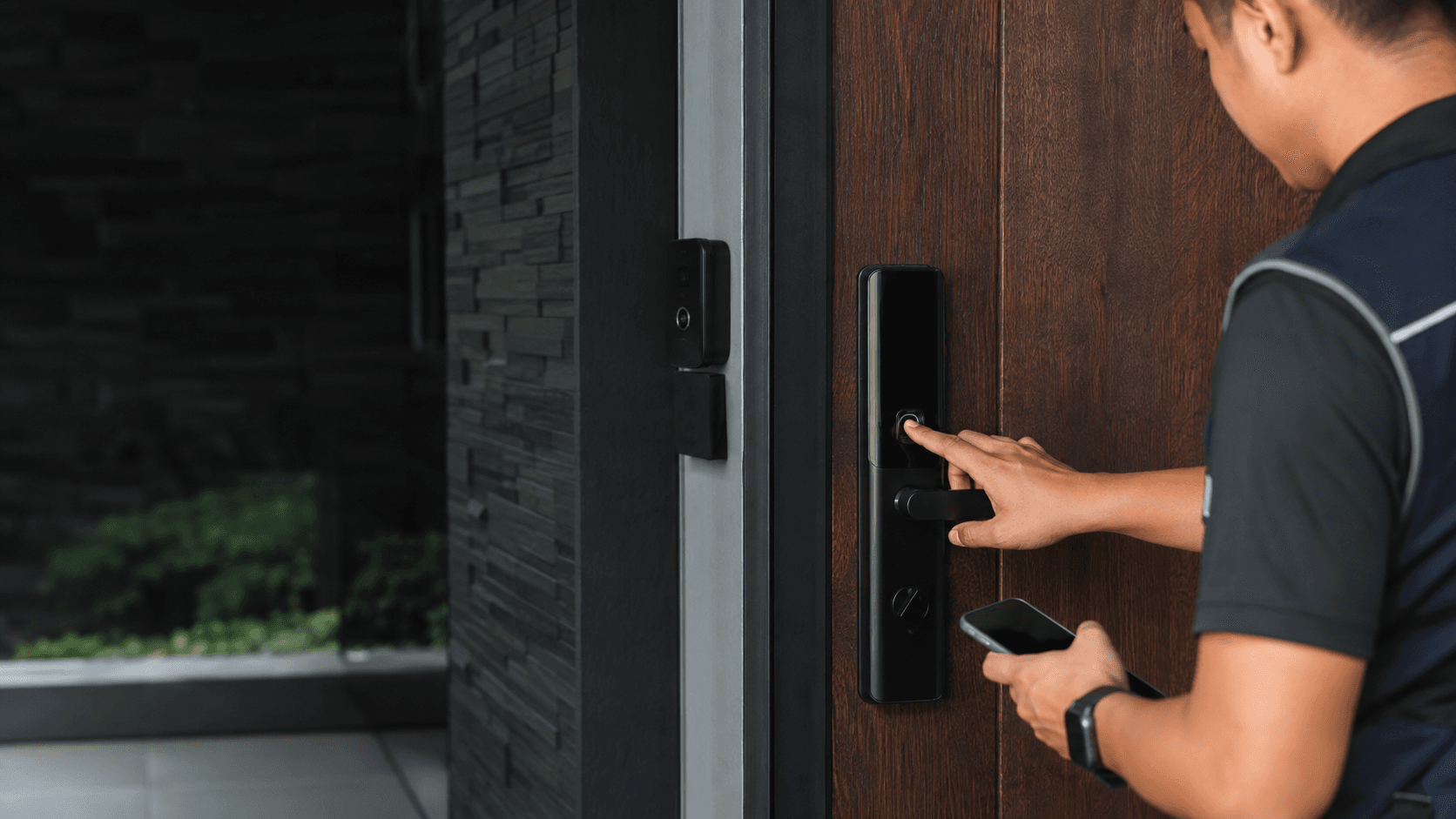
The Yale Mortise Smart Lock sits in a different category from a rim lock or a deadbolt that screws onto the face of a door. A mortise lock body is recessed into a pocket cut inside the door edge, which means the door itself — not the lock — decides whether a swap is straightforward or a workshop job. That single fact reshapes the whole buying decision, and it is the reason a site survey matters more here than on almost any other access device.
Yale Mortise Smart Lock. what the mortise format changes
A mortise format changes where the mechanism lives. Instead of a surface-mounted unit, the body, latch, and often the deadbolt sit inside the door, with the handles and cylinder passing through the face. The visible hardware is only the outer layer of a system buried in the door slab.
That arrangement produces three practical consequences. First, the door must already have a compatible pocket, or the pocket must be cut. Second, the door thickness and edge geometry constrain what will physically fit. Third, replacing the body is a carpentry-adjacent task, not a screwdriver swap, because the pocket, faceplate, and strike must all line up again after the change.
Yale's own product pages describe mortise smart locks as an integrated lock mechanism, and third-party coverage of mortise smart locks repeatedly returns to the same theme: retrofit difficulty and door modification. That convergence is the useful signal. The format is chosen for a clean, integrated look and a mechanism that is harder to attack from outside, and the price of that choice is fit complexity.
Where the format suits a door
A mortise lock body suits a door that already has a mortise pocket and a faceplate cut that matches the replacement. It also suits projects where the door is being replaced or refinished anyway, because the cutting work is absorbed into work already happening.
It suits less well where the door is thin, hollow-core, or finished in a way that cannot be re-cut without visible damage. In those cases a surface-mounted smart lock avoids destroying the door to gain a marginal aesthetic improvement.
Door condition and existing mortise cut-outs before any purchase
The pre-purchase sequence below is ordered because each check can end the process. Skipping ahead to access methods before confirming the cut-out is the most common way buyers end up with hardware that cannot be fitted.
- Confirm the existing mortise cut-out and door thickness, including the pocket depth, faceplate dimensions, and backset, so the replacement body can be matched to the door rather than the door matched to the lock.
- Confirm the access methods required, such as PIN entry, card or tag, fingerprint, app control, or a mechanical key, and decide which of those must work when the network is down.
- Confirm user roles and permissions, separating permanent household or staff access from temporary or visitor access, and deciding who can add or revoke a credential.
- Confirm the backup entry method, including a physical key or an alternative door, and test that it works before the primary method is relied upon.
- Confirm who performs installation and handover, and what that handover includes, such as credential setup, app pairing, and a walkthrough of the failure modes.
Door condition deserves its own attention because it is the check most often assumed rather than performed. A door that has swollen, been re-hung, or had its strike plate moved may accept a new body mechanically while failing to latch cleanly. Alignment problems show up as intermittent locking, which users then blame on the electronics.
What a site survey resolves
A site survey resolves the questions that photographs cannot answer: whether the pocket is square, whether the door closes against the strike without pressure, and whether the frame has moved since the original lock was fitted. Eyonic's installation process for its security work runs through site survey, system proposal, installation, and handover, and the same sequence applies to door hardware, because the survey is where fit is confirmed or ruled out.
Access methods and user roles across household or office doors
Access methods are usually the easiest part of the decision and the least likely to cause a failure. The harder question is who holds which credential and who can change it.
In a household, the permission model is simple: a small number of permanent users, occasional visitors, and one person who administers the lock. In an office, the model is not simple. Staff join and leave, cleaners and contractors need time-limited access, and someone must be able to revoke a credential the same day a person departs.
Eyonic's own review guidance on smart lock door access notes that smart locks work best when door condition, user roles, and backup method are reviewed before installation, and that for business use the usual question is whether a standalone smart lock or an access-control panel is more appropriate. That is the correct fork in the road. A standalone lock manages a door. An access-control panel manages a building's worth of doors, with central records and consistent policy.
Standalone lock or access-control panel
A standalone lock fits a single entrance where the user list is short and stable, and where administration by one or two people is acceptable. An access-control panel fits premises with multiple controlled doors, a changing user list, or a need for a record of who entered where and when.
The trade-off is administration load against capability. A standalone lock is quick to live with and cheap to change. A panel costs more to install and configure but scales without adding a separate administration routine at every door.
installation and handover in Sarawak
Installation is where the earlier checks either pay off or fail. A body that matches the existing pocket goes in with the door on its hinges and the work is measured in hours. A body that does not match means cutting, and cutting means the door is off its hinges and the site is disrupted.
Handover is the part most often under-specified. A useful handover covers credential setup for each user role, app pairing and account ownership, the behaviour of the lock when power or connectivity is lost, how to add and revoke a user, and what to do when the lock reports a fault. Without that, the first problem becomes a call-out rather than a two-minute fix.
Eyonic is a security system supplier based in Sarawak that plans, supplies, and installs monitoring and access systems for homes, offices, shops, and industrial sites, and has completed work for public and commercial clients in Kuching, including the Kuching Immigration Office project, which focused on arrival flow, staff areas, visitor movement, and dependable daily operation. That project context is relevant to door access because arrival flow and visitor movement are exactly the problems a door access decision is meant to solve.
One limit is worth stating plainly. The evidence available does not confirm that Eyonic supplies or installs the Yale Mortise Smart Lock specifically; the brand's documented coverage is smart lock door access generally and multi-brand access control. Anyone evaluating this product for a Sarawak property should confirm supply and installation scope directly rather than assume it.
Backup entry power and permission planning
Backup entry is the failure mode that matters most, because it is the one that locks people out rather than merely inconveniencing them. A physical key, a second door, or a documented override should exist and should be tested before the primary method becomes the only method in daily use.
Power is the second failure mode. Battery-powered locks degrade gradually, and the practical risk is not sudden death but a warning that nobody acted on. Planning means deciding who is responsible for responding to a low-power indication and where the replacement consumable is kept.
Permissions are the third. A lock that cannot be administered by the people on site becomes a dependency on an external party. Deciding in advance who holds administrator rights, and how those rights transfer when a person leaves, prevents the common situation where a property has a smart lock and no one who can manage it.
What happens when access fails
When app access fails, the lock should still open by its local methods, which is why the access-method decision and the backup decision belong together. When a credential is lost or a person departs, revocation should be possible without a site visit. When the lock itself faults, the response depends on whether a mechanical override exists and whether the door can be secured while the fault is resolved.
Comparing a standalone lock against a wider access control setup
The comparison is not really about the lock. It is about how many doors need policy, how often the user list changes, and whether a record of movement is required.
A standalone lock is the right answer for one door, a stable user list, and a preference for minimal administration. A wider access-control setup is the right answer for multiple doors, frequent changes, or any requirement to review who entered where. A mortise-format lock can serve either case, because the format describes the mechanism in the door, not the management layer behind it.
Cost is a real constraint, and the honest position is that no Malaysia-specific pricing or warranty evidence for this product is available here. What can be said is that Eyonic publishes package pricing for its other security work — RM 1,599 for a Hikvision CCTV package, RM 1,599 for a Hikvision alarm system, and RM 1,599 for an autogate package — and that completed project budgets have ranged from RM 8,000 to RM 18,000 for an engineering consultancy office setup in Kuching and RM 12,000 to RM 28,000 for the Kuching Immigration Office work. Those figures describe other systems, not this lock, and should be read as scale indicators only.
For a property in Malaysia, the practical next step is to establish the door facts before the product facts. Share the location, property type, and required system with Eyonic on WhatsApp at +60 11-5111 7959, and the fit question can be answered against the actual door rather than a product listing.