
The brand most buyers in Malaysia encounter when they search for Panasonic surveillance hardware is Panasonic itself, and the range is documented on Panasonic's regional security pages rather than on a single Malaysian retail page. That matters, because the buying decision usually depends less on the badge on the camera and more on who surveys the site, who configures recording, and who answers when something stops working.
Panasonic CCTV Camera Range and Where It Fits
Panasonic's published surveillance material organises the range by housing type and by job. Bullet cameras cover long corridors and perimeter lines. Dome and turret cameras suit ceilings and low-profile indoor mounting. PTZ units handle wide areas where an operator needs to move the view. ANPR cameras are aimed at number plate capture, fisheye cameras at full-room coverage from one point, and thermal cameras at detection where visible light is poor.
Alongside the cameras, Panasonic lists network video recorders, video management software, a mobile app, firmware update tools and an IP manager utility for addressing devices. That software layer is part of the product line, not an accessory. A camera range without a recorder, a viewing client and a firmware path is only half a system.
Panasonic's surveillance business has also been associated with the i-PRO brand, and i-PRO's own product pages describe edge AI, cyber security features and cloud video. Buyers comparing Panasonic CCTV camera options against other brands should confirm which entity currently supplies the specific model, because support, firmware and warranty routes follow the manufacturer, not the reseller.
What the range does not settle
Choosing a housing type does not answer resolution, lens, storage or retention. Those depend on the site. A shop entrance, a factory loading bay and an office corridor produce different requirements even when the same camera family is used.
What Malaysian Sites Should Check Before Buying
Malaysian sites add conditions that a product page cannot address. Heat and humidity affect housing and cabling. Monsoon rain and wind-driven water test outdoor seals and mounting brackets. Power stability in some commercial areas makes surge protection and a suitable power path part of the design rather than an afterthought.
Network conditions matter too. Remote viewing depends on upload bandwidth at the site, not download speed. A site with a slow or contended connection will deliver a poor mobile experience regardless of camera quality, and that constraint is usually discovered after installation if it is not checked beforehand.
Three checks belong in every pre-purchase conversation:
- Site survey — walk the property, identify entry points, blind spots, cable routes and where the recorder will live.
- System proposal — confirm camera positions, recorder capacity, storage retention target and how remote viewing will be delivered.
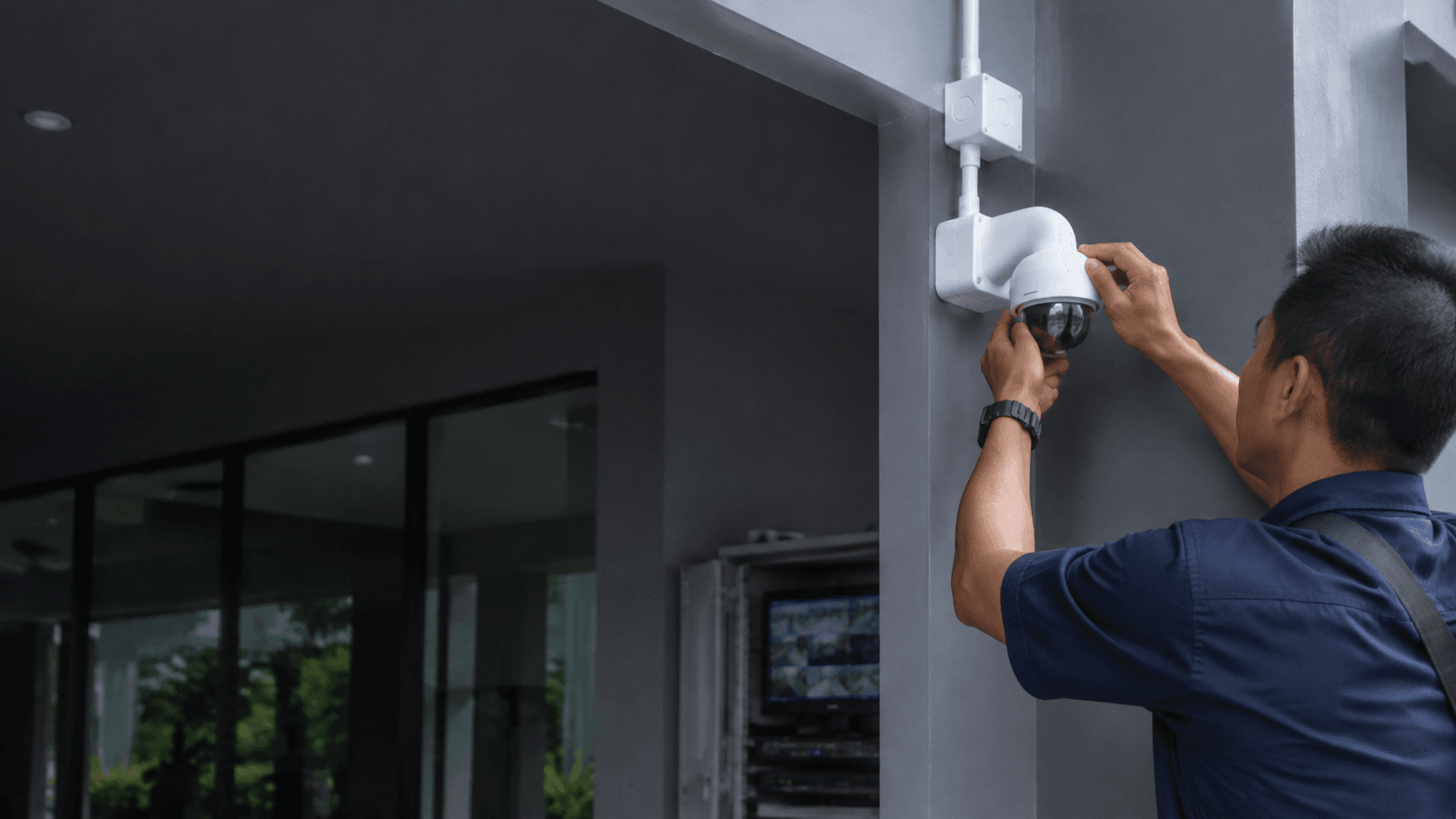
- Installation — mount, cable, configure recording and set up viewing access.
- Handover — test the system with the people who will use it, and confirm they can review footage without assistance.
That sequence is the one Eyonic follows on CCTV installation work in Sarawak, and it applies to Panasonic CCTV camera projects as much as to any other brand, because the survey and handover stages are brand-independent.
Questions worth asking a supplier
Which entity provides firmware updates for the specific model, and for how long? What happens if a camera fails in month fourteen? Is the recorder sized for the retention period the site actually needs, or for the shortest period that fits the budget? Can the person who reviews footage do so without calling the installer?
Those questions separate a supportable installation from a box of hardware. They also reveal whether the supplier has thought about the site or is quoting a package.
Panasonic CCTV Camera Installation and Handover Steps
Installation quality determines whether a surveillance system is useful a year later. Cabling that is tidy and labelled makes fault-finding faster. Camera angles that were tested on site, rather than assumed from a floor plan, reduce the number of cameras needed and the number of blind spots left behind.
Recording configuration deserves the same attention. Frame rate, resolution and retention interact directly: higher settings consume storage faster, and a recorder that fills in ten days when the site needs thirty is a design error, not a hardware fault.
Handover is the stage most often skipped. A system that only the installer can operate creates a dependency. Testing playback, exporting a clip and checking mobile access with the site's own staff closes that gap.
Where installations commonly go wrong
Cameras aimed at a wall of glass, or into a light source, produce unusable images at exactly the times that matter. Cable runs added after the fact leave exposed conduit and new failure points. Recorders placed in unconditioned rooms suffer in Malaysian heat. None of these are brand problems, and none are fixed by buying a better camera.
Lighting Placement and Recording Considerations
Lighting is the single largest variable in image quality. A camera that performs well in daylight can fail at night if the scene has no usable light and the camera relies on infrared. Reflective surfaces, headlights and street lighting can also overwhelm a sensor at night.
Eyonic's guidance on colour night-vision cameras is to check the actual lighting conditions at the site before confirming placement, rather than assuming a specification translates into a usable image. The same discipline applies to any Panasonic CCTV camera being considered for a night-critical position.
Placement decisions follow from the survey. Height affects angle and identification quality. Distance from the subject affects whether a face or a plate is recognisable. Coverage of an approach path is often more useful than coverage of a door, because it captures intent rather than arrival.
Recording settings should be set against a retention target, not a default. If the site needs thirty days, the recorder, drive capacity and camera settings must be chosen together to reach it.
Costs Packages and Project Budget Ranges
Panasonic CCTV camera pricing for Malaysia is not published in the material available here, and quoting a figure without a supplier source would be misleading. What can be stated is the shape of project costs from comparable work.
Eyonic's published package pricing for Hikvision-based systems is RM 1,599 for a CCTV package, RM 1,599 for an alarm system and RM 1,599 for an autogate package. Those figures cover camera supply and setup, basic recording configuration and mobile viewing handover on the CCTV side.
Larger projects scale well beyond package pricing. Eyonic's Kuching Immigration Office project, which covered arrival flow, staff areas, visitor movement and dependable daily operation, carried an approximate budget of RM 12,000 to RM 28,000. An engineering consultancy office project in Kuching, covering staff movement, visitor handling, tidy cabling and clearer daily site control, carried an approximate budget of RM 8,000 to RM 18,000.
Those ranges reflect site size, camera count, cabling distance and the amount of configuration required. A single-office installation and a public building with multiple zones do not sit in the same bracket, and the difference is usually labour and cabling rather than cameras.
What drives the number up
Long cable runs, difficult mounting heights, the need for additional power points, and integration with existing access control or alarm systems all add cost. So does a requirement for higher retention, because storage capacity scales with it.
Questions Buyers Ask
Is Panasonic CCTV camera equipment still available and supported? Panasonic's regional security pages continue to list surveillance cameras, network video recorders, software and firmware tools, and i-PRO publishes its own surveillance product line. Buyers should confirm the current supply and support route for the specific model before committing.
Can Panasonic cameras be mixed with other brands? Mixing is possible when the recorder and cameras share a protocol, but it complicates support. A single-vendor system is easier to diagnose, and a mixed system should be a deliberate choice rather than an accident of availability.
How many cameras does a typical site need? That follows from the survey. A small shop may need four; a multi-zone commercial building may need twenty or more. Camera count should be driven by coverage requirements, not by package tiers.
Does remote viewing need a static IP? Not necessarily. Many systems use a cloud service or a peer-to-peer connection, but the site's upload bandwidth still determines how well it works.
What should be confirmed before signing? The model being supplied, who provides firmware and warranty support, the retention period the recorder is sized for, and whether handover includes training for the people who will use the system.
Share your location, property type and required system with Eyonic on WhatsApp at +60 11-5111 7959 for the next practical step.