
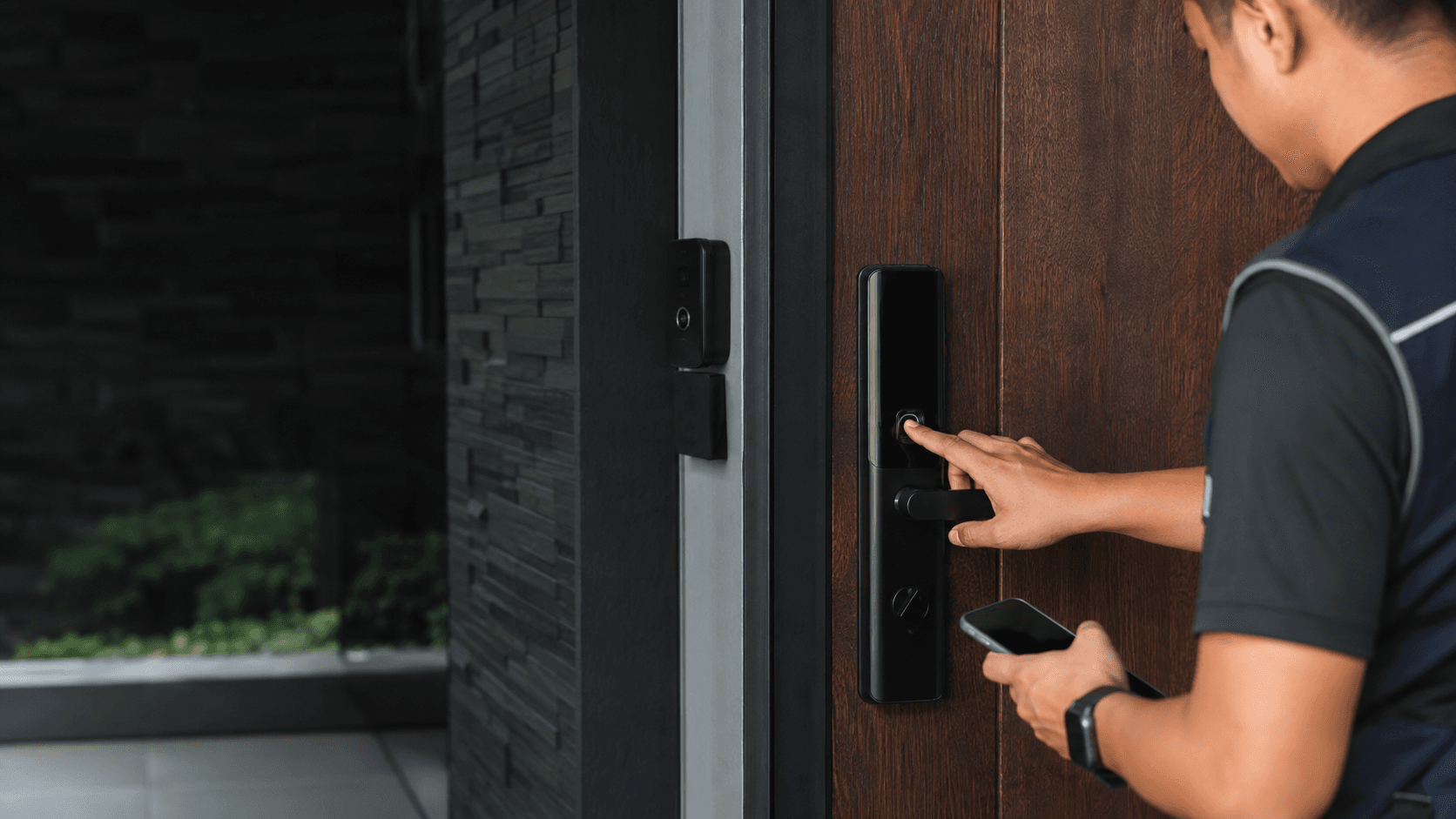
Yale residential locks sit at the meeting point of two very different buying journeys. One buyer wants a mechanical deadbolt that matches an existing keyway and never needs a battery. Another wants a keypad entry that can be re-coded when a tenant leaves. The product names overlap, the installation requirements do not, and the gap between those two journeys is where most purchase mistakes happen.
This guide maps the Yale residential locks range as it appears across manufacturer and retail listings, then narrows to the decisions that actually change the outcome: door preparation, credential type, connectivity, and who holds the ability to add or remove a user.
Yale Residential Locks. What Matters Before You Choose
Three variables decide almost everything else. The first is the door itself. Bore diameter, backset, door thickness, and whether the door is wood, hollow metal, or glass all constrain which lock bodies will physically fit. The second is the credential. a physical key, a keypad code, a phone, or a combination. The third is who administers access, because a lock that one person manages behaves very differently from a lock that must be re-keyed for every change in occupancy.
Yale's own brand positioning leans on longevity and everyday reliability rather than on any single technology. The company states it has been making locks for over 180 years, and its global site frames the range around protecting "the things that matter most." That heritage claim is a brand statement, not a performance specification, and it should not be read as evidence that any particular model outperforms another.
Retail listings add a second layer of useful detail. Amazon's Yale store describes Assure Locks and Assure Levers as replacements for existing door hardware, with keypads for keyless entry. That framing matters because it tells the buyer the intended use case is a swap, not a new build. GoKeyless describes Yale digital door locks as offering keyless entry with auto locking and Bluetooth features. August Home's Yale page lists Yale Access products as manageable from the August App, alongside named items such as the Yale Approach Lock with Wi-Fi, Yale Assure Locks, the Yale Smart Cabinet Lock, the Yale Smart Delivery Box, Yale Keypad, Yale Keypad Touch, and the Connect Wi-Fi Bridge.
Those named items are the clearest available signal of how the range is segmented. A cabinet lock and a delivery box are not door locks in the conventional sense, and a Wi-Fi bridge is an accessory rather than a lock. Treating the whole list as interchangeable door hardware is the most common category error in this space.
Choosing the Right Yale Residential Locks
A short sequence keeps the decision grounded in the door rather than in the feature list.
- Measure the door. thickness, bore hole diameter, backset distance from the door edge, and the centre-to-centre spacing between the deadbolt and the handle bore if both are being replaced.
- Confirm the door material and frame condition, since hollow metal, solid wood, and glass doors accept different hardware and different reinforcement.
- Decide the credential set. key only, keypad only, keypad plus key, or phone-based access, and whether a physical key must remain as a fallback.
- Decide whether the lock must be administered remotely or only at the door, because that determines whether a bridge or hub is required.
- Check the power source and what happens when it fails, including whether an external power option or mechanical override exists.
- Verify the finish and handing against the door swing before ordering, since a returned lock costs more time than a measured one.
The fourth item is the one buyers most often skip. August Home's own product listings repeatedly note that remote access and voice-assistant features require a Wi-Fi bridge, and that the bridge is included with some configurations and not others. A lock advertised as app-controlled may therefore deliver app control only within Bluetooth range until a bridge is added. That is a configuration difference, not a defect, but it changes both the cost and the experience.
What is yale residential locks?
Yale residential locks is the portion of the Yale lock range intended for homes and apartments rather than for commercial or institutional openings. The distinction is practical rather than cosmetic. Residential locks are typically sold through retail and e-commerce channels, are designed for standard residential door preparations, and are marketed on convenience features such as keyless entry, auto locking, and app-based access sharing.
The commercial side of the same brand has moved separately. ASSA ABLOY ACCENTRA, formerly Yale Commercial Locks, now describes its products as designed for commercial, multi-family, and mixed-use applications, covering door closers, exit devices, key systems, and electronic access control. A buyer searching for a lock for a shopfront, an office suite, or a multi-door building is therefore looking at a different catalogue with different hardware standards, even though the Yale name appears on both.
Multi-family sits awkwardly between the two. A landlord fitting one unit may reasonably use a residential smart lock. A landlord fitting forty units with a shared master key system is describing a commercial access-control problem, and residential hardware will not solve it.
Yale Locks | Official Online Store | Yale Home
The manufacturer's own site is the reference point for what the range actually contains, and it is organised by region rather than by product category. Yale Home presents localised sites and directs visitors to the appropriate regional storefront, which means the models, finishes, and certifications shown for one market may not match another.
That regional structure has a direct practical consequence for buyers in Malaysia and elsewhere in Southeast Asia. A model number seen in a US retail listing may not be the model number sold locally, and a lock sold locally may ship with a different cylinder, a different warranty term, or a different radio module. Matching the model number to the regional catalogue is more reliable than matching the product photograph.
Retail and specialist listings fill in the gaps the manufacturer site leaves open. The Home Depot and Lowe's both maintain Yale residential door lock sections, and GoKeyless and HomeControls carry Yale entry systems ranging from deadbolts to door handles. Andersen Windows sells Yale Assure Lock passive handles and accessories such as a Bluetooth/Wi-Fi kit and a Z-Wave module as replacement parts for its own patio doors. That last example is worth noting: a Yale lock sold as a component of another manufacturer's door system may be configured specifically for that door and not be a general-purpose retrofit.
Where the range splits
Across the accessible listings, the range separates into four practical groups. Mechanical deadbolts and handlesets use a physical key and no electronics. Keypad deadbolts add code-based entry while retaining a key cylinder. Connected smart locks add Bluetooth, Wi-Fi, or Z-Wave and are administered through an app. Accessories such as bridges, keypads, and modules extend an existing lock rather than replacing it.
The August Home listing also names a smart cabinet lock and a smart delivery box. These use the same access-sharing concept applied to furniture and parcel storage rather than to a door, and they should be evaluated against the cabinet or box they are meant to secure, not against a door lock's specifications.
Practical Considerations for Yale Residential Locks
Installation realities decide whether a chosen lock works in a given home. The points below are the ones that most often force a change of plan after purchase.
Door preparation is the first constraint. A lock designed to replace existing hardware assumes the existing bore and backset match its requirements. Doors drilled for a different standard, or doors with an integrated handle and lock assembly, may need additional preparation or may not accept the lock at all.
Power and connectivity form the second constraint. Battery-powered locks need periodic replacement, and the interval depends on usage and on how often the motor runs. Bluetooth-only operation keeps the lock functional at the door but limits remote administration. Adding a bridge extends range and enables remote features, and it also introduces a device that needs its own power and network connection.
Credential management is the third. A keypad lock allows codes to be added and removed without re-keying the cylinder, which is the main operational advantage over a mechanical lock in a rental or shared-entry setting. That advantage depends on the lock supporting enough distinct user slots and on someone remembering to revoke access when it should end.
Backup entry is the fourth. A lock with no mechanical override depends entirely on its electronics and its power source. Where a lost key is recoverable but a dead battery at the wrong moment is not, the backup method deserves as much attention as the primary one.
Eyonic, a security system supplier in Sarawak, describes smart lock door access as suited to controlled convenience when user permissions and backup entry are planned properly, and notes that smart locks work best when door condition, user roles, and backup method are reviewed before installation. For business use, the same source describes checking whether a standalone smart lock or an access-control panel is the more appropriate choice. That distinction applies directly here: a single residential door and a building with multiple controlled openings are different problems.
What the evidence does not settle
Several questions a buyer might reasonably ask are not answered by the accessible listings. Model-level battery life, ingress protection ratings, cylinder security ratings, and warranty terms vary by region and by model, and the manufacturer and retail pages reviewed here do not state them consistently. Where a specification is not published for the exact model and region, it should be confirmed with the seller rather than inferred from a similar product.
Pricing is similarly unresolved. The accessible listings do not provide consistent prices for the Yale residential range, and prices differ by market, finish, and configuration. Any figure quoted without a regional source should be treated as indicative only.
Making an Informed Choice About
The decision narrows to a small number of questions with concrete answers. Does the door accept the lock without modification? Does the credential set match how the door is actually used? Is remote administration required, and if so, is the necessary bridge included or purchased separately? Is there a working backup entry method? Is the model number the one sold in the relevant region?
Where the answer to the first question is uncertain, measurement comes before purchase. Where the answer to the third is yes, the bridge belongs in the same order as the lock. Where the answer to the fourth is no, the lock is a single point of failure and should be reconsidered.
For a single home door, a keypad deadbolt with a mechanical key override covers the majority of residential use cases without introducing a network dependency. For a door that must be managed remotely, a connected lock plus bridge is the coherent configuration. For multiple controlled openings in one building, the residential range is the wrong catalogue, and the commercial access-control side of the market is the correct starting point.
Where a property already has other security systems in place, the lock is one component among several. Eyonic's work on the Kuching Immigration Office project focused on arrival flow, staff areas, visitor movement, and dependable daily operation, and its KTA Sarawak Sdn Bhd project addressed staff movement, visitor handling, tidy cabling, and clearer daily site control. Both illustrate the same principle: door hardware decisions sit inside a wider access pattern, and a lock that fits the pattern is more useful than one that only fits the door.
Share your location, property type and required system with Eyonic on WhatsApp at +60 11-5111 7959 for the next practical step.