
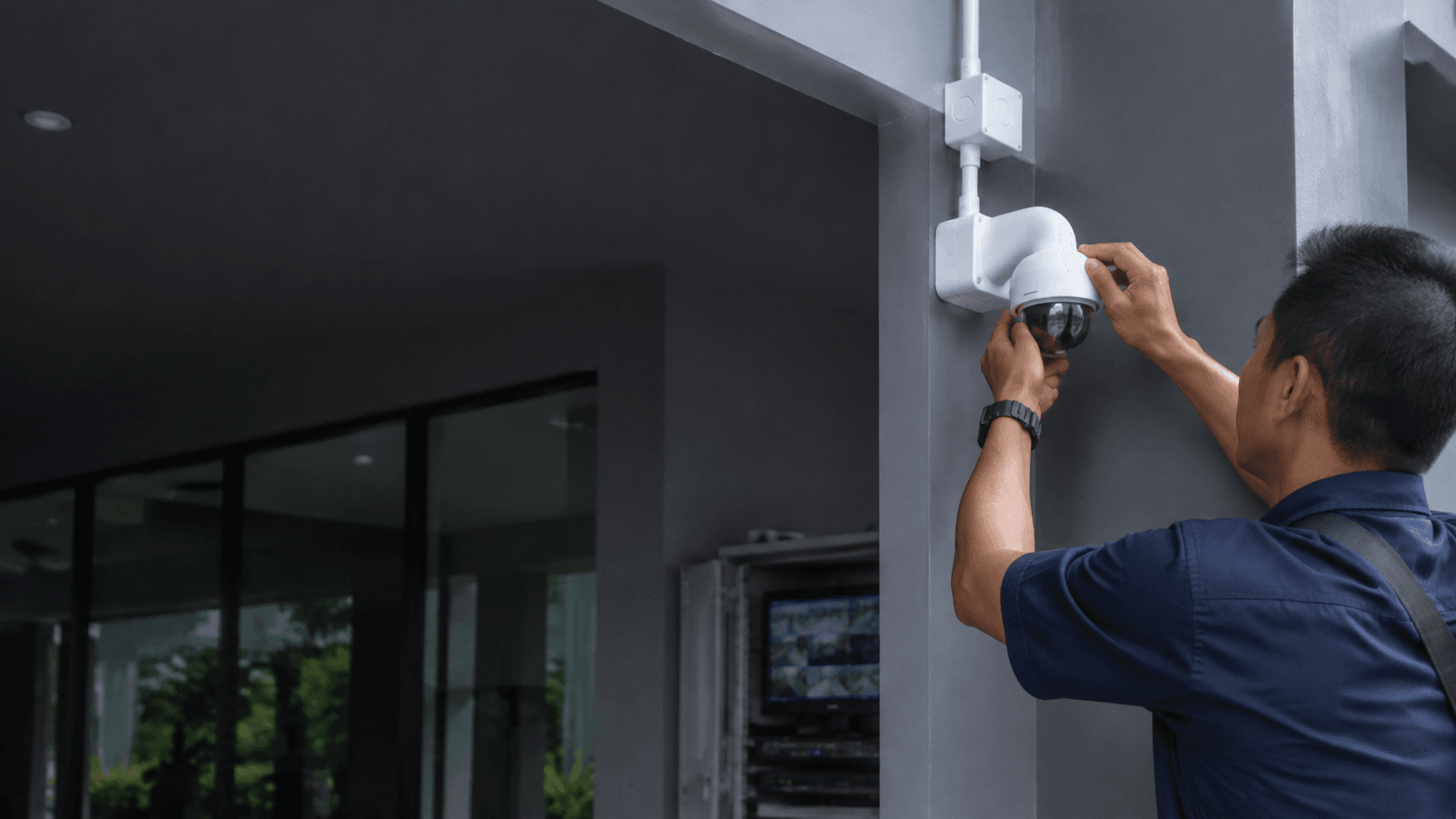
Buyers searching for an adt outdoor camera cost usually want one number. The honest answer is that the number is assembled from several parts, and each part can be quoted separately or bundled. In Malaysia, the practical question is not only what the camera costs, but which parts of the system are one-off payments and which repeat every month.
This page sets out the components that make up an adt outdoor camera cost, the platform choices that change the hardware line, the installation work behind the figure, and the recurring charges that follow. It also lists what to confirm in writing before any deposit changes hands.
What an adt outdoor camera cost usually includes
A quoted adt outdoor camera cost normally bundles four separate things: the camera unit itself, the mounting and cabling work, the recording or storage arrangement, and any monitoring subscription. Treating those as one figure hides where the money actually goes.
Hardware is the most visible line. It covers the camera body, its power supply or PoE injector, and the bracket or housing used to fix it to a wall, soffit, or pole. A camera sold as a standalone unit and a camera supplied as part of a multi-camera kit carry different per-unit economics, because kit pricing spreads the recorder and cabling across several cameras.
Installation is the second line, and it varies more than hardware. A single camera mounted above an existing power point and routed to an existing recorder is a short job. A camera on a distant boundary wall, requiring conduit, a new cable run, and a ladder or scaffold, is a different job entirely.
Storage and monitoring form the third and fourth lines. Local recording on a recorder is a one-off hardware cost. Cloud recording and professional monitoring are usually recurring. A page that quotes only the camera price and omits the recurring side gives an incomplete picture of the adt outdoor camera cost.
- Camera unit, bracket, and power supply or PoE injector.
- Cable run, conduit, and mounting labour.
- Recorder or cloud storage for recorded footage.
- Monitoring subscription, if professional monitoring is required.
- Any contract length, early-termination term, or equipment-return condition.
Adt Outdoor Camera hardware and platform choices
Hardware cost moves with the platform the camera belongs to. A camera designed to work inside one manufacturer's ecosystem cannot simply be swapped for a cheaper unit from another, because the app, recorder, and monitoring integration are tied together.
Two structural choices drive most of the difference. The first is whether the camera is a branded unit supplied with the security platform, or a third-party camera integrated into it. The second is whether the camera records locally to a recorder on site, or streams to cloud storage. Local recording shifts cost into hardware at the start. Cloud recording shifts cost into a subscription over time.
Resolution, night-time performance, and weather sealing also move the price, though the effect is smaller than the platform decision. A higher-resolution sensor costs more than a lower-resolution one. A camera rated for exposed outdoor mounting costs more than an indoor unit pressed into outdoor service, and the second option usually fails early in wet or coastal conditions.
For buyers in Sarawak and similar climates, weather resistance is not a minor specification. Heat, humidity, and heavy rain shorten the working life of a housing that was never designed for permanent outdoor exposure. Paying more for a properly sealed unit is often cheaper across the life of the installation than replacing an indoor camera every couple of years.
Lighting conditions matter as much as the hardware tier. Eyonic advises checking actual lighting conditions at the intended position before confirming placement for ColorVu-style cameras, because a position that looks adequately lit during the day can behave very differently after dark. That check costs nothing and prevents paying for a camera capability the position cannot use.
Installation and setup work behind the figure
Installation is where quotes diverge most, because labour is priced against site conditions rather than against the camera. Two identical cameras on two different buildings can carry very different installation charges.
The work itself follows a predictable sequence. Eyonic's CCTV installation process runs through site survey, system proposal, installation, and handover. Each stage has a cost implication: the survey determines cable routes and mounting points, the proposal fixes the scope, the installation consumes the labour, and the handover covers configuration and user training.
Several site conditions push installation cost upward. Long cable runs across a compound need more cable and more conduit. Masonry or reinforced walls take longer to drill and fix than timber or plasterboard. Positions that require a ladder, scaffold, or elevated platform add access time. Retrofitting a camera into a finished building with no spare cable path is slower than wiring a building under construction.
Self-installation removes the labour line but shifts risk to the buyer. A self-installed camera still needs a power source, a network path, correct aiming, and configuration in the app or recorder. Where the camera must integrate with an existing alarm or monitoring platform, self-installation can fail at the integration step even when the physical mounting is sound.
Professional installation also carries the handover. That step covers confirming the camera records, confirming remote viewing works on a phone, and confirming the user can retrieve footage. Skipping handover is a common reason a working system is later described as unreliable, because nobody was shown how to use it.
Monitoring, storage, and recurring charges
Recurring charges are the part of an adt outdoor camera cost that buyers most often underestimate. A camera that records to a local recorder has no monthly fee attached to storage. A camera that streams to cloud storage usually does.
Professional monitoring is a separate recurring line from storage. Monitoring means a response centre watches alarm or camera events and acts on them. Storage means footage is retained somewhere retrievable. The two are sometimes sold together and sometimes separately, and a quote that mentions only one leaves the other unresolved.
Contract length changes the real cost even when the monthly figure stays the same. A twelve-month term and a thirty-six-month term at the same monthly rate are not equivalent commitments. Early-termination terms, equipment-return conditions, and price-increase clauses all belong in the comparison, because they determine what leaving costs.
There is also a practical limit worth naming. Cloud storage retention is finite, and the retention window determines how far back footage can be retrieved. A short retention window is cheaper and less useful after an incident that is discovered weeks later. Buyers should match the retention window to how quickly they would realistically notice a problem.
Adt Outdoor Camera cost questions to settle before buying
Most disputes about an adt outdoor camera cost trace back to a question that was never asked before the deposit. Settling these points in writing removes the ambiguity.
Ask what the quoted figure covers and what it excludes. A price that covers the camera and mounting but excludes the recorder, the cable, or the first year of monitoring is not comparable to an all-in figure. Ask for the exclusions explicitly rather than assuming the quote is complete.
Ask whether the equipment is owned or rented. Ownership means the hardware is an asset after the contract ends. Renting means payments continue for as long as the system is used, and the hardware may need to be returned. The two arrangements produce very different long-run costs for the same camera.
Ask what happens at the end of the contract. Renewal terms, price adjustments, and the process for cancelling all affect the total. Ask also whether the camera continues to record if monitoring is cancelled, because some systems lose cloud functionality when the subscription lapses.
Ask who supports the system locally. A camera platform supported through a local installer is easier to service than one supported only through a remote call centre, particularly when a replacement part or a site visit is needed. Availability and dealer coverage vary by market, and that variation should be confirmed rather than assumed.
For buyers comparing an ADT-style platform against a locally supplied alternative, the comparison is rarely like for like. A local package such as the RM 1,599 Hikvision CCTV package covers camera supply and setup, basic recording configuration, and mobile viewing handover as a one-off. Larger installations scale upward: Eyonic's Kuching Immigration Office project carried an approximate budget of RM 12,000 to RM 28,000, and the KTA Sarawak Sdn Bhd office project carried an approximate budget of RM 8,000 to RM 18,000. Those figures reflect multi-camera commercial scopes rather than a single outdoor camera, and they show how much the total depends on camera count, cabling, and site conditions.
Share your location, property type and required system with Eyonic on WhatsApp at +60 11-5111 7959 for the next practical step.