
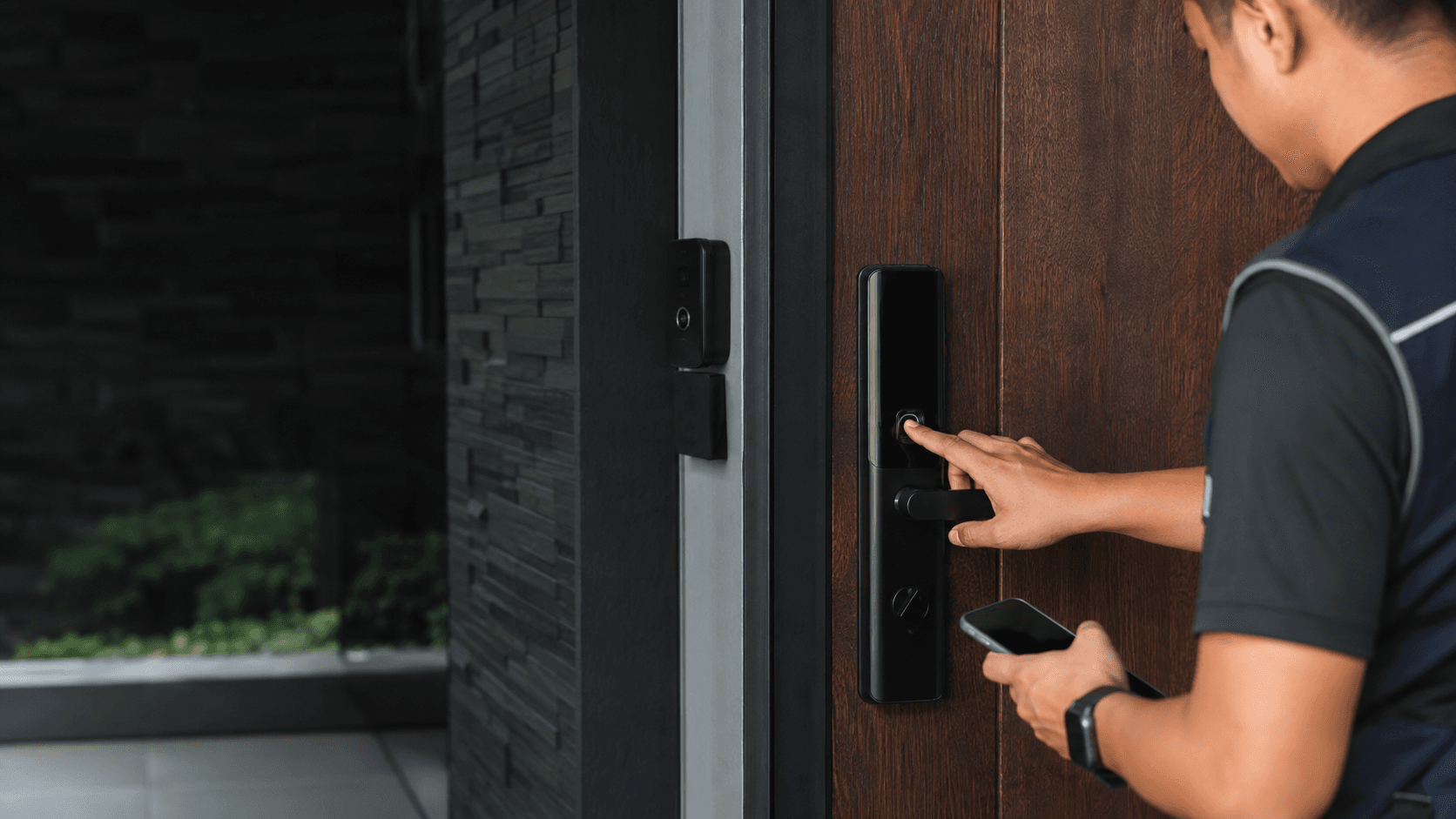
The exact-match query digital deadbolt lock describes a lock body that keeps the deadbolt throw of a conventional lock but swaps the keyway for an electronic credential reader. That distinction matters because the deadbolt itself is the part that resists forced entry, while the electronics only change how the bolt is retracted.
Eyonic Sdn Bhd plans, supplies and installs security and ELV systems in Sarawak, Malaysia, and its smart lock door access review states that smart locks work best when door condition, user roles and backup method are reviewed before installation. The same review notes that for business use, Eyonic usually checks whether a standalone smart lock or an access-control panel is more appropriate.
Digital Deadbolt Lock. What It Replaces on a Door
A deadbolt is a bolt that extends into the door frame and is not spring-loaded, so it cannot be slipped with a shim the way a latch can. A digital deadbolt lock keeps that bolt and the housing around it, then replaces the key cylinder with a reader and a small motor or clutch that moves the bolt when a valid credential is presented.
Three physical arrangements appear on doors:
- Full deadbolt replacement, where the exterior and interior assemblies are both swapped and the existing bore and bolt hole are reused.
- Retrofit or adapter fitting, where the electronic unit mounts over the interior thumb-turn of an existing deadbolt and leaves the original key cylinder in place on the outside.
- Combined lockset, where the deadbolt and the lever or knob share one body and one credential reader.
The first two keep the door's existing preparation. The third usually does not, because the latch and bolt spacing on a combined unit has to match the door's existing holes or the door needs new boring.
What the lock does not replace is the strike plate and the frame. A deadbolt that throws into a short strike with thin screws gives up most of its advantage regardless of how the bolt is driven, so the frame side of the door deserves the same attention as the reader.
Keypad, Fingerprint and App Entry Compared
Entry method is the choice most readers weigh first, and each method carries a different failure mode rather than a different level of security.
Keypad access depends on a shared secret. It suits households where several people need entry and codes can be changed when someone leaves, and it suits offices where a visitor code can be issued for a defined period. Its weakness is that codes get shared beyond the intended group, and a worn keypad can hint at which digits are used.
Fingerprint access removes the shared secret and ties entry to a person. It suits a small, stable group where each user can be enrolled individually. Its weakness is enrolment quality: dry, wet or damaged skin reads less reliably, and a user who cannot enrol consistently will need a fallback.
App entry moves the decision to a phone. It suits remote granting, temporary access and a record of who entered. Its weakness is dependency. the phone must be charged, the app must be installed and the connection must be available at the moment of entry.
Most digital deadbolt lock designs combine at least two of these, and the combination is what determines daily reliability. A lock with a keypad and a mechanical key covers the case where the electronics fail. A lock with only an app does not.
Door Condition and User Roles Before Installation
Door condition decides whether an electronic deadbolt is a straightforward swap or a joinery problem. The checks below are the ones Eyonic applies to smart lock work before quoting, and they are worth walking through on the actual door rather than from a photograph.
- Measure the existing bore diameter and the backset, which is the distance from the door edge to the centre of the bore, and confirm the new lock matches both.
- Check the door thickness against the lock's stated range, since a thin or unusually thick door changes how the assemblies clamp together.
- Inspect the frame and strike for rot, cracks or a shallow mortise, because a loose strike undermines the bolt regardless of the reader.
- Confirm the door closes and latches without binding, since a door that needs a push to close will fight an auto-lock feature.
- Check whether the door is exposed to direct rain or sustained sun, because exterior electronics age faster in those positions.
- Decide whether the door is a main entrance, a staff door, a store room or a gate, because that changes how many people need access and how often.
- List every user and the role each one needs, separating permanent staff or family from contractors, cleaners and visitors.
- Agree the backup method before installation, whether that is a mechanical key, an external power point or a second entry route.
- Decide whether a standalone lock is enough or whether the door should sit on an access-control panel with other doors.
User roles are the second half of that list and the part most often skipped. A household needs a handful of credentials and rarely changes them. A shop or office needs credentials that can be added and removed as staff change, and it needs to know who holds the ability to issue them. Where several doors must be managed together, or where entry needs to be logged centrally, an access-control panel is the more appropriate structure than a series of independent locks.
Where a standalone lock stops being enough
A standalone digital deadbolt lock manages its own users and its own record. That is sufficient for a home, a small office and a single store room door. It becomes awkward when the same person needs access to several doors and must be enrolled separately on each one, or when a manager needs one view of who entered where. At that point the doors are better treated as one system.
Power, Backup Entry and Daily Reliability
Every electronic deadbolt depends on power, and the honest planning question is what happens on the day that power is not there.
Battery-powered locks avoid cabling and suit doors where running a supply is impractical. The trade-off is a maintenance routine: someone has to notice the low-battery warning and act on it before the lock stops responding. A lock that reports low battery only through an app is a poor fit for a property where nobody opens that app.
Hardwired or externally powered locks remove the battery routine but add a dependency on the supply and on the cabling route to the door. On an existing door, that route is often the harder part of the job.
Backup entry should be decided before purchase, not after the first lockout. The options are a mechanical key override, an external power terminal that accepts a battery from outside, or a second door that remains mechanically keyed. A property with only one entrance and no key override has no fallback if the electronics fail while the building is empty.
Daily reliability also depends on the door itself. A door that swells in wet weather, a frame that has moved, or a strike that was never aligned will cause more call-backs than the electronics ever will. On an exterior door in Sarawak's climate, that movement is a normal condition rather than a fault.
Digital Deadbolt Lock Planning for Homes and Offices
The same product serves two quite different jobs, and the planning differs accordingly.
For a home, the priorities are convenience and a reliable fallback. A keypad or fingerprint lock on the main entrance, with a mechanical key kept somewhere other than inside the house, covers the common cases. Households that rent should confirm with the owner before changing door hardware, since the door and its preparation usually belong to the property.
For an office, shop or industrial site, the priorities shift to who can grant access and how that access is withdrawn. A digital deadbolt lock on a staff door works well when the user list is short and stable. When staff turnover is regular, or when the door sits alongside other controlled doors, the planning should start from the access structure rather than from the lock.
Eyonic's completed work in Kuching shows the same pattern in non-lock systems. The Kuching Immigration Office project focused on arrival flow, staff areas, visitor movement and dependable daily operation, and the KTA Sarawak Sdn Bhd project supported staff movement, visitor handling, tidy cabling and clearer daily site control. Both are examples of access and movement being planned as a flow rather than as individual devices, which is the same reasoning that decides whether a door needs a standalone lock or a panel.
Budget expectations should be set from a site survey rather than from a product listing, because the door preparation, the cabling route and the number of doors change the work far more than the lock model does. Eyonic's published package pricing covers CCTV, alarm and autogate work at RM 1,599 per package, and its completed project budgets have ranged from RM 8,000 to RM 28,000 depending on scope, which gives a sense of how widely installation work can vary.
Installation Handover and Ongoing Support
Handover is where a lock either becomes usable or becomes a source of calls. Eyonic's installation process runs through site survey, system proposal, installation and handover, and the handover stage is where the practical details should be settled.
A useful handover covers the master credential and who holds it, the enrolment and removal process for each user, the low-battery or fault indication and what it looks like, the backup entry method and where the key or power point is kept, and the person to contact when the lock does not respond. It should also record what was tested on the day, including the door closing cleanly and the bolt throwing fully into the strike.
Ongoing support depends on what was installed. A standalone lock needs occasional credential changes and battery replacement. A door on an access-control panel needs the user list maintained as staff change, and that maintenance is easier when one person owns it rather than being shared informally.
Readers comparing options for a Malaysian door can narrow the decision quickly by answering three questions: what the door is made of and how it currently closes, who needs entry and how often that list changes, and what happens on the day the electronics do not respond. Those three answers usually point to one arrangement and rule out the others.
Share the location, property type and required system with Eyonic on WhatsApp at +60 11-5111 7959 for the next practical step.