
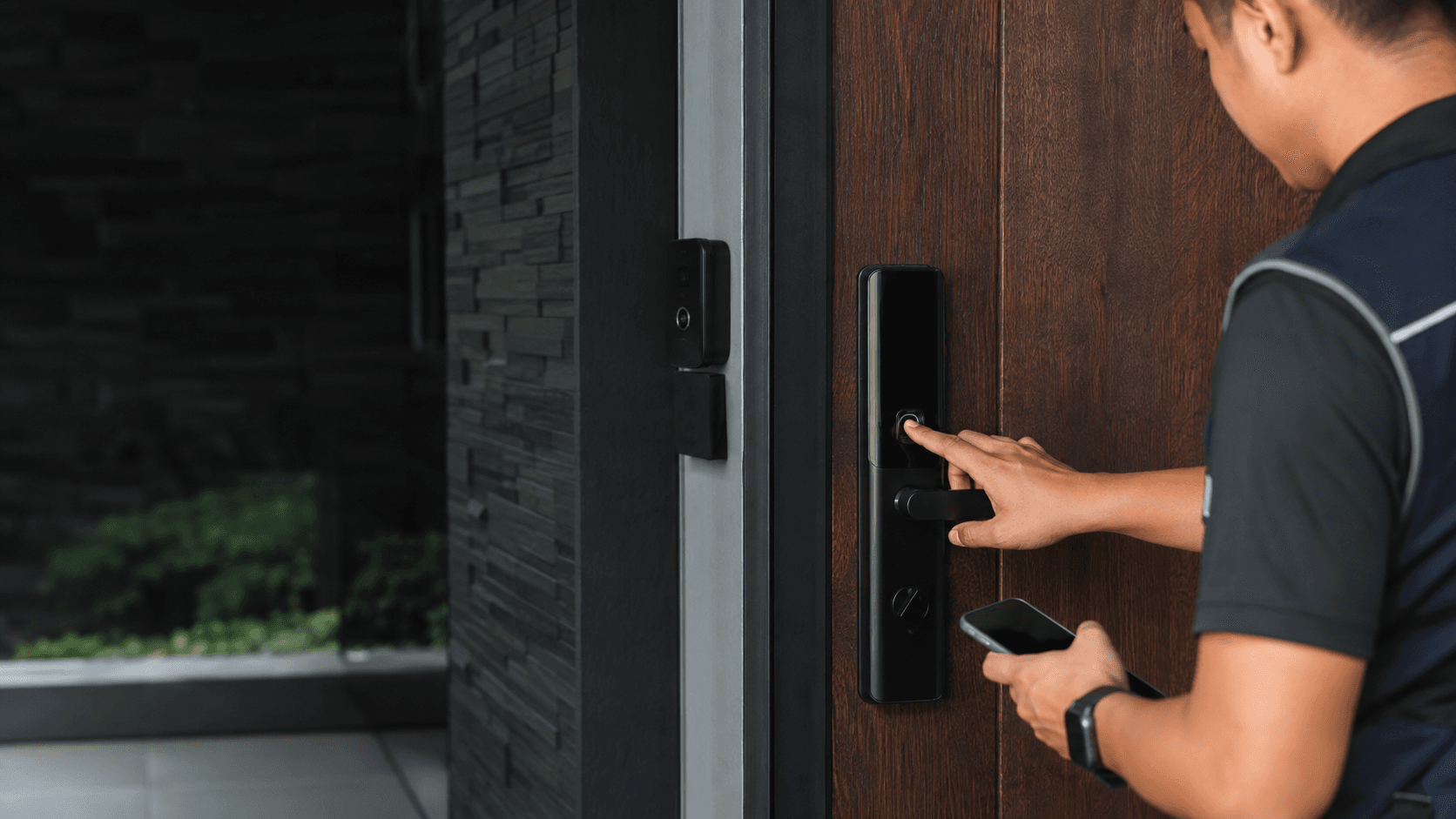
Most buyers start with the lock. The more useful starting point is the door it has to sit in, because an entrance door carries the weight of daily use, weather and the household's comings and goings. A lock that suits one door may not suit the next one, and no amount of product browsing settles that question.
This guide covers what to check before committing to Yale Main Door Locks, how user roles and backup entry shape the choice, what a site survey actually examines, and how Eyonic approaches smart lock door access in Sarawak.
Door condition decides which Yale main door locks fit
An entrance door is not a neutral surface. Its material, thickness, existing cut-outs and how it closes all constrain what can be installed. A solid timber door, a metal gate-adjacent door and a glass entrance each present different fixing points and different ways of routing a lock body.
Three conditions matter most during an assessment:
- Site survey — the door, frame, existing hardware and how the household actually uses the entrance are examined on site.
- System proposal — a recommendation follows, covering whether a standalone lock or a wider access-control arrangement suits the property.
- Installation — the lock is fitted to the surveyed door, with cabling and power considered where the setup requires them.
- Handover — access methods, user permissions and the backup entry route are explained and tested before the job closes.
Existing hardware is often the deciding factor. A door that already carries a mortise preparation, a rim lock or a deadbolt has a footprint that a replacement has to respect or deliberately replace. Removing old hardware leaves marks and sometimes leaves a weaker fixing area, so the survey looks at what is already there rather than assuming a clean door.
Door thickness and the gap between door and frame affect whether a lock body sits flush and whether the bolt or latch engages cleanly. A door that has swollen, dropped or been rehung may close with pressure in one corner, and a lock fitted to a door that does not sit square will wear faster and misalign sooner.
Weather exposure matters on an entrance door in a way it does not on an internal door. Rain, sun and humidity act on the outer face, the frame and any exposed electronics. That is a reason to look at the actual door in its actual position rather than at a specification sheet.
User roles and backup entry
Who needs to get through the door, and how often, shapes the access method more than the lock brand does. A household of two adults and a domestic helper has a different pattern from a shop entrance with staff arriving at different hours or a small office where visitors need supervised entry.
Roles to map before choosing.
- Residents who enter daily and need the fastest reliable method.
- Family members, including children or elderly parents, who may need a simpler method than an app.
- Domestic helpers or regular service providers who need access on set days.
- Occasional visitors, contractors or delivery access that should not carry permanent rights.
Backup entry is the part most often left until after installation. If the primary method is a fingerprint, a keypad code or a phone, there needs to be a second way in that does not depend on the same failure. A physical key, a mechanical override or a second credential method covers the case where a battery runs flat, a phone is lost or a reader stops responding.
Eyonic's own product guidance notes that smart locks work best when the door condition, user roles and backup method are reviewed before installation, and that for business use the choice between a standalone smart lock and an access-control panel is worth checking. That distinction matters. a single entrance with a handful of users is a different problem from a door that needs scheduled permissions, audit trails or integration with other building systems.
What a site survey covers before installation
A site survey is where the assumptions get tested. It is not a sales visit; it is the point at which the door, the household pattern and the building's constraints are checked against each other.
The survey examines the door and frame condition, including material, thickness, squareness and existing cut-outs. It looks at how the door is used through the day and whether the entrance is the only way in or one of several. It checks whether power is available near the door for a lock that needs it, and whether cabling can be routed tidily. It also considers what happens during a power interruption and how the door behaves when the lock is not powered.
For properties with more than one controlled door, the survey extends to how the entrances relate. A main door, a side gate and a back entrance may need to work as one arrangement rather than three separate locks, and that changes both the hardware and the way permissions are managed.
Eyonic's installation process follows site survey, system proposal, installation and handover. The same sequence applies to door access work, and the handover step is where access methods and backup entry are confirmed with the people who will use them daily.
How Eyonic approaches smart lock door access
Eyonic Sdn Bhd is a security system supplier based in Sarawak, working on CCTV and ELV systems for homes, offices, shops and industrial sites. Door access sits alongside that work rather than apart from it, which matters when an entrance also needs a camera covering the approach or an intercom at the gate.
The approach is to treat smart lock door access as controlled convenience rather than a standalone gadget. That means checking whether a single lock is enough or whether the door needs to sit within a wider access arrangement, and planning user permissions and backup entry at the same time as the hardware.
Completed work includes the Kuching Immigration Office project, which focused on arrival flow, staff areas, visitor movement and dependable daily operation, and the KTA Sarawak Sdn Bhd project, which supported staff movement, visitor handling, tidy cabling and clearer daily site control. Both are examples of entrances and movement being planned around how a site actually operates rather than around a product list.
Eric Yong founded Eyonic Security Systems and has worked in the industry for more than ten years, with experience in technical installation of digital security solutions for commercial businesses in Sarawak.
Where a property needs more than a lock, related work includes alarm systems, autogate installation, keyphone intercom and CCTV. Package pricing published by Eyonic starts at RM 1,599 for a Hikvision CCTV package, RM 1,599 for a Hikvision alarm system and RM 1,599 for an autogate package. Door access work is quoted separately because the door and the user requirements vary too much for a fixed figure.
Questions to settle before ordering
Several questions are worth answering before any lock is ordered, because each one can change the recommendation.
Is the entrance door the only way in, or is there a gate or side entrance that also needs control? A single door is a simpler problem than a property with several entry points, and the answer affects whether a standalone lock or a wider arrangement makes sense.
What happens when the primary access method fails? If the answer is unclear, the backup entry has not been planned. A physical key or a second credential method should be settled before installation, not after.
Who administers access, and how often do permissions change? A household that rarely changes who has access needs less administration than a workplace with staff turnover or regular visitors.
Does the door need to work with anything else? A camera covering the entrance, an intercom at the gate or an alarm system may all interact with how the door is used, and planning them together avoids rework later.
What is the condition of the door today? A door that is warped, damaged or poorly hung may need attention before a lock is fitted, and that is better known at survey stage than on installation day.
For readers in Sarawak working through these questions on a specific property, sharing the location, property type and required system with Eyonic on WhatsApp at +60 11-5111 7959 is the next practical step.