
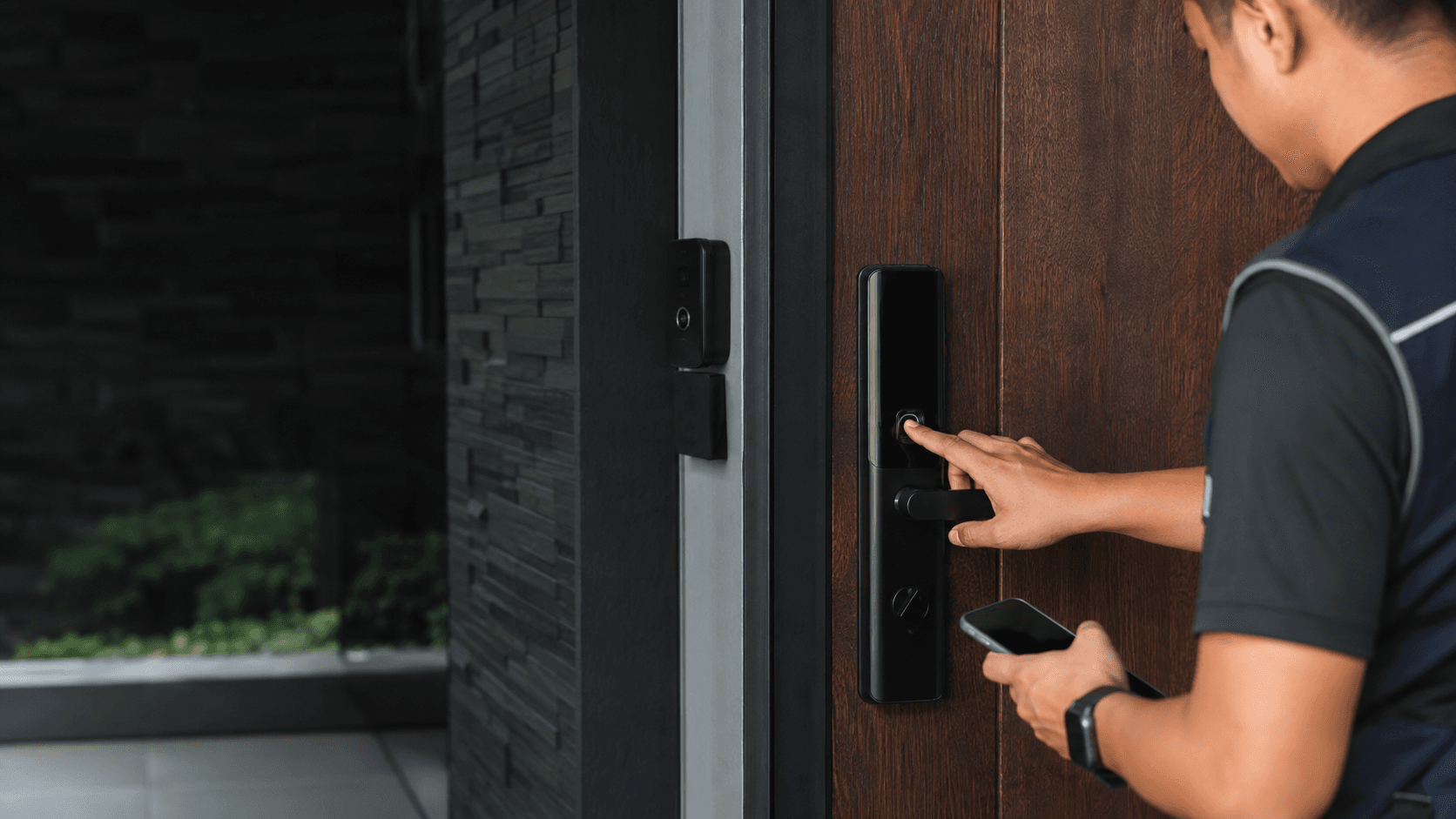
The phrase best smart lock for ring hides a practical question. Buyers in Malaysia are not really choosing a lock in isolation. They are choosing a lock that has to sit inside a Ring doorbell or Ring Alarm setup, on a specific door, with a specific set of people who need to get through it every day.
That changes the order of the decision. Compatibility comes first, because a lock that cannot talk to Ring is just a lock. Door condition comes second, because the best electronics in the world will not fix a door that has dropped on its hinges. User roles and backup entry come third, because a lock that strands a family member or a staff member outside is worse than a key.
Best Smart Lock For Ring. what compatibility actually means
Compatibility is not one thing. It is at least three separate questions, and a lock can pass one while failing another.
The first question is whether the lock is certified to work with Ring at all. Ring publishes a Works with Ring programme, and certified locks appear on that list. A lock that is not on the list may still be a good lock, but it will not appear inside the Ring app as a managed device.
The second question is what the lock is actually pairing with. A Ring doorbell and a Ring Alarm are different products with different integration paths. A lock that integrates with Ring Alarm is not automatically the same lock that integrates with a Ring doorbell. Buyers who own only a doorbell and no alarm panel are working with a narrower set of options than buyers who own the full alarm system.
The third question is the mechanism. Ring integrations have historically run through Z-Wave for alarm-panel pairing, while other locks rely on Wi-Fi or a bridge. The mechanism matters because it determines whether the lock needs a hub, whether it needs a separate app, and what happens when the home internet drops.
Because the specific certified model list and the exact mechanism for any named lock are not confirmed here, the safe move is to verify the lock against Ring's own published compatibility documentation before purchase, and to confirm the pairing path for the exact Ring product already owned.
Smart Lock For Ring options seen in current search results
Current search results for this query cluster around a small set of brands. Yale, Schlage, Kwikset, Level, August and Aqara appear repeatedly across retailer collections, manufacturer pages and independent reviews.
Two patterns are worth noting. First, retailer and manufacturer pages tend to present compatibility as a simple badge, which is why so many buyers arrive at the checkout stage without knowing whether the lock pairs with a doorbell or an alarm panel. Second, independent review pages tend to rank locks on their own merits, with Ring compatibility treated as one feature among many rather than the deciding factor.
Neither pattern answers the local question. A lock that is widely reviewed overseas may have no confirmed local supply, no local installer, and no local support path. That gap is where a site survey and a local installation partner change the outcome.
Why brand lists alone do not settle the choice
A brand name tells a buyer almost nothing about fit. Two locks from the same brand can differ in whether they replace an existing deadbolt or retrofit over it, whether they need a hub, and whether they support the number of user codes a household or office actually needs.
The practical filter is narrower: which certified locks are available locally, which of those suit the existing door, and which of those can be installed and handed over by someone who will still be reachable if something goes wrong.
Door condition, user roles and backup entry before buying
Eyonic's own product guidance on smart lock door access states that smart locks work best when the door condition, user roles and backup method are reviewed before installation, and that for business use the usual check is whether a standalone smart lock or an access-control panel is more appropriate. That is the correct order of operations, and it applies to homes as much as offices.
Door condition covers more than whether the door closes. A deadbolt needs a clean, aligned strike plate and a door that has not swollen or dropped. A retrofit lock needs enough clearance on the interior face. A lever-style lock needs the existing handle hardware to be compatible. None of these can be judged from a photograph with confidence.
User roles determine whether a standalone lock is enough. A home with four family members needs four codes and a way to revoke one. A small office with rotating staff, a cleaner and a delivery routine needs scheduled access, an audit trail, and a way to disable a code the same day someone leaves. That is the point at which an access-control panel becomes the more sensible structure, because a standalone lock manages people one code at a time.
Backup entry is the question buyers skip and later regret. Every electronic lock has at least one failure mode: a flat battery, a dropped network, a failed motor, a forgotten code. The backup method has to be decided before installation, not after. A physical key kept off-site, a second entry door, or a mechanical override are all valid answers, but one of them has to exist.
- Check the door itself. alignment, strike plate, hinge drop, and whether the existing deadbolt or handle hardware can accept the lock.
- Decide whether the lock is standalone or part of a wider access-control setup, based on how many people need access and how often that list changes.
- Confirm the backup entry method and where the physical key or override will be kept.
- Confirm power and network at the door, including what the lock does when either fails.
- Confirm who installs the lock and who hands over the codes, the app setup and the recovery process.
How installation and handover work in Sarawak
Eyonic's documented installation process runs through site survey, system proposal, installation and handover. That sequence exists because the survey is where door condition, user roles and backup entry get settled, and the handover is where the buyer learns how to add a user, remove a user and recover access.
The same discipline shows up in completed work. For the Kuching Immigration Office project, the focus was arrival flow, staff areas, visitor movement and dependable daily operation. For KTA Sarawak Sdn Bhd, the focus was staff movement, visitor handling, tidy cabling and clearer daily site control. Both are access questions before they are hardware questions, and both depend on the system still working on an ordinary Tuesday.
Handover is the part that separates a working installation from a frustrating one. A handover should leave the buyer able to add a code, delete a code, check a battery level, and get back in when the electronics fail. If that is not demonstrated on site, the lock is only half installed.
Costs, packages and what a site survey covers
Eyonic's published package pricing is RM 1,599 for the Hikvision CCTV package, RM 1,599 for the Hikvision alarm system, and RM 1,599 for the autogate package. Each package covers supply, setup and handover of that system. Smart lock pricing is not published in the same way, so a lock quote depends on the survey.
A site survey for a smart lock should establish the door type and condition, the existing hardware, whether the lock will be standalone or part of an access-control setup, the number of users and how often that number changes, the backup entry method, and the network and power available at the door. It should also confirm whether the chosen lock is certified for the Ring product already in the home or building.
Larger access projects sit in a different budget band. The Kuching Immigration Office project carried an approximate budget of RM 12,000 to RM 28,000, and the KTA Sarawak Sdn Bhd project carried an approximate budget of RM 8,000 to RM 18,000. Those figures describe multi-point access and security work, not a single residential lock, and they are useful mainly as a signal that scope drives cost far more than the lock itself.
Questions to settle before confirming a smart lock
The remaining decisions are the ones that determine whether the installation holds up after the first month.
Whether the lock is certified for the exact Ring product in the building is the first. A Works with Ring certification for one Ring product does not automatically extend to another, so the pairing path needs confirming against the specific doorbell or alarm panel in use.
Whether the lock is standalone or part of an access-control panel is the second. Standalone suits a home with a stable list of users. An access-control panel suits a site where people come and go, where an audit trail matters, and where access needs to be revoked quickly.
What happens on battery or network failure is the third. The answer should be a specific method, not an assumption that it will not happen.
Who installs and who hands over is the fourth. A lock fitted by someone who will not return is a lock with no support path, and the handover is where the buyer learns the recovery process.
Eyonic Sdn Bhd plans, supplies and installs security and ELV systems for homes, offices, shops and industrial sites in Sarawak, and its founder Eric Yong has worked in technical installation of digital security solutions for commercial businesses in Sarawak for more than 10 years. Buyers who want the door, the Ring setup and the backup entry reviewed together can share the location, property type and required system with Eyonic on WhatsApp at +60 11-5111 7959.