
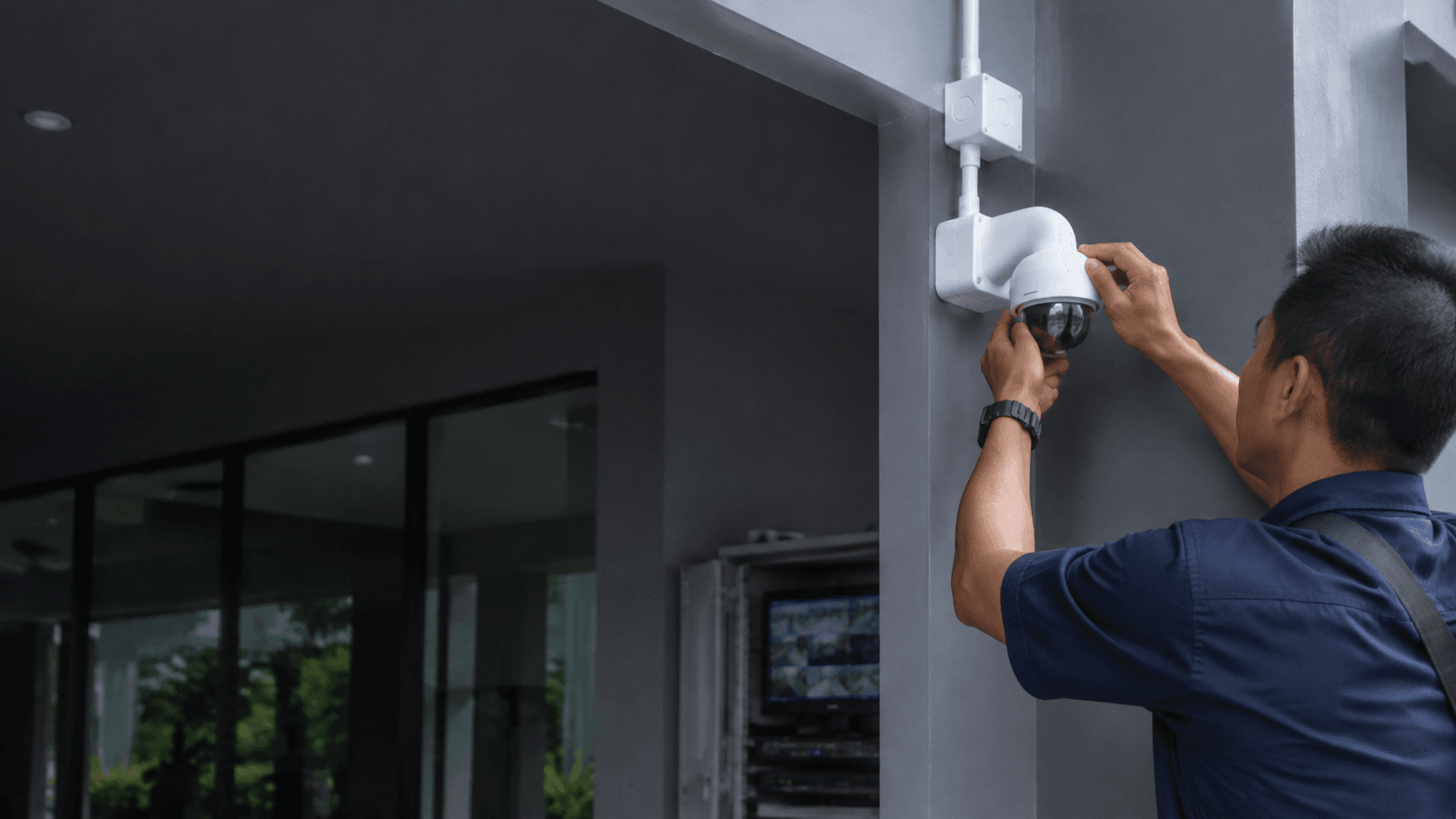
The phrase covers more than one kind of product. Some kits send video to a recorder over Wi-Fi but still run a power cable to every camera. Others run on batteries or solar and connect straight to a phone app. Both are sold as wireless, and the difference decides how much work happens on installation day.
Eyonic Sdn Bhd plans, supplies and installs monitoring systems with camera placement, recording and remote viewing for homes, offices, shops and industrial sites in Sarawak. The company's documented installation process runs through four stages.
- Site survey — the property is inspected before anything is quoted or mounted.
- System proposal — the survey findings are turned into a recommended setup.
- Installation — cameras, recording and viewing are set up on site.
- Handover — the system is explained and passed to the owner.
That sequence matters more for wireless than for wired. A wired camera has one obvious question: where does the cable run? A wireless camera raises several at once, and the survey is where they get answered.
Wireless Home Cctv Systems. What the Term Covers
Wireless describes the video path, not the whole system. A camera still needs power unless it carries its own battery, and footage still needs somewhere to live, whether that is a recorder, a memory card or a cloud plan.
Three arrangements are common in Malaysian homes:
- Wi-Fi cameras feeding a wireless recorder, each camera plugged into a nearby power point.
- Standalone Wi-Fi cameras recording to a memory card or cloud service, viewed through an app.
- Battery or solar cameras that need no fixed power point at all.
The first keeps recording local and under the owner's control. The second is the simplest to add one camera at a time. The third removes the power constraint but adds a maintenance routine, because something has to be recharged or cleaned.
None of these is automatically better. The choice follows from where cameras need to sit and what power and network reach those positions.
How Wireless Home Cctv Systems Handle Power and Signal
Two constraints decide whether a wireless layout works in a particular house: power at the camera position, and signal strength between camera and recorder or router.
Power is the constraint people forget. A camera on the front gate pillar may sit far from any power point, and running a supply there is real work even when no video cable is involved. Battery and solar models avoid that run, but they introduce a recharge or cleaning cycle that has to be kept up.
Signal is the second constraint. Wi-Fi passes through walls, floors and large furniture with varying results, and a camera at the far end of a double-storey terrace house may sit at the edge of usable coverage. A wireless recorder placed near the cameras rather than near the router often solves this, because the camera-to-recorder link is shorter.
This is why a survey comes before a proposal. The survey checks where cameras can actually go, whether power reaches those points, and whether the link back to the recorder holds. A layout that looks tidy on paper can fail on one of those three checks.
What to Check Before Choosing Wireless Home Cctv Systems
Four checks decide most of the outcome, and all four are answerable during a survey rather than guessed at beforehand.
Where cameras must point. Entry points, gate, car porch and any blind side of the house set the camera count. Adding cameras later is easier on a wireless system than a wired one, but the recorder still needs capacity for them.
What power reaches each position. A nearby power point makes a plug-in camera straightforward. No power point means either a new supply run or a battery and solar model, and that is a different maintenance commitment.
How the signal behaves at each position. Distance, wall thickness and the number of walls between camera and recorder all affect the link. This is measured on site, not assumed from a floor plan.
Where footage is stored and for how long. Local recording keeps footage in the house and under the owner's control. Cloud recording moves it off site but usually carries a subscription. The right answer depends on how long footage needs to be kept and who needs to see it.
Remote viewing is the last piece. It is set up and handed over as part of the installation, so the owner leaves with a working phone view rather than a manual.
Lighting and Placement Checks for Wireless Home Cctv Systems
Placement is not only about coverage angles. Lighting at the camera position decides how much detail the footage actually carries after dark.
Eyonic recommends checking actual lighting conditions before confirming placement for ColorVu-style cameras. A position that looks well lit in the afternoon can be almost black at night, and a camera that performs well in one spot may disappoint a few metres away.
Practical checks at each proposed position:
- Whether any light source reaches the area after dark, and what kind.
- Whether a passing car, streetlight or neighbour's lamp will trigger motion alerts.
- Whether the camera can be reached for cleaning, since a dusty lens undoes good placement.
- Whether the angle covers the approach to a door or gate rather than only the door itself.
Wireless cameras are often mounted where a cable run would have been awkward, which is an advantage, but it also means positions get chosen for convenience. The lighting check is what stops a convenient position from becoming a useless one.
Installation Flow from Survey to Handover
The documented Eyonic process is site survey, system proposal, installation and handover. For a wireless setup, each stage carries a specific decision.
The survey establishes camera positions, power availability and signal behaviour. The proposal turns those findings into a recommended system rather than a generic package. Installation mounts the cameras, configures recording and sets up remote viewing. Handover explains the system and confirms it works as intended.
Eyonic's project record includes work for the Kuching Immigration Office, covering arrival flow, staff areas, visitor movement and dependable daily operation. That project was a public office rather than a home, and the documented budget range for that type of work was RM 12,000 to RM 28,000. A separate project for KTA Sarawak Sdn Bhd covered a practical office setup in Kuching supporting staff movement, visitor handling, tidy cabling and clearer daily site control, with a documented budget range of RM 8,000 to RM 18,000.
Those figures describe commercial office work, not a typical house, and they should not be read as a home price. For homes, Eyonic's published packages start at RM 1,599 for a Hikvision CCTV package covering camera supply and setup, basic recording configuration and mobile viewing handover. The same RM 1,599 figure applies to the Hikvision alarm system package and the autogate package.
What the packages do not state is which wireless camera models, transmission standards or power options are supplied, and no wireless camera pricing is published. Those details come out of the survey and proposal rather than a listing.
Where Evidence Is Still Thin
Several questions about wireless home CCTV systems in Malaysia do not have published answers from Eyonic, and it is worth knowing which ones before comparing options.
There is no published information on which wireless transmission standards, frequencies or resolutions Eyonic installs, and none on whether battery, solar or plug-in power options are offered. There is no published wireless camera pricing, no stated storage capacity or retention period, and no description of how Wi-Fi behaves through Malaysian wall construction. Warranty terms, response times and after-sales support scope are also not published.
Those gaps are not a reason to avoid the category. They are a reason to ask specific questions during the survey, when the answers can be checked against the actual property rather than a general specification.
For a next practical step, share the location, property type and required system with Eyonic on WhatsApp at +60 11-5111 7959.