
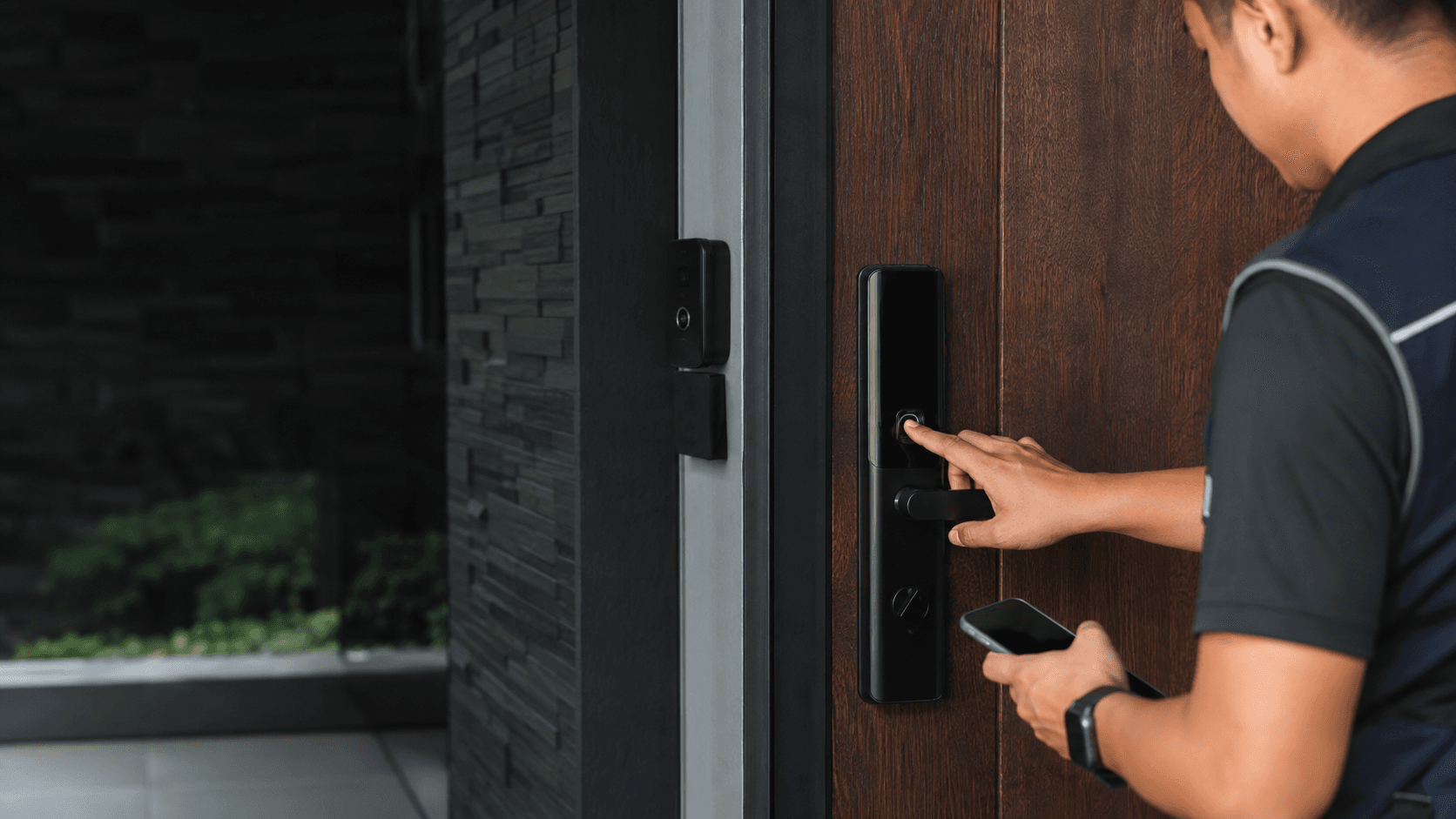
The exact-match query "kwikset smart lock touch screen" describes a small family of Kwikset deadbolts that replace a physical keypad with a capacitive glass surface. Kwikset's own product pages and third-party retailers list several distinct models under that description, and they differ mainly in wireless protocol, smart-home ecosystem support, and finish. Understanding those differences matters more than the touchscreen itself, because the touchscreen is the shared feature across the range.
- Confirm the door is a standard deadbolt preparation with adequate thickness and backset.
- Decide whether the lock should connect over Wi-Fi directly or through a hub using Z-Wave or Matter.
- Check which smart-home ecosystem the household already uses, since that narrows the model list quickly.
- Plan a backup entry method before installation, because battery-powered electronics can fail.
- Review user roles and code sharing needs if the door serves staff, tenants, or visitors rather than one household.
Kwikset Smart Lock Touch Screen. What Matters Before Choosing
The touchscreen is the visible interface, but the wireless radio underneath it decides what the lock can actually do. A Wi-Fi model such as the Halo Touchscreen Wi-Fi Enabled Smart Lock connects to a home network without extra hardware. A Z-Wave model such as the Home Connect 918 needs a compatible hub to reach the internet. A Matter-enabled model such as the Halo Select Touchscreen Wi-Fi and Matter Enabled Smart Lock can join a Matter ecosystem while still supporting direct Wi-Fi control.
That single distinction changes installation, troubleshooting, and long-term usefulness. A lock that depends on a hub stops being remotely controllable if the hub loses power or is retired. A lock with its own Wi-Fi radio depends instead on the router's range reaching the door.
Choosing the Right Kwikset Smart Lock Touch Screen
Model selection usually comes down to three questions: how the lock connects, which app or ecosystem manages it, and whether a physical key remains available as a fallback. Kwikset's Halo line is marketed around the Kwikset app, which supports remote locking and unlocking, custom user codes, schedules, activity notifications, and event history. The Home Connect 918 is positioned around Z-Wave integration with a home automation controller instead.
For a single-family home where the router is close to the front door, a Wi-Fi touchscreen model removes an entire piece of hardware from the setup. For a property already running a Z-Wave or Matter hub, a hub-based model keeps everything inside one control system. Neither approach is universally better; the deciding factor is what already exists in the building.
What is kwikset smart lock touch screen?
It is a Kwikset electronic deadbolt that uses a capacitive touchscreen instead of raised buttons for code entry. Kwikset describes its touchscreen models as keyless entry electronic deadbolts, and some listings note SecureScreen technology, which is designed to reduce the chance of fingerprints revealing frequently used digits. The touchscreen sits on the exterior escutcheon, while the interior side holds the battery compartment and the manual turn piece.
These locks are not the same as a full access-control system. A standalone smart lock manages one door with its own credential list. A commercial access-control panel manages many doors, many users, and centralized audit trails. Kwikset's touchscreen range belongs to the first category.
See Which Devices and Systems Are Compatible With Kwikset Smart Locks
Compatibility is the part of the kwikset smart lock touch screen decision that causes the most returns, because the answer depends on the specific model rather than the brand. The table below reflects what the named product pages and retailer listings state about each model.
| Model | Connection | Ecosystem notes |
|---|---|---|
| Halo Touchscreen Wi-Fi Enabled Smart Lock | Built-in Wi-Fi | Managed through the Kwikset app; no separate hub required for remote access |
| Halo Select Touchscreen Wi-Fi and Matter Enabled Smart Lock | Wi-Fi plus Matter | Can be controlled through the Kwikset app or integrated into a Matter-compatible smart home hub |
| Halo Select Plus Touchscreen Wi-Fi and Matter Enabled Smart Lock with Apple Home Keys | Wi-Fi plus Matter | Supports Apple Home Keys, allowing a tap of an iPhone or Apple Watch to unlock |
| Home Connect 918 Touch Screen Smart Lock | Z-Wave | Requires a Z-Wave compatible hub or controller for remote features |
| Premis Touch Screen Smart Door Lock | Apple HomeKit | Controlled through the HomeKit ecosystem, Siri commands, or a code |
Two practical constraints sit outside that table. First, Matter support requires a compatible Matter hub or controller on the network; without one, the lock falls back to its own app. Second, Apple Home Keys depends on Apple hardware and the Apple Home ecosystem, so it only helps households already inside that ecosystem.
Door and hardware fit
Kwikset's touchscreen deadbolts are designed for standard residential deadbolt preparations, and the product listings describe a keyed-one-side configuration, meaning the exterior is keyless while the interior retains a manual turn. Door thickness, backset, and existing bore hole dimensions still need to match the lock's requirements. On older or non-standard doors, that check should happen before purchase rather than after.
Practical Considerations for Kwikset Smart Lock Touch Screen
Battery life, network reliability, and credential management are the three operational issues that surface after installation. A Wi-Fi radio draws more power than a Z-Wave radio because it maintains a direct network connection, so Wi-Fi models generally need more frequent battery attention. A lock on a weak Wi-Fi signal may drop remote commands while still working perfectly at the keypad.
Credential management matters most where the door is shared. Kwikset's app-based models support multiple custom user codes with schedules, which suits rental units, small offices, and homes with regular visitors. The same feature becomes a liability if codes are issued casually and never revoked, because the lock's event history will show entries without identifying who used them.
Backup entry deserves a decision rather than an assumption. Kwikset's touchscreen models retain a physical key override on at least one side, and the interior turn piece allows exit without a code. Where a key override exists, keeping a key stored off-site is more useful than hiding one near the door.
Where a standalone smart lock stops being the right answer
A single touchscreen deadbolt handles one door well. It does not coordinate multiple entrances, produce a consolidated audit trail across a site, or integrate with staff scheduling systems. Buildings with several controlled doors, shared visitor traffic, or a need to prove who entered and when usually need an access-control approach rather than a series of independent locks. Eyonic, a security system supplier in Sarawak, notes that smart locks work best when door condition, user roles, and backup method are reviewed before installation, and that business use often requires checking whether a standalone smart lock or an access-control panel is the better fit.
Making an Informed Choice About
The decision narrows quickly once the building's existing technology is mapped. A household with strong Wi-Fi at the door and no hub gets the simplest setup from a Wi-Fi touchscreen model. A household already running Matter or Z-Wave gets better integration from a hub-based model. A household inside Apple's ecosystem gets the most convenience from a Home Keys capable model.
Installation itself is within reach of a competent DIY fit on a standard door, but the configuration steps — pairing the lock to the network, creating user codes, setting schedules, and confirming notifications arrive — take longer than the physical fitting. On doors that are part of a wider security setup, coordinating the lock with cameras, alarms, and intercoms avoids a second visit later.
For properties in Sarawak, Eyonic supplies and installs security and ELV systems including smart lock door access, alongside CCTV, alarm, autogate, and intercom work. The company's published packages for CCTV, alarm, and autogate are each listed at RM 1,599, and completed projects include the Kuching Immigration Office and KTA Sarawak Sdn Bhd. Share the location, property type, and required system with Eyonic on WhatsApp at +60 11-5111 7959 for the next practical step.