
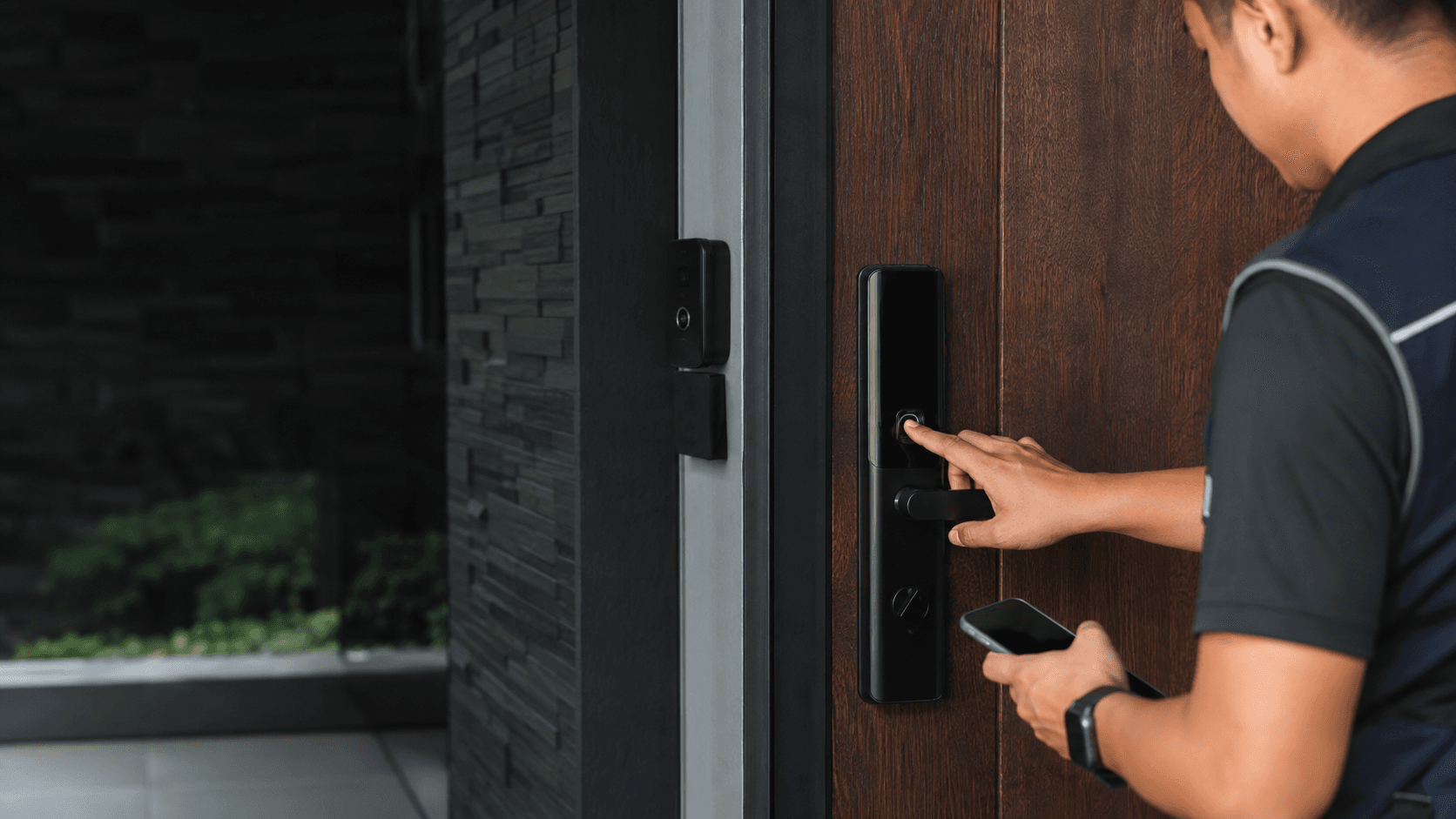
The name turns up in a handful of places: a Turbolock product page, a Best Buy listing and question thread, an eBay product record, and a Turbolock FAQ covering installation, batteries, and app behaviour. Those pages describe a keyless entry lock operated by keypad rather than a key, and they raise the same practical questions a Malaysian buyer tends to ask about any digital door lock.
What follows sticks to what those sources actually show and separates it from what they do not. No verified specification sheet for this model was available while writing, so dimensions, materials, battery type, code capacity, and local pricing are left out rather than guessed.
Turbolock Yl 99 at a glance
The clearest way to describe this lock is by category rather than by numbers. It sits in the keypad door lock group: a battery-powered unit that replaces a standard knob or deadbolt and accepts a numeric code instead of a cut key.
Turbolock's own FAQ groups the YL-99 alongside other models in its range, including the TL-99, TL-100, TL-200, TL-400, and TL-500, and answers questions about installation, batteries, keypad faults, MiFi cards, and app pairing across that family. That grouping matters because much of the support content is written for the range rather than for one model, so a specific answer for the YL-99 alone is not always available.
Third-party listings add a few structural details. The eBay record for the YL-99-SS describes a keyless smart lock with a keypad, Bluetooth and Alexa compatibility, and a metal casing, and the Best Buy question thread asks about unlocking from inside, battery cycles, leaving the door unlocked from outside, erasing codes, and opening the door when the battery runs out. Those are the questions the model actually attracts, which is a useful signal about what buyers care about.
What is not established. no verified dimensions, finish options, door thickness range, backset, or warranty terms for this model were available. Anyone quoting those figures for a Malaysian installation is working from something other than a primary source.
How a keypad door lock handles daily entry
Daily use of a keypad door lock follows a short, repeatable pattern. The lock stays latched, the user enters a code on the keypad, the latch retracts, and the door opens. On the way out, the lock either re-latches on its own or is locked manually, depending on how the unit is configured.
The Best Buy question thread shows this is where most confusion sits. Buyers asked whether the lock can be unlocked from inside, how it locks from inside, whether there is a way to leave it unlocked from outside during the day, and whether a key is included at all. Those questions point to a real design characteristic: on this type of lock, the inside and outside handles behave differently, and the locking action is not always obvious from the outside face.
Automatic locking is the other daily behaviour worth understanding. A lock that re-latches after a set delay removes the habit of checking the door, but it also means a door left ajar can re-latch against the frame rather than the strike. Turbolock's FAQ includes entries for a latch that feels loose, a latch bolt that will not extend, and a door that keeps jamming, which are the symptoms that appear when alignment drifts.
For a household with children or regular short trips in and out, the question of holding the door unlocked during the day is a genuine design decision rather than a preference. Some locks support it, some do not, and the answer for this model is not confirmed in the available sources.
What to check before fitting a Turbolock Yl 99
Fitting a keypad lock is a door problem before it is a lock problem. The checks below are the ones that decide whether the installation is straightforward or becomes a running repair.
- Inspect the door and frame for alignment, swelling, and existing bore holes, since a misaligned door will fight any latch.
- Confirm the existing lock type and whether the door is timber, metal, or glass, because the mounting method differs by material.
- Decide who needs entry and at what level, separating permanent household or staff users from occasional visitors.
- Agree the backup entry method before installation, so a flat battery or forgotten code does not lock anyone out.
- Plan the battery routine, including who checks the lock and how a low-battery warning is handled.
- Confirm the model's actual requirements against the manufacturer's current manual rather than a reseller listing.
The order matters. Door condition comes first because it constrains everything after it, and user roles come before code programming because the number of people needing access shapes how codes should be issued and retired.
Eyonic's own product review notes that smart locks work best when the door condition, user roles, and backup method are reviewed before installation, and that for business use the choice between a standalone smart lock and an access-control panel is worth checking. That is the same sequence, applied to a commercial door.
Battery, code and backup entry questions
Three questions dominate the support threads for this lock, and each has a practical answer even where the model-specific figure is missing.
Battery. Turbolock's FAQ addresses battery type, expected life, replacement, and a backup battery port for when the batteries die. The FAQ covers the range rather than the YL-99 alone, so the exact cell type and runtime for this model should be confirmed against its own manual. The important operational point is that a backup port exists on the range, which means a flat battery does not have to mean a locksmith.
Codes. The Best Buy thread asks how to erase codes and whether the door can be used without one. Passcode programming is a standard function on this class of lock, and the practical discipline is to issue a separate code per person and delete it when that person no longer needs access. Shared codes cannot be retired without changing everyone's entry.
Backup entry. This is the question that decides whether the lock is suitable for a given door. If the only way in is the keypad, a fault or a flat battery becomes an access problem. A mechanical key, an external power point, or a second entrance all serve as backup, and the choice should be settled before the lock is fitted rather than after.
App and Bluetooth behaviour also appears in the sources, with the eBay listing noting Bluetooth and Alexa compatibility and the Turbolock FAQ covering app pairing, key sharing, and remote access limits. Whether the YL-99 specifically supports app control is not confirmed in the available material.
Where a smart lock fits in a Sarawak property
For a Sarawak home, the case for a keypad lock is usually convenience and controlled access rather than a dramatic security upgrade. A lock that removes the key also removes the spare key under the pot and the key that gets copied without anyone noticing.
For a shop, office, or site office, the calculation changes. A single door with a handful of staff suits a standalone smart lock. A building with multiple doors, shift patterns, and a need to review who entered and when usually points toward an access-control panel instead, because a standalone lock records little and manages users one code at a time.
Eyonic's project work in Sarawak shows the kind of brief that comes up. The Kuching Immigration Office project focused on arrival flow, staff areas, visitor movement, and dependable daily operation, and the KTA Sarawak Sdn Bhd project covered staff movement, visitor handling, tidy cabling, and clearer daily site control. Both are about movement through a building rather than about a single lock, which is the point at which door hardware becomes part of a wider access plan.
Humidity and salt air along the coast are worth raising with any supplier, since door hardware and electronics both age faster in that environment. The available sources do not state an environmental rating for this model, so that question belongs with the manufacturer or distributor.
Getting the door and user roles reviewed first
The most useful step before buying a Turbolock Yl 99 is a look at the actual door. Bore hole size, door thickness, frame alignment, and the existing lock type all determine whether a replacement is a direct swap or a modification, and none of those can be judged from a product photo.
The second step is a short list of who needs entry and how often. That list decides whether a standalone keypad lock is enough or whether the door needs to be part of a managed access system with recorded entries and revocable credentials.
Eyonic's installation process runs through site survey, system proposal, installation, and handover, which is the same sequence that suits a door lock decision: look at the door, agree what the lock needs to do, fit it, then hand over the codes and the battery routine to the people who will use it.
For a Sarawak property, sharing the location, property type, and the system required with Eyonic on WhatsApp at +60 11-5111 7959 is a practical way to get the door and user roles reviewed before a model is chosen.