
That sequence is the working spine of every job, whether the site is a shop in Kuching, an office, a home or an industrial lot. The sections below explain what each stage decides, where the common mistakes sit, and which conditions in Sarawak change the answer.
Hikvision CCTV Systems in Sarawak: What the Setup Covers
A finished Hikvision CCTV system is four connected parts: cameras, a recorder, storage, and a way to view footage remotely. Each part constrains the others, which is why buying cameras first and planning later usually produces a system that records the wrong angles.
Cameras capture the image. The recorder — an NVR for network cameras — receives the streams, writes them to storage, and serves them to viewing devices. Remote viewing is the app or client that reaches the recorder over the internet. If any one of these is undersized or badly placed, the whole system underperforms regardless of camera quality.
Eyonic supplies and installs monitoring systems with camera placement, recording and remote viewing for homes, offices, shops and industrial sites. The company also handles alarm systems, autogate packages and intercom work, which matters when a CCTV plan has to share cabling routes or a control point with other building systems.
For a public-sector example, Eyonic completed work for the Kuching Immigration Office focused on arrival flow, staff areas, visitor movement and dependable daily operation. That brief shows the pattern. coverage follows how people actually move through a building, not a generic camera count.
What a Hikvision CCTV system does not include by default
Storage is the most common gap. A recorder without a drive records nothing, and the drive size determines how far back footage reaches. Cabling, mounting hardware, power provision and network access are separate line items on most jobs. Anyone comparing quotations should check whether storage and cabling are inside the price or added later.
How Eyonic Plans Hikvision CCTV Systems Before Installation
Planning starts with the site, not the catalogue. Eyonic's CCTV installation process runs through four stages in order, and each one produces something the next stage depends on.
- Site survey — walk the property, note entry points, blind spots, lighting, existing cabling and where power and network can reach.
- System proposal — set out camera positions, recorder location, storage, viewing method and the scope of work.
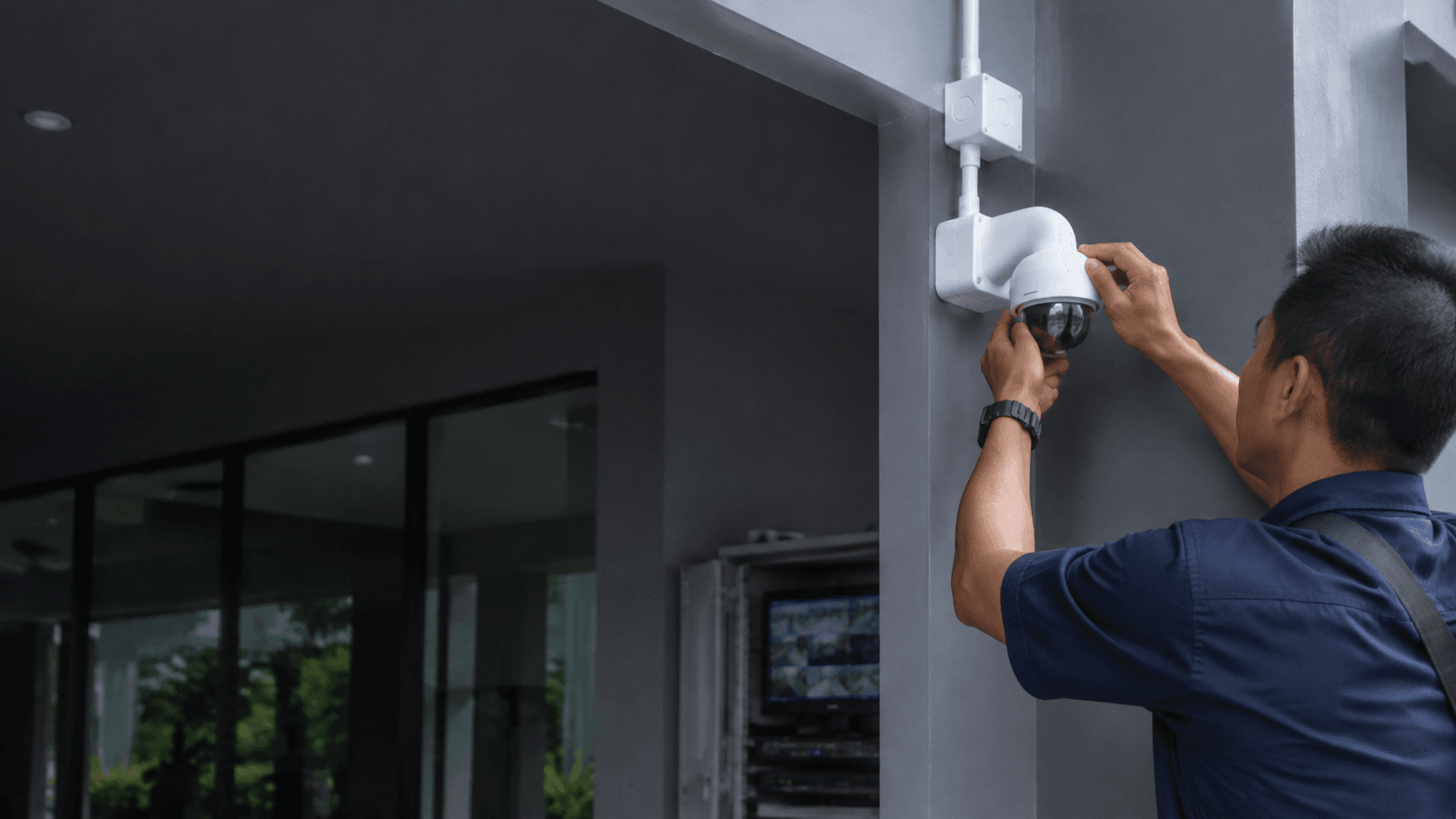
- Installation — mount cameras, run and terminate cabling, configure the recorder and bring the system online.
- Handover — test the system with the people who will use it, set up mobile viewing, and explain daily operation.
The order matters because a proposal written before a survey is guesswork. Camera positions chosen on a floor plan alone often miss the angle that actually catches a doorway, a counter or a gate.
Eric Yong founded Eyonic Security Systems and has worked in the industry for more than ten years, with experience in technical installation of digital security solutions for commercial businesses in Sarawak. That background shapes the survey stage: the questions asked on site tend to come from jobs where a placement decision later caused a problem.
What the proposal should state
A usable proposal names where each camera goes and what it is meant to see. It states where the recorder sits, how much recording time the storage supports, and how footage will be viewed. It also flags anything the site cannot support — a position with no cable route, or a view that a wall, tree or signboard will block.
Eyonic's Hikvision CCTV Package is listed at RM 1,599 and covers camera supply and setup, basic recording configuration, and mobile viewing handover. That scope describes a defined starting point rather than a full commercial build, and larger sites with more cameras, longer cable runs or wider storage needs sit outside it.
Site Survey and Camera Placement Decisions
Camera placement decides what the system is worth. A camera that covers a gate but not the approach to it records an event without the context that makes the footage useful.
Entry and exit points come first, because they carry the highest information value per camera. After that, the survey looks at cash counters, stockrooms, server racks, staff entrances and any area where a dispute or incident would need evidence. Perimeter coverage follows, and it usually needs more cameras than interior coverage because the distances are longer.
Height and angle are trade-offs rather than fixed rules. A camera mounted high is harder to tamper with but captures faces at a flatter angle and can be defeated by a cap brim. A camera mounted lower captures better facial detail but sits within reach. The right compromise depends on whether the site's main risk is intrusion, internal loss, or dispute resolution.
Cabling routes are decided during the survey, not after. Retrofitting a cable run through a finished ceiling or a tiled wall costs more than planning the route before installation begins. Where a route cannot be concealed, the survey should say so, because visible cabling affects both appearance and tamper risk.
Coverage questions worth settling on site
Which doors are used after hours? Where does a delivery vehicle stop? Which counter handles cash? Is there a route between a public area and a restricted one that nobody watches? Each answer points to a camera position, and each position needs a cable route and a recorder channel.
For an engineering consultancy office in Kuching, Eyonic's work for KTA Sarawak Sdn Bhd covered staff movement, visitor handling, tidy cabling and clearer daily site control. Tidy cabling appears in that brief because it is part of the deliverable, not an afterthought.
Recording NVR Setup and Remote Viewing
Recording is where a system either holds up or quietly fails. The recorder needs enough channels for the cameras, enough storage for the retention period the site needs, and a network path that lets authorised people view footage without exposing the system.
Retention is a straightforward calculation once the camera count and recording mode are known. Continuous recording consumes far more storage than motion-triggered recording, and higher-resolution streams consume more than lower ones. A site that needs thirty days of history needs a different storage plan from one that needs seven.
NVR setup covers more than plugging cameras in. It includes assigning addresses, configuring recording schedules, setting retention behaviour so old footage is overwritten predictably, and creating user accounts with appropriate access. A recorder left on default settings often records more than necessary and fills storage faster than expected.
Remote viewing is the feature most users judge the system by, and it is also the most common source of support calls. Mobile viewing handover is part of Eyonic's Hikvision CCTV Package, which means the app is set up and demonstrated rather than left to the buyer. The practical checks are simple. does the app connect outside the property's own network, do the right people have access, and can footage be found and exported when someone asks for it.
Edge cases that change the recording plan
Sites with intermittent internet still record locally; only remote viewing is affected. Sites sharing a network with heavy business traffic may need the recorder separated so video does not compete with point-of-sale or office systems. Multi-tenant buildings often need the recorder placed where the responsible party can reach it without entering another tenant's space.
Lighting Conditions and ColorVu Placement Checks
Lighting decides which camera suits a position, and it has to be checked on site rather than assumed. Eyonic recommends checking actual lighting conditions before confirming placement for ColorVu-style cameras, because the technology's advantage depends on how much ambient light a position really receives at night.
ColorVu cameras are designed to produce colour images in low light rather than switching to infrared black and white. That matters when colour carries information — the colour of a vehicle, a jacket, or a bag. The trade-off is that a position with almost no ambient light behaves differently from one with street lighting, corridor lighting or a nearby security lamp.
A night-time check is the only reliable test. A position that looks bright during a daytime survey can be near-dark at 2am, and a position that looks dark may sit under a lamp that is switched off after business hours. Both cases change whether a colour-capable camera delivers what the site expects.
Other lighting factors worth noting during the survey include direct glare from a lamp or the sun, strong backlight behind a doorway, and reflective surfaces such as glass or polished floors. Each can wash out an image at the exact moment footage is needed.
Where standard low light cameras still make sense
Positions with no meaningful ambient light, or where colour adds nothing to the evidence, do not need a colour-focused camera. The same applies where a position is already covered by another camera and only needs a secondary angle. Matching the camera to the position keeps the budget on the views that matter.
Installation Handover and Ongoing Support
Installation is the stage where planning becomes physical, and it is also where shortcuts show up later. Mounting, cable routing, termination and weatherproofing all determine whether a system still works reliably after a year of Sarawak heat and rain.
Outdoor positions need attention to seals, cable entry points and drainage. Indoor positions need attention to dust, heat and access for cleaning. A camera that cannot be reached safely for a lens wipe will gradually lose image quality.
Handover is the stage most often rushed, and it is the one that decides whether the system gets used. A proper handover covers live viewing, playback, exporting a clip, adding or removing a user, and what to do when something looks wrong. It also records who to contact and what information to have ready.
Ongoing support covers the questions that appear after the first week: a camera that dropped offline, a password that needs resetting, a storage warning, or a request for footage from a specific date. Systems that were documented at handover are faster to support because the recorder location, channel map and access details are already known.
Eyonic's project list includes work for the Kuching Immigration Office and KTA Sarawak Sdn Bhd, with approximate budgets of RM 12,000 to RM 28,000 and RM 8,000 to RM 18,000 respectively for that type of work. Those figures describe larger commercial scopes rather than a standard residential installation, and they show how far a project can sit above a basic package once camera count, cabling and site complexity grow.
Choosing between a package and a planned system
A package suits a defined property with straightforward coverage: a home, a small shop, or an office with a handful of key positions. A planned system suits sites with multiple buildings, long perimeter runs, shared infrastructure, or a need to document coverage for someone else. The deciding factor is usually how many unknowns the survey turns up.
For sites in Kuching and across Sarawak, the practical next step is to share the location, property type and required system with Eyonic on WhatsApp at +60 11-5111 7959 so the survey and proposal stages can be scoped against the actual building.