
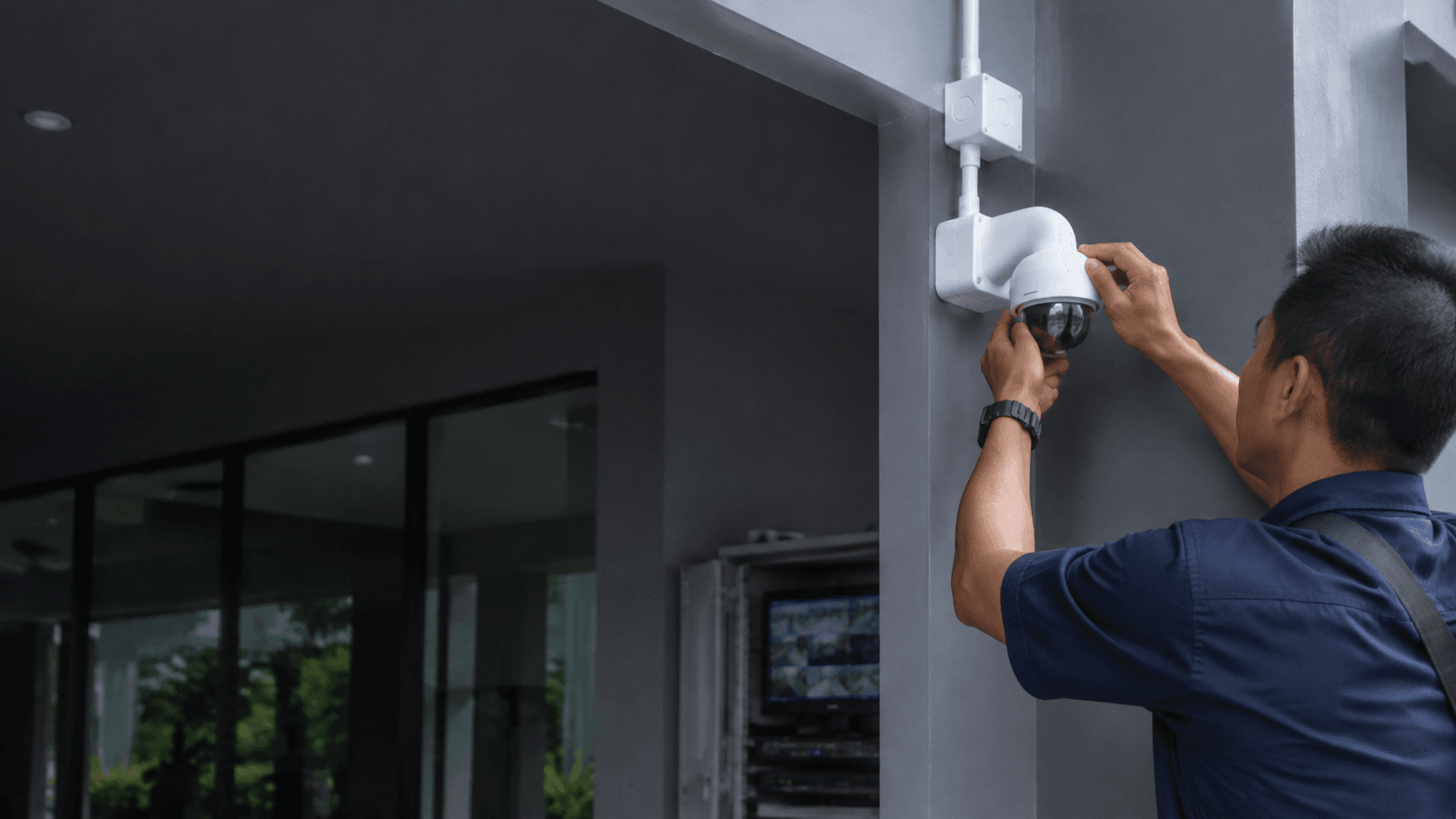
The exact phrase describes a closed system: cameras connect by cable to a recorder that stores footage locally, rather than relying on Wi-Fi to move video. That single design choice shapes everything else — where cameras can go, how stable the picture stays, and what the installation actually involves.
Eyonic Sdn Bhd is a security system supplier in Sarawak that handles planning, supply and installation, with founder Eric Yong working in the industry for more than 10 years. The company's project list includes the Kuching Immigration Office and KTA Sarawak Sdn Bhd.
Wired CCTV. What a Hardwired Camera System Actually Is
A hardwired camera system sends video and power through cabling to a recorder, which writes footage to local storage. The recorder is the centre of the system. Cameras feed it, storage holds the recordings, and remote viewing pulls the picture back out over a network connection.
That structure separates wired CCTV from battery or Wi-Fi cameras in one practical way: the camera does not depend on a wireless signal to deliver video. A cable either carries the signal or it does not. There is no drop-out when a router restarts, no interference from a thick wall, and no battery to swap.
The trade-off is physical. Cable has to be run, concealed where possible, and terminated at both ends. That work happens once, and it is the part of the job that decides whether the finished system looks tidy or looks like an afterthought.
Eyonic's CCTV service covers camera placement, recording and remote viewing for homes, offices, shops and industrial sites. Those four elements — placement, recording, viewing, and the cabling that connects them — are the whole system in outline.
When a Wired CCTV Setup Makes More Sense Than Wireless
Wired suits a property where cameras stay in fixed positions and the building can accept cable. Wireless suits a site where running cable is impractical, or where a camera needs to move.
Several situations push the decision toward cable:
- The property has multiple cameras covering entrances, walkways and perimeter points that will not move.
- Footage needs to be stored on site rather than in a cloud account.
- The building is under construction or renovation, so cable routes are still open.
- The site has a stable power layout and a sensible place to house a recorder.
- Coverage must hold up in a building where Wi-Fi signal is already unreliable.
The reverse cases matter just as much. A rented unit where drilling is restricted, a single camera watching a gate from far across a road, or a temporary site that will be dismantled in months — these are poor fits for a hardwired camera system, and a supplier should say so rather than sell cable that cannot be run cleanly.
For a public office, the priority is usually continuity. The Kuching Immigration Office project focused on arrival flow, staff areas, visitor movement and dependable daily operation — the kind of requirement where a fixed, cabled layout earns its place because the coverage points do not change from day to day.
What Gets Decided Before Any Cable Is Run
Placement decisions made on paper often fail on site. Eyonic's guidance on ColorVu-style cameras is to check actual lighting conditions before confirming placement, because a position that looks correct on a floor plan can sit in shadow, face a light source, or cover the wrong angle once the building is seen in person.
Three decisions come before installation work begins:
- Lighting check. Confirm how each position behaves at night and in low light, since that determines whether the camera sees usable detail or a bright smear.
- Camera placement. Fix the coverage points — entrances, walkways, counters, storage, vehicle access — and confirm each one has a viable cable route and mounting surface.
- Recording and remote viewing. Decide where the recorder lives, how footage is stored, and who needs to view the system from a phone or office screen.
These are the questions that change the quote. A camera position with no accessible cable path costs more to serve than one beside an existing route. A recorder that needs a dedicated cabinet, ventilation or a network point adds work. Deciding this before installation keeps the number stable instead of moving mid-job.
Wired CCTV Installation, Step by Step
Eyonic's installation process runs through four stages, from first visit to handover.
- Site survey. The property is assessed in person — building layout, camera positions, cable routes, recorder location and power.
- System proposal. The survey findings become a defined scope covering cameras, placement, recording and viewing.
- Installation. Cabling is run, cameras are mounted, the recorder is set up, and the system is configured.
- Handover. The finished system is explained, including how to view footage and use remote access.
The survey stage carries the most weight. It is where a proposal either matches the building or does not. A supplier who quotes without seeing the site is guessing at cable routes, and cable routes are where budgets move.
Handover matters for a different reason. A system nobody knows how to use gets abandoned. Walking through live view, playback and mobile access at the end of the job is what turns an installation into something the property actually relies on.
Costs, Packages and What Changes the Number
Eyonic's Hikvision CCTV Package is priced at RM 1,599 and covers camera supply and setup, basic recording configuration, and mobile viewing handover. That figure describes a defined package scope, not a universal price for every property.
Larger projects sit well above it. The Kuching Immigration Office project carried an approximate budget of RM 12,000 to RM 28,000, and the KTA Sarawak Sdn Bhd office project an approximate budget of RM 8,000 to RM 18,000. Both were office environments with multiple coverage points and tidy cabling requirements.
The gap between RM 1,599 and those ranges is not markup. It reflects scope. how many cameras, how far cable must travel, how difficult the routes are, whether the recorder needs its own housing, and how much of the work involves making the finished installation look deliberate rather than improvised.
Two constraints shape the number more than anything else. First, cable distance and route difficulty — a camera 5 metres from the recorder through an open ceiling is a different job from one 40 metres away through finished walls. Second, the state of the building. New construction and renovation leave routes open; a finished office with tiled walls and no ceiling void does not.
What does not change the number is the software side. Recording configuration and mobile viewing handover are part of the package scope, not separate line items.
Wired CCTV Questions Property Owners Ask Before Booking
Does a wired system need internet? The cameras and recorder work without it. Internet is needed for remote viewing from outside the property, not for local recording.
Can footage be viewed from a phone? Yes, where remote viewing is configured. Eyonic's CCTV service includes remote viewing as part of the scope, and mobile viewing handover is part of the RM 1,599 package.
How long does installation take? It depends on camera count and cable routes. The site survey is what produces a realistic timeline, which is why the survey comes before the proposal rather than after.
Can cameras be added later? Often, if the recorder has spare capacity and cable routes remain accessible. This is worth raising during the survey, because planning for future points is cheaper than retrofitting them.
What if the building cannot take cable? Then a hardwired layout is the wrong answer for that property, and the honest response is to say so. A supplier who surveys the site will identify this before any work is quoted.
Who installs it? Eyonic handles planning, supply and installation for properties in Sarawak, including homes, offices, shops and industrial sites.
For a property in Sarawak, the practical next step is a site survey. Share the location, property type and required system with Eyonic on WhatsApp at +60 11-5111 7959, and the survey findings become the basis for a defined scope rather than an estimate.