
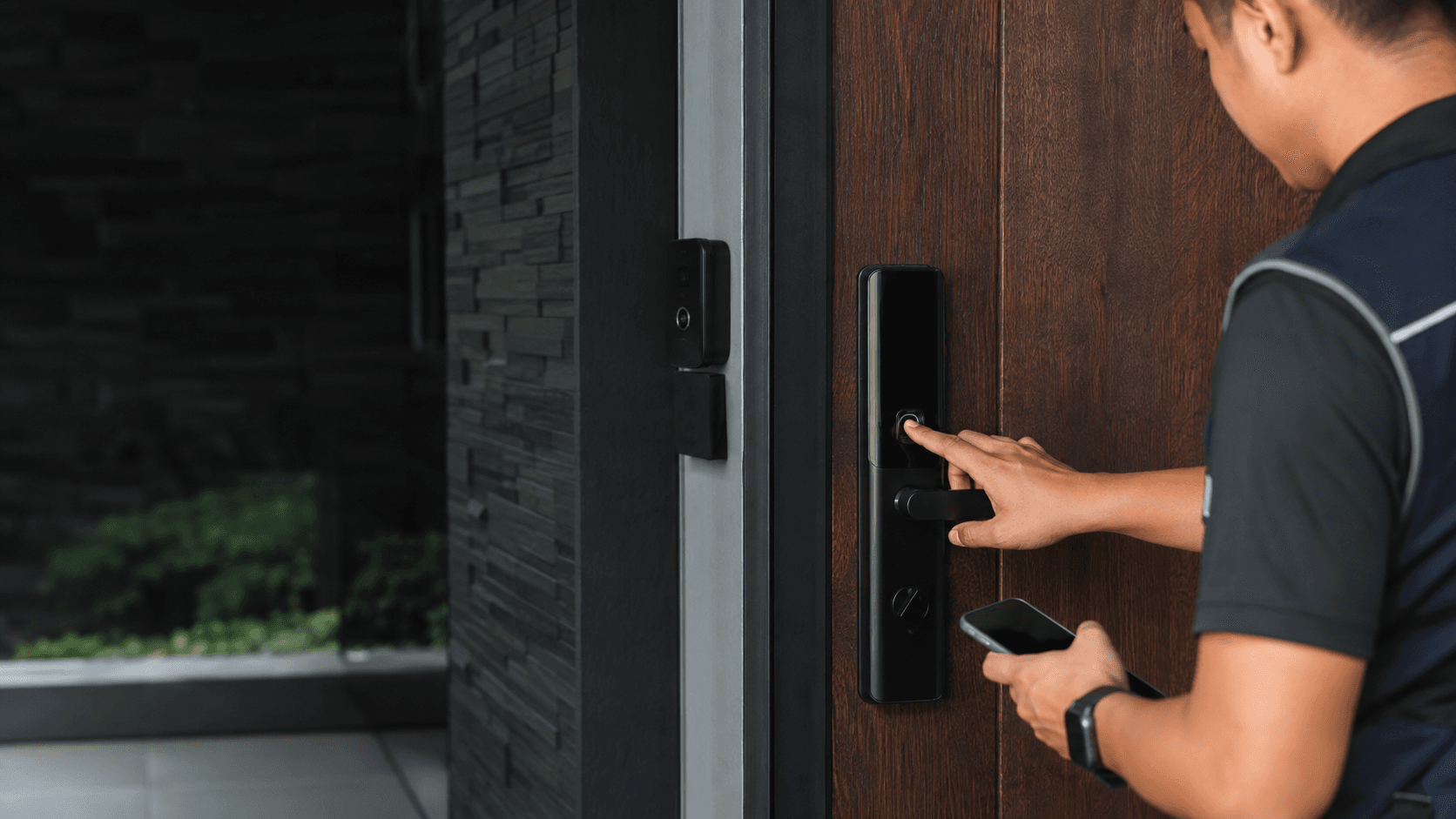
Yale positions the keypad as an add-on rather than a standalone lock, so the buying decision turns on door condition, who needs daily access, and what happens when the phone is flat or the app is unreachable. In Malaysia, that usually means a rented apartment, a family home, or a small office where staff and visitors arrive at different hours.
- Survey the door and the people who use it, noting handle type, frame condition, and whether the door is shared or private.
- Propose the access method, deciding between a standalone smart lock and a keypad-plus-lock combination.
- Install and pair the hardware, then confirm the lock, keypad, and app all respond as expected.
- Hand over codes, permissions, and a backup entry method, and test each one before the installer leaves.
Eyonic runs access work in that order, with site survey, system proposal, installation, and handover as the four stages. The same sequence applies whether the job is a single door or a larger office fit-out.
What the Yale Linus Keypad adds to a Linus smart lock
The keypad gives a door a second way in that does not depend on a phone. Yale describes the accessory as pairing with a Yale Linus Smart Lock to enable key code entry and simpler one-touch locking on the way out. That matters in daily use. a household member without the app, a cleaner, or a short-stay guest can be given a code instead of a key or a phone login.
One-touch locking is the quieter benefit. Leaving the house usually means pulling the door shut and hoping the lock engaged. A keypad on the outside wall lets the last person out press once and walk away, which reduces the number of times a door is left unlocked by accident.
The keypad does not replace the lock. It extends it. A door still needs a compatible Yale Linus smart lock as the core device, and the keypad is the surface that people actually touch.
Yale Linus Keypad compatibility and door checks
Compatibility is the first thing to confirm, and it is also the hardest to confirm from a listing page alone. Yale's own product pages describe the keypad as an accessory to a Yale Smart Lock and, on one regional page, specifically as pairing with the Yale Linus Smart Lock. That is a strong signal, but it is not a full model-by-model compatibility list, and no verified list of supported Linus lock models is available here.
Because of that gap, the practical approach is to check the exact lock model already fitted, or the model being purchased, against Yale's current documentation before ordering. A keypad bought for the wrong lock generation is an expensive mistake that only shows up at pairing.
Door condition matters just as much. Smart locks work best when the door condition, user roles, and backup method are reviewed before installation, and for business use the choice between a standalone smart lock and an access-control panel should be settled first. A door that sticks, a frame that has moved, or a handle that does not return cleanly will cause more trouble than any app setting.
Three checks are worth doing before committing:
- Whether the existing deadbolt or lock body is the model the keypad is designed to work with.
- Whether the door closes and latches under its own weight without being pushed or lifted.
- Whether there is a sensible mounting surface beside the door for the keypad, clear of rain and direct sun.
For a business door, the same review should also ask whether a keypad is the right layer at all. Where many people need different levels of access, or where entry records matter, an access-control panel is often the better fit, and a smart lock is the simpler choice for a small number of trusted users.
Access codes, permissions, and backup entry
Codes are the reason most people buy the keypad. Yale's regional product pages describe creating custom entry codes to unlock a Yale Smart Lock without a traditional key or smartphone, and one retailer listing describes creating up to 256 unique codes from a smartphone. That figure comes from a reseller rather than Yale, so it should be treated as indicative rather than confirmed.
What matters more than the maximum count is how codes are assigned and retired. A code given to a contractor for two weeks should be removable without disturbing anyone else's access. A code shared with a family member should survive a phone change. A code for a short-stay guest should expire on its own.
Permissions follow the same logic. The useful questions are who can add and remove codes, whether those changes are visible in an activity history, and whether the person managing access is the same person who holds the physical key.
Backup entry is the part most often skipped. A keypad runs on its own power source, and a smart lock does too, so a flat battery on either device can lock out everyone who relies on codes. A conventional key, kept somewhere other than under the mat, is still the simplest fallback. Where the door is the only way into a business premises, a second independent entry method is not optional.
Installation and handover steps
Installation is short when the door is ready and the lock is already paired. The work that takes time is the preparation: confirming the lock model, checking the door swings and latches cleanly, and deciding where the keypad sits so it is reachable but not exposed.
Pairing is done through the Yale Home app, which Yale lists alongside iOS and Android as the control layer for the keypad. The app is also where codes and permissions are managed, so the handover should include a walkthrough of that screen rather than just a working door.
Handover is where most installations are won or lost. Every code should be tested at the door, not assumed to work. Every user should unlock once with their own credential. The backup key should be tried. The activity history should be checked to confirm entries are being recorded.
Eyonic applies the same handover discipline across its security work. On the Kuching Immigration Office project, the focus was arrival flow, staff areas, visitor movement, and dependable daily operation, which is the same set of concerns a keypad installation raises on a smaller scale. On the KTA Sarawak Sdn Bhd project, the requirement was a practical office setup supporting staff movement, visitor handling, and clearer daily site control.
For a residential door, handover is usually a fifteen-minute conversation. For an office, it is worth writing down who holds which code and when it expires.
Yale Linus Keypad questions before buying
Most of the uncertainty around this accessory comes down to four things: whether it fits the lock already owned, whether it fits the door, what it costs locally, and what happens when something fails.
On fit, the answer depends on the lock model, and the safest route is to confirm against Yale's current documentation rather than a marketplace listing. On the door, the deciding factors are latch alignment, frame condition, and a mounting position that is sheltered and reachable.
On price and availability in Malaysia, no verified figure is available here. Local pricing moves with distributor stock, so a current quote from a Malaysian supplier is the only reliable number. The same applies to warranty and support terms, which should be confirmed in writing at the point of purchase rather than assumed from a global page.
On failure, the honest answer is that any battery-powered access device will eventually need attention. The design question is whether the door still opens when it does. A keypad plus a conventional key plus a phone gives three routes in; a keypad alone gives one.
Technical specifications for the keypad, including dimensions, battery type, wireless protocol, and code capacity, are not verified here and should be taken from Yale's own documentation. Retailer listings quote figures such as Bluetooth Smart and product dimensions, but those come from resellers and may not match the current model.
For a property in Sarawak where the door is part of a wider security setup, it helps to treat the keypad as one component among several. Eyonic plans, supplies, and installs monitoring and access systems for homes, offices, shops, and industrial sites, and the same survey-first approach applies whether the job is a camera layout or a single smart lock. Sharing the location, property type, and required system with Eyonic on WhatsApp at +60 11-5111 7959 is the practical next step for a site that needs an assessment before hardware is chosen.