
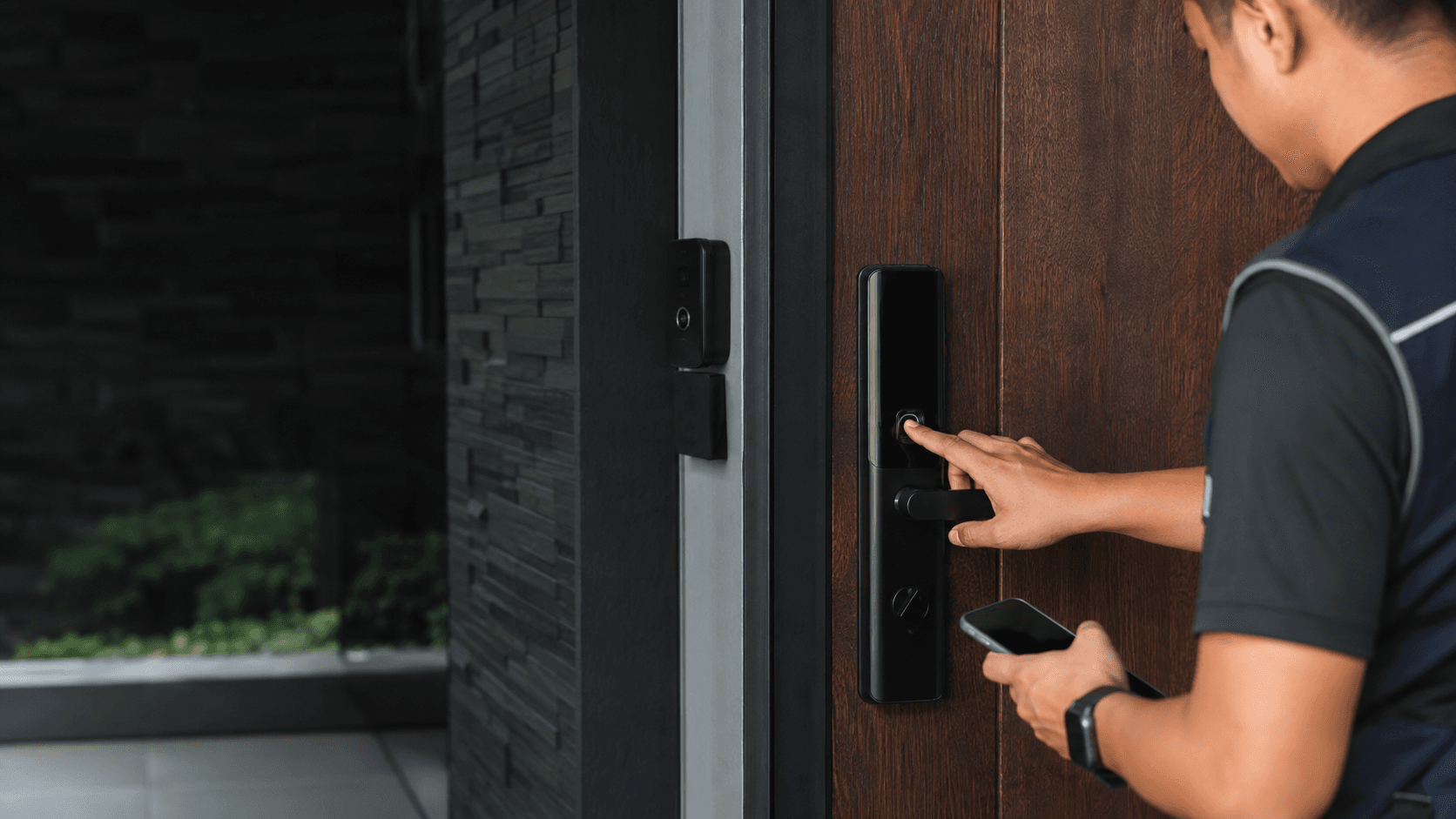
The exact-match query smart lock with doorbell describes a single device that replaces two separate fittings: the deadbolt or lever on the door, and the video doorbell beside it. Eyonic Sdn Bhd, a security system supplier based in Sarawak, Malaysia, lists smart lock door access among its product reviews and notes that smart locks work best when the door condition, user roles and backup method are reviewed before installation.
That review point matters more than any feature list. A combined lock and doorbell draws power, network bandwidth and daily use from the same door, so the decision is rarely about which brand looks best. It is about whether the door, the wiring route and the people using it can support one device doing two jobs.
What a Smart Lock With Doorbell Actually Does
A smart lock with doorbell merges two functions that are normally installed separately. The lock half handles entry. keypad codes, fingerprint reads, app commands or a physical key. The doorbell half handles awareness: a camera view of whoever is at the door, often with two-way audio and a recording of the visit.
Competitor product pages show how manufacturers describe the combination. TP-Link markets a smart video door lock with fingerprint, keypad, app, RFID, physical key and temporary passcodes alongside a built-in video doorbell and auto-lock. Lockly describes its Vision model as a smart lock with a built-in HD video doorbell. Those descriptions confirm the category exists as a single product type rather than a bundle of two devices.
The practical difference from a separate lock and doorbell is the shared trigger. When the camera sees a visitor, the same device can log the event against the entry record. When a code is used, the camera can capture who used it. That pairing is the reason buyers look for this category at all.
What the device does not solve
A combined unit does not remove the need for a backup entry method. Eyonic's smart lock review states that smart locks work best when the door condition, user roles and backup method are reviewed before installation. A dead battery on a combined lock and camera affects both functions at once, so a physical key or a second entry point remains part of the plan.
It also does not replace a full CCTV system. A door camera sees one approach. Cameras covering a gate, a car porch or a rear entrance answer different questions, which is why Eyonic plans camera placement as part of a wider monitoring setup rather than treating the door as the whole picture.
Choosing the Right Smart Lock With Doorbell
The choice narrows quickly once four conditions are checked in order. Skipping the first two is the most common reason a combined lock and doorbell underperforms after installation.
- Confirm the door type and thickness, because a combined unit is heavier than a standard deadbolt and needs a compatible cutout.
- Confirm the power route, since a camera draws more current than a lock alone and battery life depends on how often the camera wakes.
- Confirm the network at the door, because live view and recordings need a stable connection at that exact spot, not just elsewhere in the building.
- Confirm who needs entry and how often, because staff, family, tenants and visitors need different permissions and different backup arrangements.
- Confirm the recording destination, whether that is local storage or a cloud plan, and who reviews the footage afterwards.
Eyonic's own installation process follows a comparable sequence for security work: site survey, system proposal, installation and handover. The same order applies here, because the survey is what reveals whether the door and the network can carry a combined device.
Residential and business use diverge
For a home, the appeal is convenience and a record of who came to the door. For a business, the question shifts. Eyonic's smart lock review notes that for business use, the company usually checks whether a standalone smart lock or an access-control panel is more appropriate. A shop with several staff entrances, or an office where visitor movement needs to be tracked, may need permissions and logs that a single combined lock cannot provide on its own.
Eyonic's project work shows the same pattern at larger sites. At the Kuching Immigration Office, the focus was arrival flow, staff areas, visitor movement and dependable daily operation. At KTA Sarawak Sdn Bhd, an engineering consultancy, the requirement was a practical office setup supporting staff movement, visitor handling, tidy cabling and clearer daily site control. Both cases point to the same lesson: the door device is one part of how people move through a building.
Practical Considerations for Smart Lock With Doorbell Installation
Installation is where the combined category separates from a simple deadbolt swap. The lock body sits in the door, the camera faces outward, and the two share a power source and a wireless connection.
Door condition comes first. A door that has warped, swollen or been trimmed to fit an older lock may not accept a heavier combined unit without adjustment. Eyonic's review places door condition ahead of user roles and backup method for exactly this reason.
Lighting and camera placement come next. Eyonic recommends checking actual lighting conditions before confirming placement for ColorVu-style cameras, and the same caution applies to a door camera. A door that faces direct afternoon sun, or a corridor with no light at all, produces a very different image from a sheltered entrance. Placement should be confirmed against the real conditions at the door rather than a showroom demonstration.
Network coverage at the door is the third constraint. A combined lock and doorbell that streams video needs a connection strong enough for live view. If the door sits at the far end of a building, or behind thick walls, the camera half may connect intermittently even when the lock half works fine.
Battery and power planning is the fourth. A camera that records every approach drains faster than a lock that only wakes for entry. Reducing recording triggers, or wiring the unit where that is possible, changes how often the device needs attention.
Where the combined approach fits less well
A building with a metal door and frame, a gate rather than a swing door, or a shared entrance serving multiple units may be better served by separate devices. A standalone smart lock on the unit door plus a separate doorbell or camera at the shared entrance keeps each function on the surface it suits.
Rental properties raise a further constraint. A combined unit that requires cutting or drilling may not be reversible at the end of a tenancy, which pushes the decision toward retrofit options or toward leaving the door hardware untouched.
Cost and Scope in Sarawak
Eyonic publishes package pricing for related security work, which gives a sense of scale for a wider installation. The Hikvision CCTV package, the Hikvision alarm system package and the autogate package are each listed at RM 1,599, covering supply, setup and handover for the relevant system.
Larger project work sits in a different range. Eyonic lists an approximate budget of RM 12,000 to RM 28,000 for work of the type carried out at the Kuching Immigration Office, and RM 8,000 to RM 18,000 for the type of office setup delivered for KTA Sarawak Sdn Bhd. Those figures describe multi-part installations rather than a single door device, and they show how quickly scope grows once a door is treated as one point in a wider system.
A single smart lock with doorbell sits well below those project figures, but the surrounding work is what determines the final cost: whether cabling is needed, whether the network requires an access point near the door, and whether the footage needs a storage plan.
Making an Informed Choice About
The decision comes down to whether one device at one door can carry both jobs without compromise. Where the door is standard, the network reaches it, and the people using it need simple entry plus a view of visitors, a combined unit is a tidy answer. Where the door is unusual, the entrance is shared, or the site needs permissions and logs across several points, separate devices or an access-control panel serve better.
Eyonic's founder, Eric Yong, has worked in the industry for more than ten years, with experience in technical installation of digital security solutions for commercial businesses in Sarawak. That background shapes the company's approach to reviewing smart lock door access: check the door, check the roles, check the backup, then decide.
For a property in Sarawak, the practical next step is to describe the door, the building type and the system required. Eyonic can be reached on WhatsApp at +60 11-5111 7959 to discuss the site and the appropriate setup.