
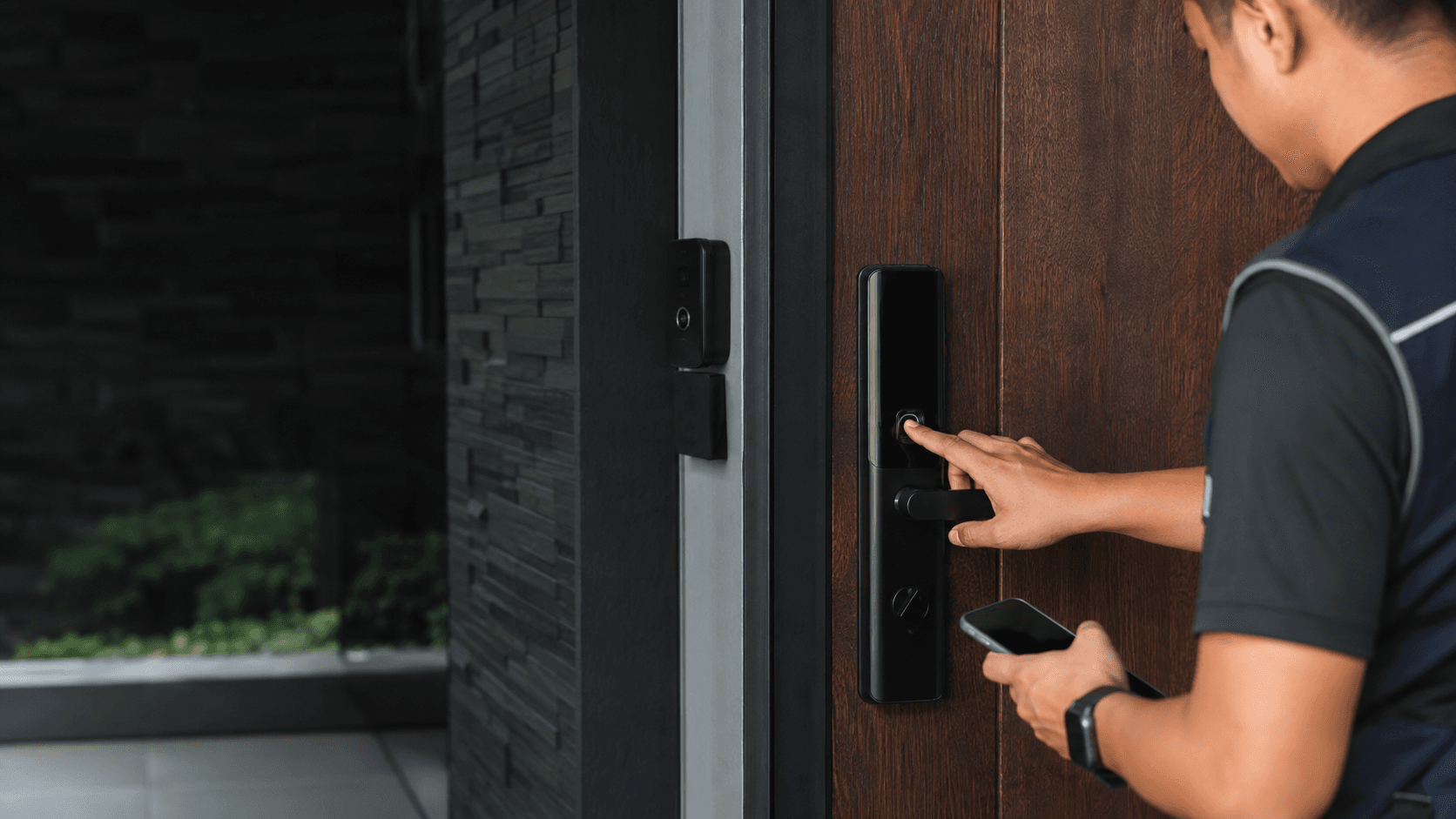
The appeal is simple. no key to carry, no code to remember, and no fumbling at the door with groceries in both hands. The trade-offs are equally real. Sensor reliability varies with finger condition, battery power is a hard dependency, and installation depends on the existing door preparation. This guide covers how a fingerprint home lock works, what separates a good unit from a frustrating one, and which household situations actually benefit.
Fingerprint Home Lock. What Matters Before You Choose
Most buyers focus on the sensor and ignore everything around it. The sensor is rarely the failure point. Door alignment, battery management, and backup entry decide whether the lock feels reliable after six months.
Three constraints shape the decision more than brand preference:
- Confirm the door's existing bore and backset match the lock's requirements, because a misaligned bolt defeats a good sensor.
- Check how many fingerprints the lock stores and whether it supports multiple users, since a single-user limit rules out most families.
- Verify the backup method, whether that is a physical key, a keypad code, or a 9V jumper, so a dead battery never means a locked-out household.
- Decide whether the lock needs Wi-Fi or Bluetooth, because remote access and offline operation are different products with different battery costs.
- Review the door's exposure to rain and direct sun, since exterior hardware ratings vary and an exposed gate is not the same environment as a covered porch.
That sequence matters because each step can eliminate a model before the next one is worth checking. A lock with an excellent sensor but no keyway is a poor fit for a household that wants a mechanical fallback. A lock with every smart-home integration is wasted on a door with no Wi-Fi coverage.
What Is a Fingerprint Home Lock and How Does It Work
A fingerprint home lock stores a mathematical template of a finger's ridge pattern and compares a fresh scan against that template before releasing the deadbolt. The template stays in the lock's local memory on most residential models, which means entry does not depend on an internet connection.
The scan-verify-unlock sequence runs in under a second on a working sensor. Three stages are involved.
- The sensor captures the ridge pattern and converts it into a template.
- The lock compares that template against enrolled prints stored on the device.
- A match triggers the motor or solenoid that retracts the bolt.
Capacitive sensors read the live layer of skin and are harder to spoof than older optical sensors, which read a surface image. That distinction explains why two locks at similar prices can behave very differently against a lifted print or a photograph.
Fingerprint, keypad, or full smart lock
A fingerprint-only lock is the narrowest option. A keypad lock adds code entry for visitors and contractors without enrolling a print. A full smart lock adds app control, remote access, and integration with platforms such as Amazon Alexa, Google Home, Apple HomeKit, Samsung SmartThings, and Matter.
The practical difference is who needs access and how often it changes. A household with a fixed set of residents gets most of the benefit from fingerprint entry alone. A household that regularly issues temporary access, such as a rental host or a home with frequent tradespeople, gains more from code and app management.
Choosing the Right Fingerprint Home Lock
Fit comes down to four variables: door condition, user count, power, and environment. Each one has a clear failure mode when ignored.
Door condition is the most common installation blocker. Deadbolt replacements generally assume a standard bore and backset, and a door that has been re-drilled or fitted with non-standard hardware may need additional work before any electronic lock fits cleanly.
User count determines whether the lock's memory is adequate. Households with several residents, regular domestic help, or short-stay guests need enough enrolment slots and a simple way to remove a print when access ends.
Power strategy separates convenience from dependency. Wi-Fi features draw more current than Bluetooth-only operation, so a lock with remote access typically needs more frequent battery attention than an offline unit. A 9V jumper or physical key provides the fallback when that attention slips.
Environment decides hardware class. A covered residential entry and an exposed gate present different demands, and a lock rated for one may not suit the other.
Where a fingerprint home lock fits well
Fingerprint entry suits households where residents come and go frequently, where keys are routinely lost, or where an older resident finds key handling difficult. It also suits short-stay rental entries where issuing and revoking codes is easier than collecting keys.
It fits less well where the door is shared with a building's master key system, where the entry is fully exposed to weather, or where the household wants zero electronic dependency on the primary door.
Practical Considerations for Fingerprint Home Lock Installation
Installation is usually a direct deadbolt swap on a standard door, but the surrounding decisions carry more weight than the swap itself.
Sensor placement matters for households with children or older users. A sensor positioned at an awkward height or angle produces repeated failed reads, which erodes trust in the lock faster than any technical fault.
Enrolment quality matters more than enrolment quantity. Registering the same finger two or three times from slightly different angles improves first-try read rates, particularly for fingers that are dry, worn, or affected by cold weather.
Access review is the step most households skip. Removing a print when a tenant, contractor, or former household member no longer needs entry is as important as adding one, and it is the main reason app-managed locks appeal to landlords.
For properties in Sarawak, Eyonic Sdn Bhd supplies and installs security and ELV systems, including smart locks, and its published smart lock guidance notes that locks work best when door condition, user roles, and backup method are reviewed before installation. The same guidance notes that for business use, a standalone smart lock and an access-control panel are different choices rather than interchangeable ones.
Battery weather and sensor limits
Battery life is the most predictable failure point. A lock that reports low battery through an app gives warning; a lock that does not will simply stop responding. Either way, the backup method is what prevents a lockout.
Weather exposure affects both the sensor and the finish. A covered porch and an exposed gate are different operating environments, and hardware that performs well in one may degrade faster in the other.
Sensor limits are real but narrow. Very dry skin, deep cuts, and heavy manual work can reduce read consistency. Enrolling a second finger as a fallback resolves most of these cases without changing the lock.
Making an Informed Choice About
The decision usually resolves to one question: does the household want convenience layered onto a mechanical lock, or does it want electronic access to replace the key entirely?
Layering convenience onto a mechanical lock is the lower-risk path. The keyway remains as a fallback, the fingerprint handles daily entry, and a battery failure is an inconvenience rather than a lockout.
Replacing the key entirely is the cleaner experience but demands more discipline. Battery monitoring, backup code management, and a plan for guests all become ongoing responsibilities rather than one-time setup tasks.
Neither path is wrong. The mismatch happens when a household buys for the second path and maintains it like the first.
For readers comparing a fingerprint home lock against a broader security setup, the lock is one layer. Camera coverage, alarm sensors, and gate automation address different risks, and a lock decision made in isolation from those layers often produces gaps that only become obvious after an incident.
Eyonic's completed work includes a project for the Kuching Immigration Office covering arrival flow, staff areas, visitor movement, and dependable daily operation, and a project for KTA Sarawak Sdn Bhd covering staff movement, visitor handling, and tidy cabling. Both illustrate the same principle that applies to a single residential door: access hardware works best when the movement pattern is understood before the hardware is chosen.
For a property in Sarawak, sharing the location, property type, and required system with Eyonic on WhatsApp at +60 11-5111 7959 is the practical next step. Eyonic's published packages include a Hikvision CCTV package, a Hikvision alarm system, and an autogate package, each listed at RM 1,599, for readers who want to plan the lock alongside the rest of the property's security layers.