
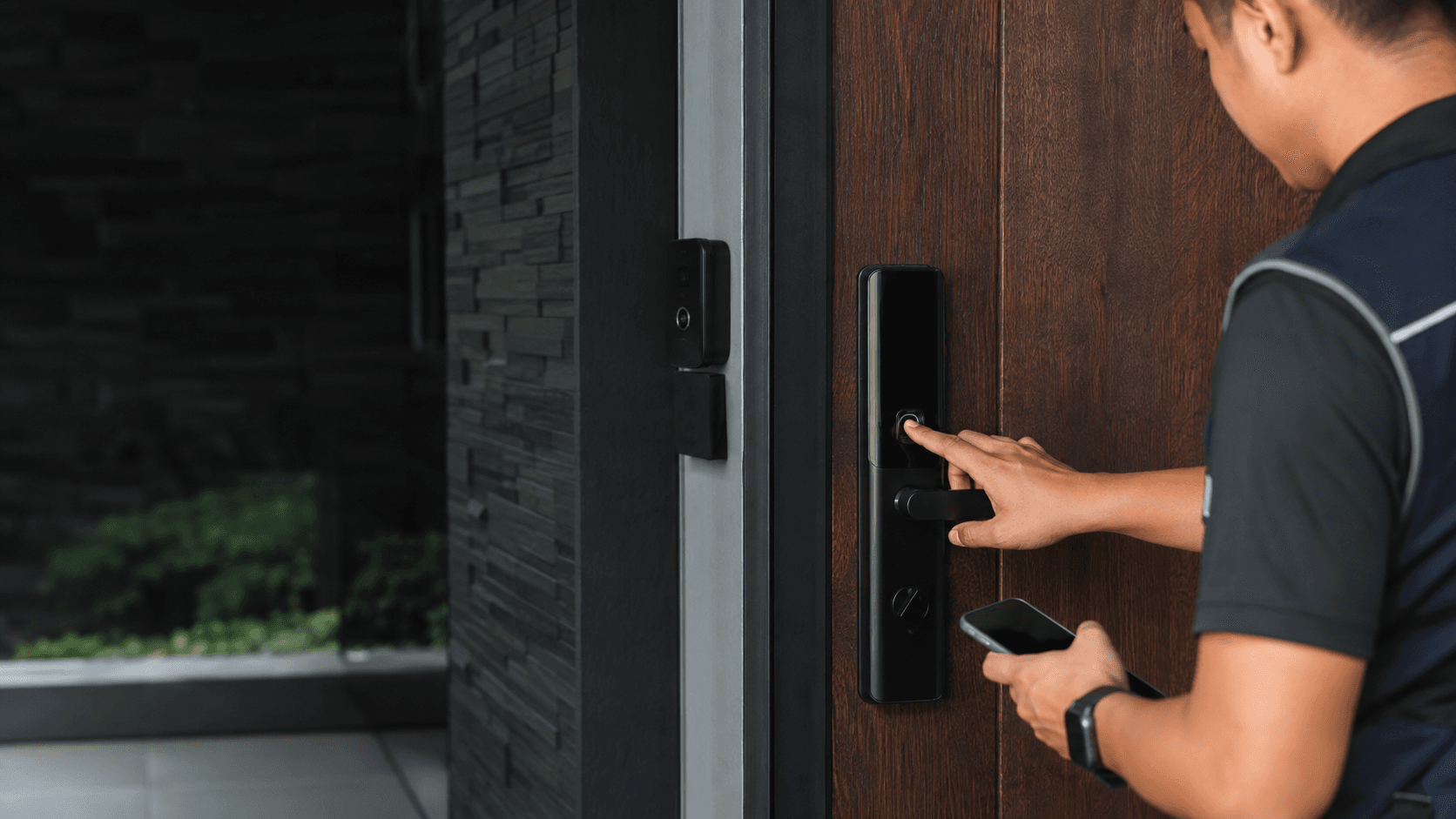
The exact-match query brass keypad door lock describes a lock opened by entering a code on a keypad rather than turning a key, finished in brass rather than satin nickel, matte black or bronze. Buyers in Malaysia usually arrive at this term while comparing a keyless entry option for a main door, an office entrance or a shop lot, and the decision rarely turns on the keypad alone.
What decides the outcome is the door itself, the people who need to enter, and what happens when the electronics stop cooperating. Eyonic's own product review guidance states that smart locks work best when door condition, user roles and backup method are reviewed before installation, and that for business use the choice between a standalone smart lock and an access-control panel is usually checked first.
Brass Keypad Door Lock. Keyless Entry for Malaysian Doors
A brass keypad door lock is a mechanical lock body with an electronic keypad interface, supplied in a brass or brass-toned finish. The keypad replaces the key cylinder as the everyday method of entry, while the lock body still does the physical work of securing the door.
Malaysian doors vary more than a catalogue assumes. A single-leaf timber main door, a metal grille door, a glass office door and a shop lot roller shutter each present a different mounting problem, and the lock has to match the door rather than the other way around. That is why the practical sequence below runs before any model is confirmed.
- Check the door condition. material, thickness, existing cutout, backset, and whether the frame closes squarely enough for the latch to seat.
- List the user roles. who needs permanent access, who needs temporary access, and who only needs occasional entry.
- Confirm the backup method. how the door is opened when the battery is flat, the keypad fails, or the code is forgotten.
- Agree the handover. who holds the master code, how codes are added or removed, and who is contacted when the lock misbehaves.
Those four checks are the difference between a lock that works quietly for years and one that generates a call every few weeks. They also determine whether a standalone keypad lock is the right answer at all, or whether the door needs an access-control panel instead.
What the Brass Finish Changes on a Keypad Door Lock
Brass is a finish choice, not a functional one. The keypad, the electronics and the locking mechanism behave the same way whether the outer body is brass, satin nickel or matte black. What changes is appearance, how the surface ages, and how well it matches the rest of the door hardware.
Brass finishes are commonly sold in two broad presentations. Polished brass is bright and reflective, and it shows fingerprints and smudges more readily because the surface is smooth and light-coloured. Antique brass is darker and deliberately aged, which hides handling marks better and suits older timber doors and traditional shopfronts. Neither presentation changes code capacity, battery behaviour or entry speed.
The finish matters most where the lock sits beside other visible hardware. A brass keypad door lock on a door with a chrome handle and a stainless steel viewer looks like three separate purchases. Matching the finish across the handle, the lock and any gate hardware produces a tidier result for a shopfront or an office entrance where the door is seen all day.
There is a practical limit worth stating plainly. Brass plating and brass-toned coatings are surface treatments, and their long-term behaviour depends on the coating quality, the local climate and how often the surface is cleaned. No verified durability comparison between brass plating and other finishes on keypad locks is available here, so the finish should be chosen on appearance and matching rather than on an assumed lifespan advantage.
How Keypad Entry Works Across a Normal Week
Day to day, a keypad lock is simpler than a keyed lock. A person walks up, enters a code, and the latch releases. There is no key to carry, no key to copy, and no key to lose. For a household, that removes the recurring problem of cutting spare keys for family members, helpers and contractors.
Across a normal week, the pattern usually looks like this. Regular users enter with their own codes. Occasional visitors are given a temporary code that is removed afterwards. The owner keeps a master code that can add and delete other codes. The lock records nothing visible to the user unless the model includes an audit function, so code discipline is a human habit rather than something the lock enforces.
User codes are the part that needs planning, not the part that needs technology. A useful split is permanent codes for people who live or work there, temporary codes for cleaners, contractors and short-stay visitors, and a master code held by one or two people only. When a temporary code is not removed, the lock quietly becomes less secure than the key it replaced.
Battery access is the other weekly consideration. Keypad locks draw power from batteries, and the batteries eventually run down. The design question is where the battery compartment sits and whether it can be reached from outside the door. If the compartment is only accessible from the inside, a flat battery on a locked exterior door becomes a genuine problem rather than an inconvenience.
Backup entry when the battery dies
Every keypad lock needs a stated backup method before it is installed. The common approaches are a mechanical key override, an external power terminal that accepts a temporary battery, or a second entry point on the same property. The backup method should be tested at handover, not discovered during a failure.
For a shop or office, the backup question is sharper than for a home. If the only person who knows the override procedure is absent, the door stays shut. Writing the procedure down and storing it somewhere other than behind the locked door is a small step that prevents a large disruption.
When more than one person needs regular entry
Multiple regular users are where a keypad lock outperforms a keyed lock. Each person receives a distinct code, so removing one person's access does not require rekeying the door or collecting a key. That is the main operational gain for an office, a clinic or a shop with shift staff.
The limit appears when the requirement grows beyond a handful of users or when entry needs to be logged, scheduled or integrated with other systems. At that point, Eyonic's guidance is to check whether a standalone smart lock or an access-control panel is more appropriate. A standalone lock is simpler and cheaper to run; a panel handles scale, records and integration that a single lock cannot.
Door Conditions That Decide Whether a Brass Keypad Door Lock Fits
The door decides more than the lock does. Before a brass keypad door lock is confirmed, the physical door has to be measured and inspected, because a lock that does not seat properly will not latch reliably no matter how good the electronics are.
Four conditions carry most of the weight. Door thickness determines whether the lock body fits within the leaf. The existing cutout and backset determine whether the new lock drops into the old preparation or requires fresh drilling. Door material determines whether the leaf can be cut and whether it has the internal structure to hold the lock. Frame alignment determines whether the latch and strike plate meet cleanly when the door closes.
Metal doors, glass doors and doors with a narrow stile are the common edge cases. A metal grille door may not have a suitable mounting surface for a standard lock body. A glass office door usually needs a different fixing method entirely. A narrow-stile aluminium shopfront door may have too little material around the cutout to support the lock.
Existing preparation is the other practical constraint. Replacing a lock that already has a cutout is usually straightforward if the new body matches the old backset. Fitting a keypad lock to a door that has never carried one means new drilling, and on a hollow-core or composite door that work has to be done carefully to avoid weakening the leaf.
None of these conditions can be judged from a photograph or a product listing. They are settled by looking at the actual door, which is why a site survey comes before a proposal rather than after it.
Planning User Codes Backup Entry and Battery Access
Planning happens before installation and is reviewed at handover. The three items that need a decision are who gets a code, how the door opens without the keypad, and how the battery is replaced without locking anyone out.
For user codes, the practical approach is to assign one code per person rather than one shared code. A shared code cannot be withdrawn from a single individual, so it survives every staffing change. Individual codes can be deleted cleanly when someone leaves, which is the whole point of moving away from keys.
For backup entry, the method should be confirmed in writing and tested while the installer is still on site. A backup method that has never been tried is an assumption, not a plan.
For battery access, the compartment location and the replacement procedure should be demonstrated at handover. Whoever maintains the property needs to know which battery type the lock uses and where spares are kept, because a lock that stops working on a Sunday evening is a maintenance problem, not a security one.
Handover is also where the master code changes hands. Eyonic's installation process runs through site survey, system proposal, installation and handover, and the handover stage is where the operating knowledge transfers to the people who will actually use the door.
Practical Next Step for a in Sarawak
For a property in Sarawak, the practical next step is a site survey rather than a product order. The survey confirms the door condition, the user roles and the backup method, and it settles whether a standalone keypad lock or an access-control panel is the better fit for the entrance in question.
Eyonic Sdn Bhd plans, supplies and installs security and ELV systems for homes, offices, shops and industrial sites in Sarawak, and has completed work for public-sector and consultancy clients including the Kuching Immigration Office and KTA Sarawak Sdn Bhd. Those projects centred on arrival flow, staff areas, visitor movement and dependable daily operation, which is the same set of concerns that decides how a keypad lock is configured on a busy entrance.
Eric Yong, founder of Eyonic Security Systems, has worked in the industry for more than ten years and is experienced in the technical installation of digital security solutions for commercial businesses in Sarawak. That experience is most useful at the survey stage, where the door is assessed before anything is specified.
Share the location, property type and required system with Eyonic on WhatsApp at +60 11-5111 7959 for the next practical step.