
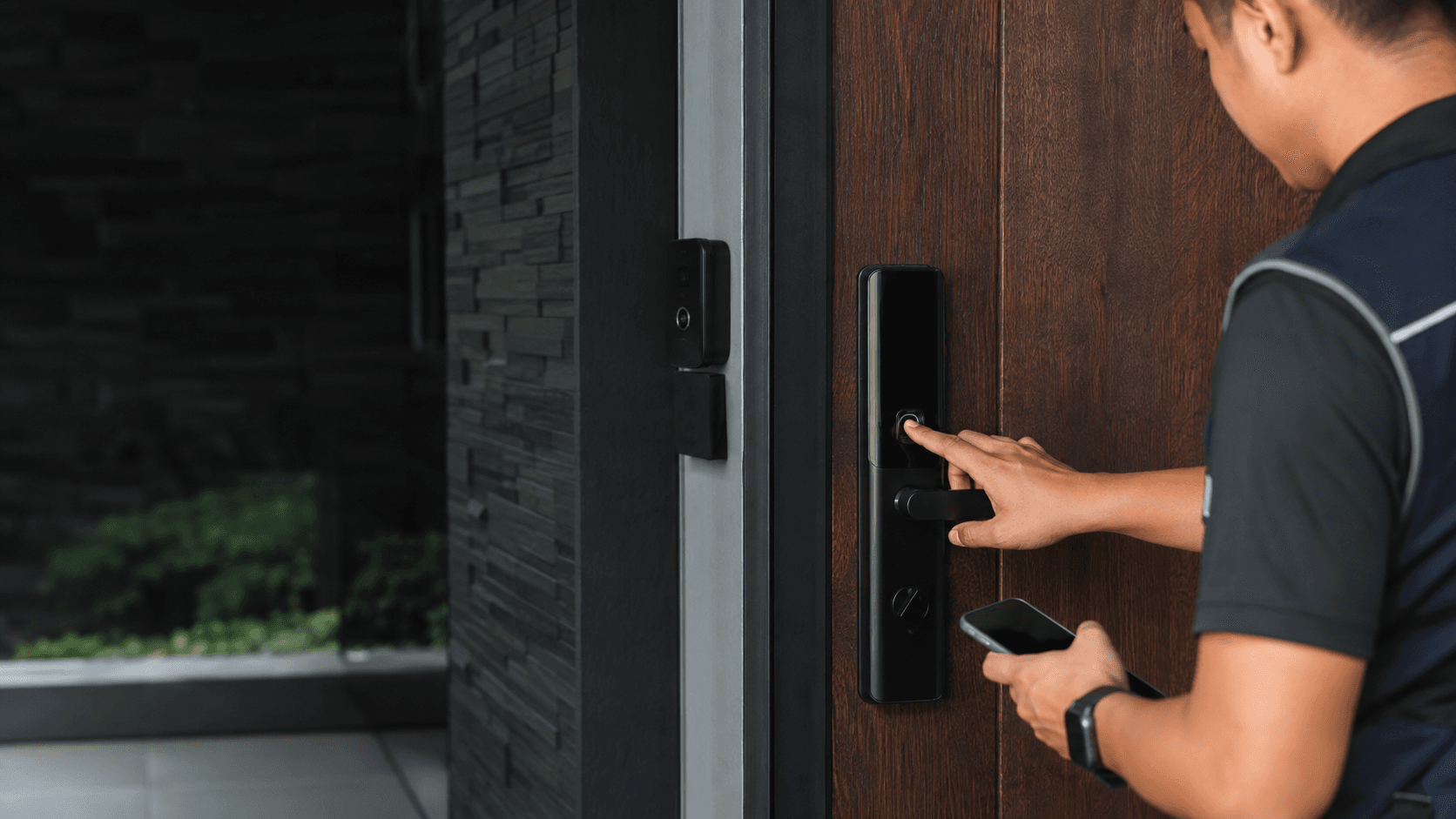
No single sticker price covers every property. A quotation reflects which lock body is chosen, how the remote signal is delivered, what the existing door and frame can accept, and how many people need their own access credential. Eyonic Sdn Bhd, a security system supplier in Sarawak, treats smart lock door access as a controlled-convenience decision that depends on door condition, user permissions and a planned backup entry method.
What Electronic Door Lock With Remote Control Means in Practice
A remote control door lock is a locking device that can be operated from a distance rather than only at the door face. The remote may be a handheld fob, a wall-mounted button, a keypad, a phone app, or a combination of these. The lock itself is usually a motorised deadbolt or a lever-handle unit with an internal motor that drives the bolt when it receives a signal.
Two broad families exist, and they price differently. A standalone smart lock carries its own reader, motor and power source inside the door hardware. An access control panel sits away from the door and manages credentials, schedules and multiple openings from one point. Eyonic checks which of the two suits a business before recommending hardware, because the choice changes both the wiring and the quotation.
The practical difference shows up in daily use. A standalone unit suits a single entrance where a handful of people need entry. A panel-based setup suits a building where staff, visitors and contractors need different levels of access at different times. The Kuching Immigration Office project, which covered arrival flow, staff areas and visitor movement, is the kind of environment where those distinctions matter more than the lock model itself.
How Electronic Door Lock With Remote Control Price Is Usually Built Up
A quoted figure is normally assembled from several parts rather than a single product line. The order below reflects how a supply-and-install quotation is typically structured.
- The lock body or locking hardware, chosen to match the door type and the required entry methods.
- The remote-control setup, which may be a fob, a receiver module, a keypad, or a network connection that allows app control.
- Any access control panel or controller needed to manage multiple users, schedules or doors.
- Power provision, whether that means batteries, a low-voltage supply, or wiring back to a distribution point.
- Door preparation, including cutting, reinforcing or replacing hardware so the lock seats and aligns correctly.
- Installation labour and configuration, covering mounting, wiring, pairing remotes, setting user permissions and testing.
- Handover, where the installer confirms each user can enter, the backup method works, and the responsible person knows how to add or remove access.
Because these items are quoted together, two properties with the same door can receive different figures. A door that already has a suitable cutout and a nearby power source needs less work than one that requires new preparation and a fresh cable run.
Why the Lock Body Is Only Part of the Figure
The hardware is the most visible line item, but it is rarely the largest. Configuration time, door preparation and power provision often carry more weight in the final number, particularly where the door is solid, metal-framed, or fitted with an existing lock that must be removed cleanly.
What Changes the Electronic Door Lock With Remote Control Price in Malaysia
Several factors move a quotation up or down, and most of them are visible during a site survey rather than over the phone.
Door condition is the first. A hollow-core interior door, a solid timber entrance door and a metal-framed shopfront door each demand different hardware and different preparation. A door that is warped, misaligned or fitted with an incompatible existing lock adds labour before any new device is mounted.
User count and permissions are the second. A household with three regular users needs less configuration than a shop where staff, supervisors and delivery personnel require separate access rights. Where permissions must be changed often, a panel-based approach usually makes more sense than reprogramming a standalone unit each time.
Power and wiring are the third. Battery-powered locks avoid cabling but introduce a maintenance routine. Mains-powered or networked locks need a supply route, which may mean surface trunking, concealed conduit, or a connection back to an existing low-voltage point.
Backup entry is the fourth. Every electronic lock needs a way in when the primary method fails, whether that is a mechanical key, an external power terminal, or a second credential type. Planning this at quotation stage avoids a return visit later.
Scale is the fifth. A single door is priced as a single installation. Multiple doors sharing one controller spread the cost of the controller across the project, which changes the per-door figure even when the hardware is identical.
Where Remote Control Fits Alongside Other Systems
Remote-controlled locking is often installed as part of a wider setup rather than on its own. Eyonic supplies and installs CCTV, alarm systems, autogate motors, keyphone intercoms and ELV systems across Sarawak, and a gate or entrance lock frequently connects to the same access routine as the camera coverage and the intercom at the same point of entry. Where that overlap exists, combining the work in one visit usually costs less than separate call-outs.
Door Condition, User Roles and Backup Entry Before Purchase
Three checks decide whether a quoted lock will actually work in daily operation. Skipping them is the most common reason a lock is replaced within its first year.
Door condition determines fit. The installer needs to confirm the door thickness, the frame material, the existing cutout and whether the door closes squarely. A lock that fits the opening but not the frame will bind, drain its motor and fail early.
User roles determine the control method. A home with a fixed group of residents can run on a standalone smart lock. A business with rotating staff, visiting contractors and delivery access needs a way to add and revoke credentials without reprogramming the device at the door.
Backup entry determines resilience. Power loss, a flat battery or a failed motor should never leave a property sealed. A mechanical override, an external power point or a second credential path keeps the door usable when the primary method is unavailable.
Questions to Settle Before Requesting a Quotation
A quotation is only as accurate as the information behind it. Working through the following checks first reduces the chance of a revised figure after the installer arrives.
- Confirm the door type, thickness and frame material for every opening involved.
- List who needs access and whether their permissions will change often.
- Decide the preferred entry method and whether a handheld remote, keypad or app control is required.
- Identify the backup entry method and confirm it will be tested at handover.
- Check whether power is available near the door or whether batteries are preferred.
- Note any existing lock, intercom, alarm or camera that should work alongside the new device.
- Ask what the quotation includes and what would be charged separately.
Eyonic's installation process follows site survey, system proposal, installation and handover, so the survey stage is where these answers are gathered rather than assumed. The same discipline applies to lock work as to camera placement, where actual conditions on site decide the final configuration.
Reading a Quotation Without a Reference Price
Where no verified market figure is available for a specific model, the useful comparison is scope rather than headline number. A quotation that names the lock hardware, states the remote-control method, describes the door preparation, lists the configuration work and confirms the backup entry is more comparable than one that gives a single figure with no breakdown. Two quotations can only be judged against each other when both describe the same scope.
It also helps to ask what happens after handover. Adding a user, replacing a battery, re-pairing a remote or adjusting a schedule are routine tasks, and knowing whether these are covered or chargeable prevents surprises later.
For readers comparing lock work with other security spending, Eyonic publishes package pricing for Hikvision CCTV, alarm systems and autogate motors at RM 1,599 each, which gives a sense of how the company structures supply-and-install work. Lock pricing is quoted per site because door conditions vary far more than camera or gate installations do.
Share your location, property type and required system with Eyonic on WhatsApp at +60 11-5111 7959 for the next practical step.