
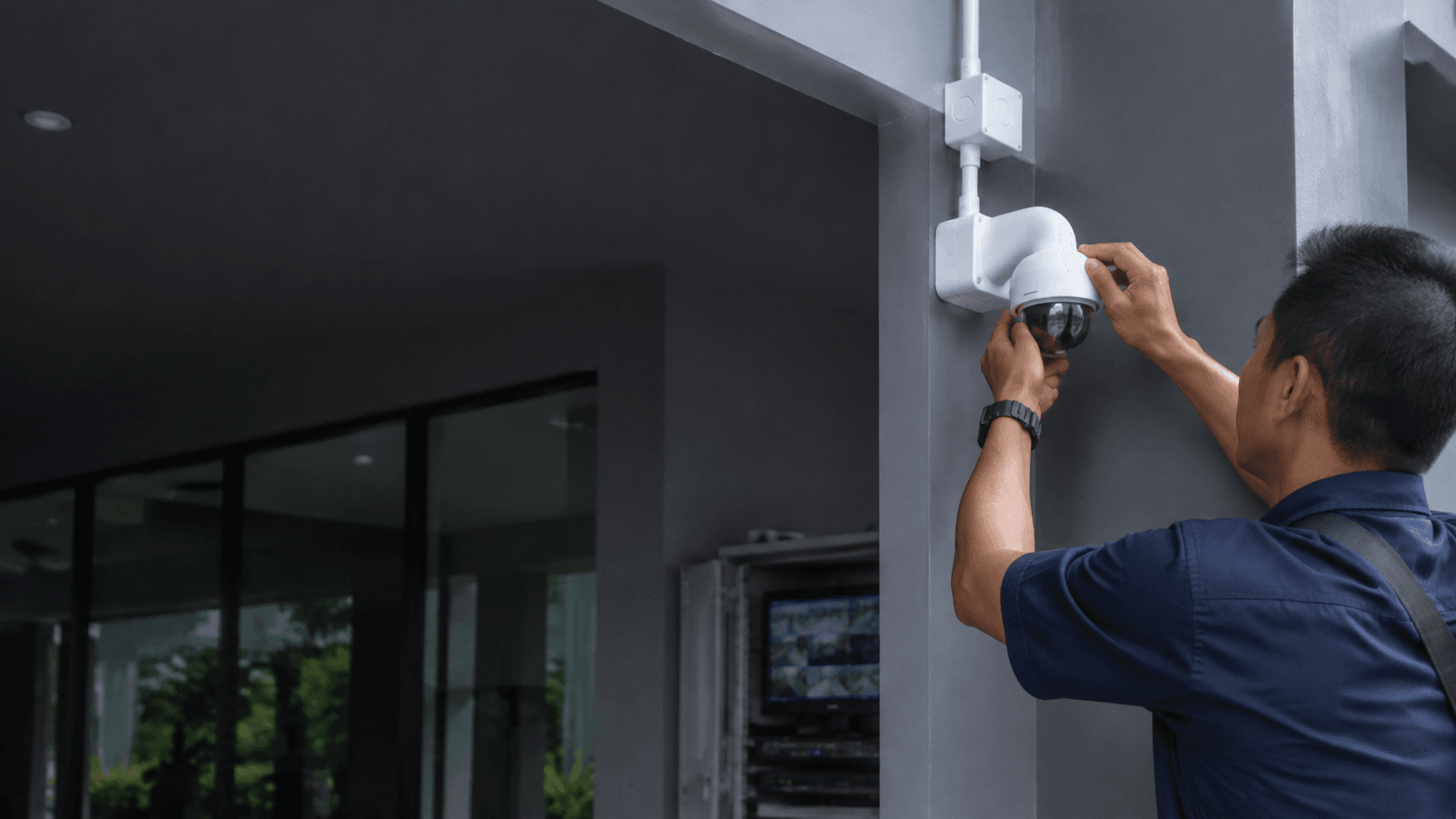
The phrase covers two related purchases: camera systems that stream over Wi-Fi, and alarm systems whose sensors talk to a panel without new cable runs. Both depend on the same three things — a stable network, sensible device placement, and a power plan that survives an outage. Eyonic's own installation work in Kuching shows how those decisions play out in real buildings.
What a wifi security system actually includes
A wifi security system is a group of devices that share one network instead of one dedicated cable per device. The camera or sensor sends data wirelessly; the recorder or hub stores it and pushes alerts to a phone app.
- Decide what needs watching or detecting — entry points, arrival flow, staff areas, or visitor movement.
- Check the network and power available at each position before committing to device types.
- Confirm placement against real lighting and sightlines rather than a floor plan alone.
- Agree the recording, storage, and remote-viewing setup.
- Install, test each zone, and hand over the mobile viewing setup.
Eyonic's CCTV installation process follows that shape: site survey, system proposal, installation, and handover. The survey stage exists because wireless performance is site-specific — wall materials, distance, and interference change what a device can realistically deliver.
Choosing the right wifi security system
The choice usually comes down to what the property needs to prove or prevent. A shop watching a counter has different requirements from an office tracking who enters and leaves.
Camera-led systems suit properties that need recorded evidence and live viewing. Eyonic plans, supplies, and installs monitoring systems with camera placement, recording, and remote viewing for homes, offices, shops, and industrial sites. Alarm-led systems suit properties that need immediate notification and deterrence rather than footage.
Lighting is the most commonly skipped check. Eyonic recommends checking actual lighting conditions before confirming placement for ColorVu-style cameras, because a position that looks adequate in daylight can behave differently after dark. That single check prevents most post-installation repositioning.
What is wifi security system terminology hiding?
Marketing language blurs three separate things. "Wireless" can mean the camera runs on battery, that it sends video over Wi-Fi, or that it connects to a hub by radio frequency. A device can be wireless in one sense and still need a power cable. Confirming which sense applies to a specific product prevents a surprise during installation.
Best wireless home security systems of 2026: expert reviewed
Published rankings for 2026 concentrate on subscription-based platforms with professional monitoring, and those comparisons are useful for understanding the category. They are less useful for a property in Sarawak, where the practical questions are network reliability, power continuity, and who services the equipment after handover.
Eyonic's approach differs in emphasis. The company supplies and installs Hikvision cameras and related ELV systems, and its project record includes government and engineering consultancy clients. The Kuching Immigration Office project focused on arrival flow, staff areas, visitor movement, and dependable daily operation — a public-building requirement where the system has to work every day without close supervision.
The KTA Sarawak Sdn Bhd project addressed a different problem: a practical office setup in Kuching supporting staff movement, visitor handling, tidy cabling, and clearer daily site control. Both projects show the same pattern. The equipment matters less than matching coverage to how the building is actually used.
Where subscription models and installed systems diverge
Subscription platforms bundle monitoring into a monthly fee and rely on the homeowner to place devices. Installed systems put the placement decision with the installer, which matters when camera angles, cabling routes, and recording configuration need to be right the first time. The trade-off is straightforward: subscription models are easier to start and harder to customise; installed systems are harder to start and easier to fit to an unusual building.
Practical considerations for wifi security system planning
Four constraints decide most installations.
Network capacity. Each camera consumes bandwidth continuously. A network that handles browsing comfortably may not handle several streams at once, particularly at higher resolutions.
Power continuity. Wireless data does not mean wireless power. Cameras and hubs still need electricity, and a power cut takes the system offline unless backup is planned.
Storage and retention. Local recording and cloud recording answer different questions. Local storage keeps footage on site; cloud storage survives device theft. The right mix depends on what the footage needs to prove.
Servicing. Equipment fails, firmware updates, and positions need adjusting. A system installed by a local supplier is easier to maintain than one bought remotely.
Eyonic's published packages start at RM 1,599 for a Hikvision CCTV package covering camera supply and setup, basic recording configuration, and mobile viewing handover. The Hikvision alarm system package at the same price covers a control panel and sensors, siren and zone setup, and user testing and handover. An autogate package at RM 1,599 covers motor recommendation, remote-control setup, and safety testing. Larger projects sit well above those figures — the Kuching Immigration Office work carried an approximate budget of RM 12,000 to RM 28,000, and the KTA Sarawak project RM 8,000 to RM 18,000.
When a is the wrong choice
Wireless is not automatically better. Sites with dense concrete or metal construction, long distances between buildings, or unreliable mains power often suit wired or hybrid designs. Where a cable route already exists, using it removes a variable. The honest answer for some properties is that a wireless-first design will underperform a wired one, and a survey should say so before installation rather than after.
Making an informed choice about coverage
The decision sequence is short. Identify what the system must detect or record. Confirm the network and power at each position. Check lighting at the times that matter. Then match the equipment to those findings rather than to a product category.
Eric Yong, founder of Eyonic Security Systems, has worked in the industry for more than ten years and specialises in technical installation of digital security solutions for commercial businesses in Sarawak. That experience is most useful at the survey stage, where placement decisions are made and where most long-term problems are either prevented or created.
For properties in Sarawak, sharing the location, property type, and required system with Eyonic on WhatsApp at +60 11-5111 7959 is the next practical step.