
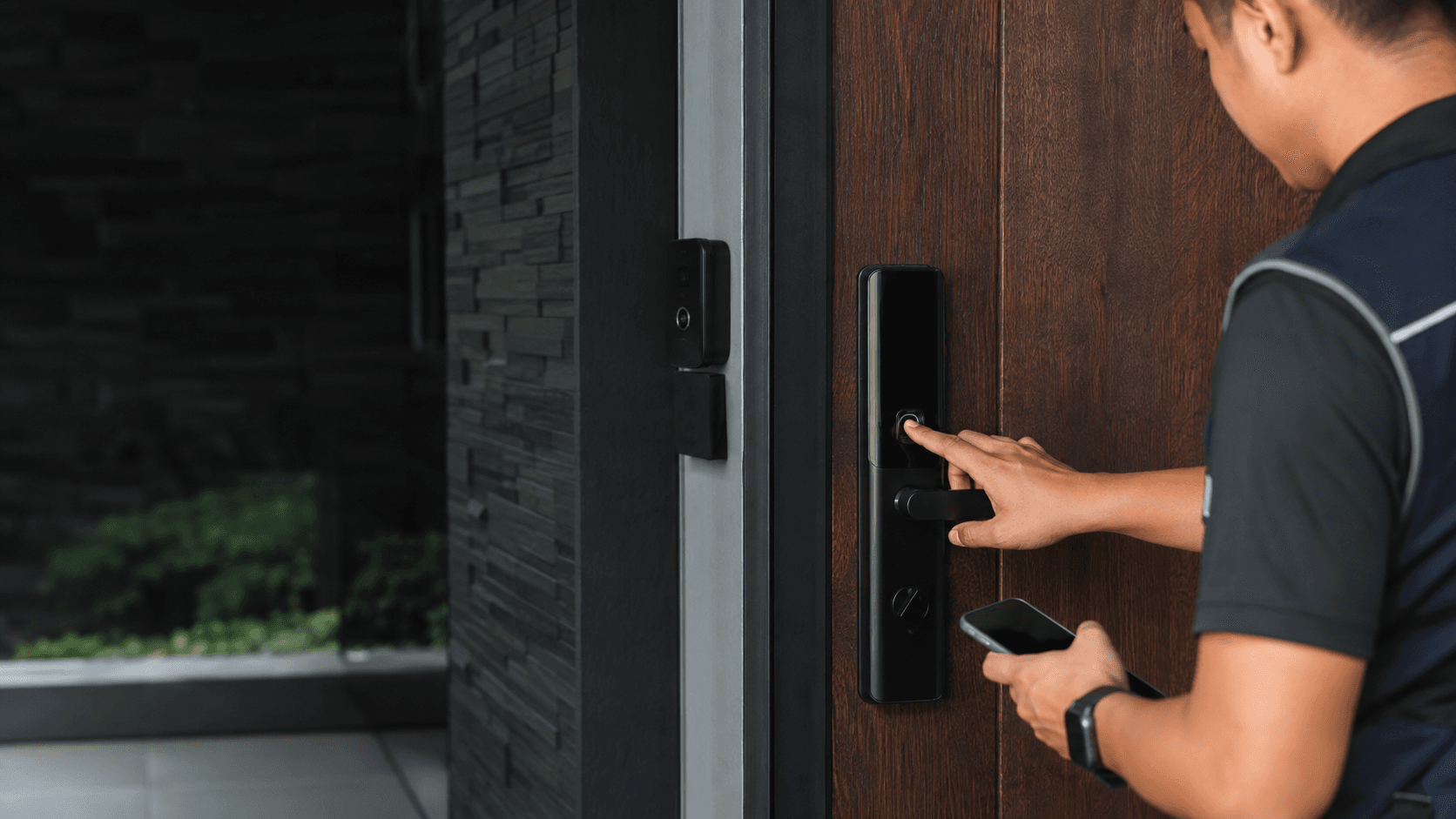
The two locking points on a single door are not one mechanism. A deadbolt throws a solid bolt into the frame; a knob or lever latches the door and carries the handle. A smart lock with deadbolt and knob therefore describes a door where both points are addressed, either by two devices or by one product that replaces both.
Eyonic Sdn Bhd, a security system supplier in Sarawak, reviews door condition, user roles and backup method before recommending smart lock door access, and checks whether a standalone smart lock or an access-control panel suits the site better.
Smart Lock With Deadbolt And Knob: What Matters Before You Choose
The deadbolt is the security point. It is the part that resists forced entry and the part most smart deadbolt products replace. The knob or lever is the convenience point. It is what the hand touches every time the door opens, and it is also where a latch holds the door closed when the deadbolt is not thrown.
That split matters because the two points fail differently. A deadbolt left unlocked leaves the door secured only by a latch that can often be slipped. A knob left unlocked behind a thrown deadbolt still leaves the door secure, but the handle is the part that wears out first from daily use.
On a smart lock with deadbolt and knob setup, the practical question is whether both points are motorised, whether only the deadbolt is motorised while the knob stays mechanical, or whether the knob is replaced by a smart lever that reports its own state. Each option changes what the access log actually shows.
Door Condition Checks Before Choosing
Door condition decides more than product choice. A smart lock with deadbolt and knob only works if the existing cutouts, backset and door thickness accept the replacement hardware, and if the frame is sound enough for the bolt to seat without binding.
Eyonic's own review guidance states that smart locks work best when the door condition, user roles and backup method are reviewed before installation. That order is deliberate. hardware that fits a warped or misaligned door will still misalign after installation.
What To Measure And Inspect
Backset is the distance from the door edge to the centre of the bore hole, and it is the measurement that most often rules a product out. Cross-bore alignment between the deadbolt and the knob matters too, because a replacement that assumes a different spacing will not cover the existing holes.
Also worth checking. whether the door is solid or hollow, whether the frame has a strike plate that can be adjusted, and whether the door closes cleanly under its own weight. A door that needs a shoulder to close will fight a motorised bolt.
Where A Single Device Stops Being Enough
Some doors carry a combined lockset where the deadbolt and the knob share one trim and one set of fixings. Others carry two independent bores. The combined type limits replacement options because the trim is a single unit, while the independent type allows the deadbolt and the knob to be handled separately.
Where the two points cannot be operated from one device, the setup becomes two access decisions rather than one. That is a design constraint, not a fault, but it changes how the door is used daily.
User Roles And Backup Entry
User permissions decide how many people hold credentials and what each of them can do. On a smart lock with deadbolt and knob, permissions may need to be issued twice if the two points are separate devices, which is where a single access-control panel becomes the more practical route for a business.
Eyonic's product review notes that for business use, the choice between a standalone smart lock and an access-control panel is usually settled by how many users need access and how often that list changes. A small office with a stable staff list behaves differently from a site with rotating contractors and visitors.
Backup Entry Has To Be Decided Before Installation
Backup entry is the fallback when a credential fails, a battery drains or a network drops. A mechanical key cylinder, a keypad code held outside the normal user list, or a physical key held off-site are all valid, but the choice has to be made before the hardware is fixed to the door.
The failure case is specific. if both locking points are electronic and both depend on the same power source or the same hub, a single fault can leave the door with no working entry method. Splitting the dependency, or keeping one point mechanical, removes that single point of failure.
Installation And Handover Sequence
Eyonic's installation process follows a defined sequence, and the same order applies to door access work. The numbered list below reflects that process.
- Site survey. inspect the door, frame, existing cutouts and the surrounding access route.
- System proposal. set out whether a standalone smart lock or an access-control panel fits the site.
- Installation. fit the hardware, confirm the bolt seats cleanly and the latch releases without binding.
- Handover. test each credential, confirm the backup entry method works, and walk through daily operation.
Handover is where most of the value sits. Testing every credential at handover catches the user who was added but never enrolled, and confirming the backup method catches the case where the only key is inside the building.
Eyonic completed a project for the Kuching Immigration Office focused on arrival flow, staff areas, visitor movement and dependable daily operation. That project is a useful reference point for how much of the work sits in movement planning rather than in the hardware itself.
Questions To Settle Before Buying
Whether a single smart lock with deadbolt and knob can operate both points together is the first question, and it cannot be answered generically. It depends on the specific product and on whether the door carries a combined lockset or two independent bores. Manufacturer documentation for the exact model is the only reliable source for that answer.
The second question is what happens when the network is down. A lock that depends on a hub or a cloud service for daily operation behaves differently from one that holds its own credential list locally. The answer determines whether the door still works during an outage.
The third question is who administers the user list. If that task falls to one person with no backup, staff turnover becomes an access risk. If it sits with a facilities role, the access-control panel route usually fits better than a standalone lock.
Pricing for smart lock supply and installation in Malaysia is not published here because no verified figure is available for this category. Eyonic's published package pricing covers CCTV, alarm and autogate systems at RM 1,599 each, which are separate product lines from door access.
Share the location, property type and required system with Eyonic on WhatsApp at +60 11-5111 7959 for the next practical step.