
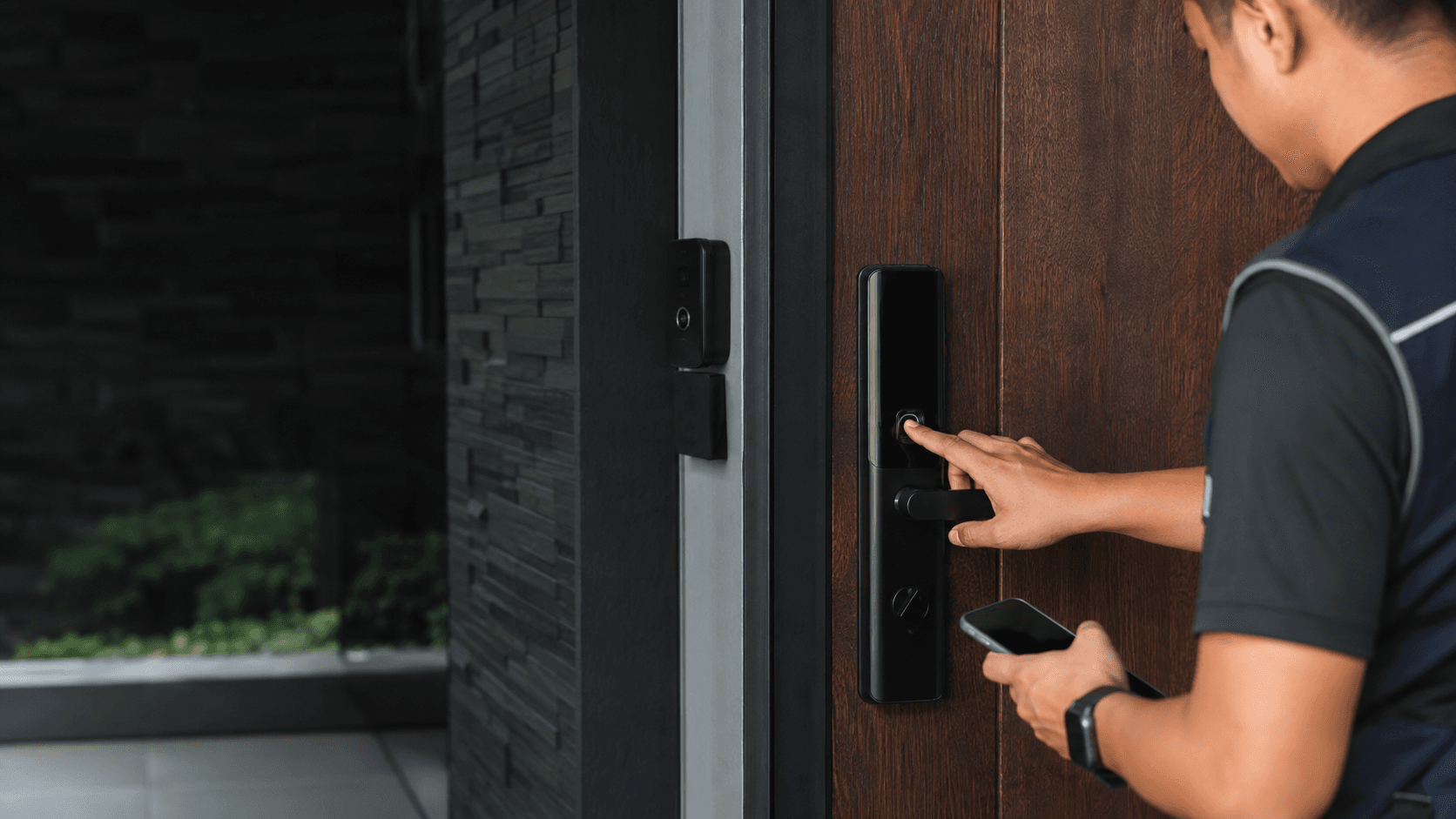
The category sits between two familiar things: a lock that opens without a key, and a lock that can be reached over a network. Eyonic's own product review notes that smart locks work best when the door condition, user roles and backup method are reviewed before installation. For business use, the same review states that Eyonic usually checks whether a standalone smart lock or an access-control panel is more appropriate.
That distinction matters in Malaysia, where a single address can hold a home, a shop and an office behind different doors. The lock is rarely the hard part. The door, the people who need entry, and the plan for the day the network or the phone fails are the parts that decide whether the installation feels calm or constantly troublesome.
Wifi Keyless Door Lock. What the Category Covers
A wifi keyless door lock is a door lock that grants entry without a physical key and can be managed over a wifi network. The label covers a wide spread of hardware, from a deadbolt replacement on a single front door to a lock that forms one part of a wider access-control setup.
Three capabilities usually sit inside the category. The first is keyless entry itself, where a code, a phone, a card or a fingerprint replaces the key. The second is network control, where the lock can be reached remotely rather than only at the door. The third is user management, where different people hold different levels of access.
Competitor pages in this category lean heavily on product naming and brand ranges. Across six analysed pages, none used the complete query in an H1 and none recorded an exact-match use in body text, so the phrase itself is effectively unclaimed in that set. The recurring topics were keyless entry, smart locks, remote lock access and home security, with lock brands and smart home platforms as the recurring entities.
What those pages rarely address is the local question. A lock that reads well in a product listing still has to fit a real door, serve real users, and survive a power cut or a dropped connection. That is where the practical work begins.
Where the category stops
A wifi keyless door lock is not the same as a full access-control system. A standalone lock manages one door and its users. An access-control panel manages multiple doors, multiple user groups and a wider view of movement through a building. Eyonic's review of smart lock door access draws that line directly, noting that for business use the choice between a standalone smart lock and an access-control panel is usually checked first.
The category also stops short of any guarantee about a specific door. No supplied evidence states whether a wifi keyless door lock suits particular door types, thicknesses or gate conditions in Malaysia, so door suitability has to be confirmed on site rather than assumed from a product page.
How Wifi Keyless Door Lock Entry Is Controlled
Control flows through three layers: the credential at the door, the network that carries commands, and the permissions that decide who may do what. A wifi keyless door lock works when all three layers agree.
At the door, entry is granted by whatever credential the lock accepts. At the network layer, the lock communicates so that access can be managed remotely and activity can be reviewed. At the permission layer, each user is given a role, and that role determines which doors open and when.
Eyonic's smart lock review places user permissions and backup entry alongside door condition as the three things to settle before installation. Those three items are not marketing language. They are the questions that decide whether the system stays manageable after the first month.
User permissions and roles
Permissions are the difference between a lock that helps and a lock that creates arguments. A household may need one permanent role and a small number of temporary ones. A shop may need staff access during trading hours and a separate arrangement for a cleaner or a delivery. An office may need staff, visitors and contractors kept apart.
Each role carries a decision about time as well as place. Access that is limited by date, by weekday, or to a single window is a normal part of the category, and competitor documentation describes codes limited by date, by weekday and time, and one-time codes. The practical question is which of those patterns matches how people actually arrive at the door.
Remote viewing and activity records
Remote viewing is the part of the category that lets someone check status without walking to the door. It also produces a record of activity, which is useful when several people share a door and nobody is certain who came in last.
Remote viewing depends on the network reaching the lock. Where wifi coverage at the door is weak, the remote layer becomes unreliable even though the lock itself still works. That is a coverage question, not a lock question, and it is worth settling before installation rather than after.
Backup entry when the network or phone is unavailable
Backup entry is the layer that keeps a door usable when the network drops, the phone is flat, or the power fails. Eyonic's review lists backup entry as one of the three items to plan before installation, which places it alongside door condition and user roles rather than treating it as an afterthought.
The backup method has to be decided deliberately. A door that depends entirely on one phone and one network has a single point of failure, and that failure will arrive at the least convenient moment. The choice of backup belongs in the planning conversation, not in the handover pack.
Door User and Backup Checks Before Choosing
Five checks cover most of the ground before any commitment. They run in order, because each one narrows the next.
- Confirm the door condition, including how the door closes, how the frame sits, and whether the existing hardware can carry a new lock.
- Define who needs entry and when, separating permanent users from temporary ones and setting the hours each group needs.
- Decide the backup entry method so the door still opens when the network, the phone or the power is unavailable.
- Confirm wifi coverage at the door, since remote control depends on a usable signal at that exact spot.
- Confirm who installs and hands over the system, including who explains the user roles and the backup method at the end.
Door condition comes first because it constrains everything else. A door that does not close cleanly will not reward a new lock, and a frame that has moved will keep causing problems regardless of how the lock is configured.
User roles come second because they shape the choice between a standalone lock and a wider access-control setup. A single door with a handful of users sits comfortably in the standalone category. Several doors with overlapping groups of staff, visitors and contractors point toward an access-control panel instead.
Backup entry comes third because it is the item most often left until the end. Wifi coverage comes fourth because it is measurable on site and cheap to check early. Installation and handover come last because they determine whether the first four decisions survive contact with daily use.
Trade offs between a standalone lock and a panel
A standalone lock is simpler to install and simpler to explain. It suits a home, a small shop, or a single office door where the user list is short and stable.
A panel costs more planning and more installation work, but it handles multiple doors and clearer separation between user groups. For a business with staff, visitors and contractors sharing entrances, that separation is usually the point.
The trade-off is not about which option is better in general. It is about how many doors and how many kinds of people the system has to serve.
Edge cases worth naming early
Some situations deserve attention before a decision is made. A door used by the public needs a different permission model from a staff-only door. A door with no reliable power nearby needs its backup method settled first. A site where the network is managed by someone else needs that person involved before installation, not after.
None of these cases is unusual. They are simply easier to handle when they are raised during planning rather than discovered during handover.
in Malaysian Homes and Premises
Malaysian premises often mix uses behind one address. A shophouse may hold a business at the front and a household at the back. An office may share a floor with a workshop. A home may have a main door, a side door and a gate that all need different levels of control.
That mix is why the category rewards planning over product selection. The same lock can be entirely appropriate at one door and a poor fit at another, depending on who passes through and how often.
Eyonic's completed work in Sarawak shows the pattern. The Kuching Immigration Office project focused on arrival flow, staff areas, visitor movement and dependable daily operation. The KTA Sarawak Sdn Bhd project supported staff movement, visitor handling, tidy cabling and clearer daily site control. Both are access questions first and hardware questions second.
Those projects are not lock installations, and they should not be read as such. They do show the kind of thinking that a door access decision benefits from: who arrives, where they go, and what has to keep working every day.
Homes shops and offices ask different questions
A home usually asks about convenience and about the people who live there. The user list is short, the hours are wide, and the main worry is being locked out.
A shop usually asks about trading hours and about staff turnover. The user list changes, and access needs to follow the roster rather than the other way round.
An office usually asks about separation. Staff, visitors and contractors need different treatment, and the record of who entered matters more than it does at home.
Each of those settings can be served by a wifi keyless door lock. What changes is the permission design and the backup plan behind it.
Installation and Handover for a
Eyonic's documented installation process runs through site survey, system proposal, installation and handover. That sequence is described for CCTV work, and it is the process the company follows for its installation services. Door access work sits inside the same shape.
The site survey is where door condition, wifi coverage and user roles get checked against the actual building rather than against an assumption. Eyonic applies the same principle elsewhere in its work: for ColorVu-style cameras, the company recommends checking actual lighting conditions before confirming placement. The equivalent discipline for a lock is checking the actual door and the actual signal before confirming a model.
The proposal stage turns those findings into a scope. It is also where the standalone-versus-panel question gets answered, since that choice affects both the hardware and the amount of installation work.
Installation follows, and handover closes the loop. Handover is where user roles are explained, the backup method is demonstrated, and the people who use the door daily learn what to do when something does not respond as expected.
What handover should cover
Handover is more than a set of codes. It should cover how each user role works, how to add or remove a user, what the backup entry method is and when to use it, and who to contact when the lock behaves unexpectedly.
It should also cover the limits. If wifi coverage at the door is marginal, that should be stated plainly rather than discovered later. If the backup method depends on something that has to be kept in a particular place, that belongs in the handover conversation.
Support after installation
No supplied evidence states warranty terms, service intervals or support response times for lock products, so those details have to be confirmed directly rather than assumed. The same applies to which lock brands or models are supplied, and to pricing for a lock and its installation.
What can be said is that the planning questions do not end at handover. User lists change, staff move on, and doors get used harder than expected. A system that was set up with clear roles and a working backup method is far easier to adjust later than one that was not.
Questions Buyers Ask
Does a wifi keyless door lock still work when the internet is down? The lock itself can continue to grant entry through its local credentials, while remote control and remote viewing depend on the network. This is exactly why backup entry is planned before installation rather than after.
Is a standalone lock enough, or is an access-control panel needed? Eyonic's review notes that for business use the company usually checks whether a standalone smart lock or an access-control panel is more appropriate. The deciding factors are the number of doors and the number of distinct user groups.
What has to be confirmed before choosing a model? Door condition, user roles and backup method come first, followed by wifi coverage at the door and clarity on who installs and hands over the system.
Can the same lock serve a home and a business at one address? It can, provided the permission design separates the two groups. A mixed-use premises needs the roles defined before the hardware is chosen, not after.
What is not yet confirmed? Technical specifications, supported brands and models, pricing, warranty terms and smart home platform compatibility are not covered by the available evidence. Those details need to come from the supplier directly.
Share your location, property type and required system with Eyonic on WhatsApp at +60 11-5111 7959 for the next practical step.