
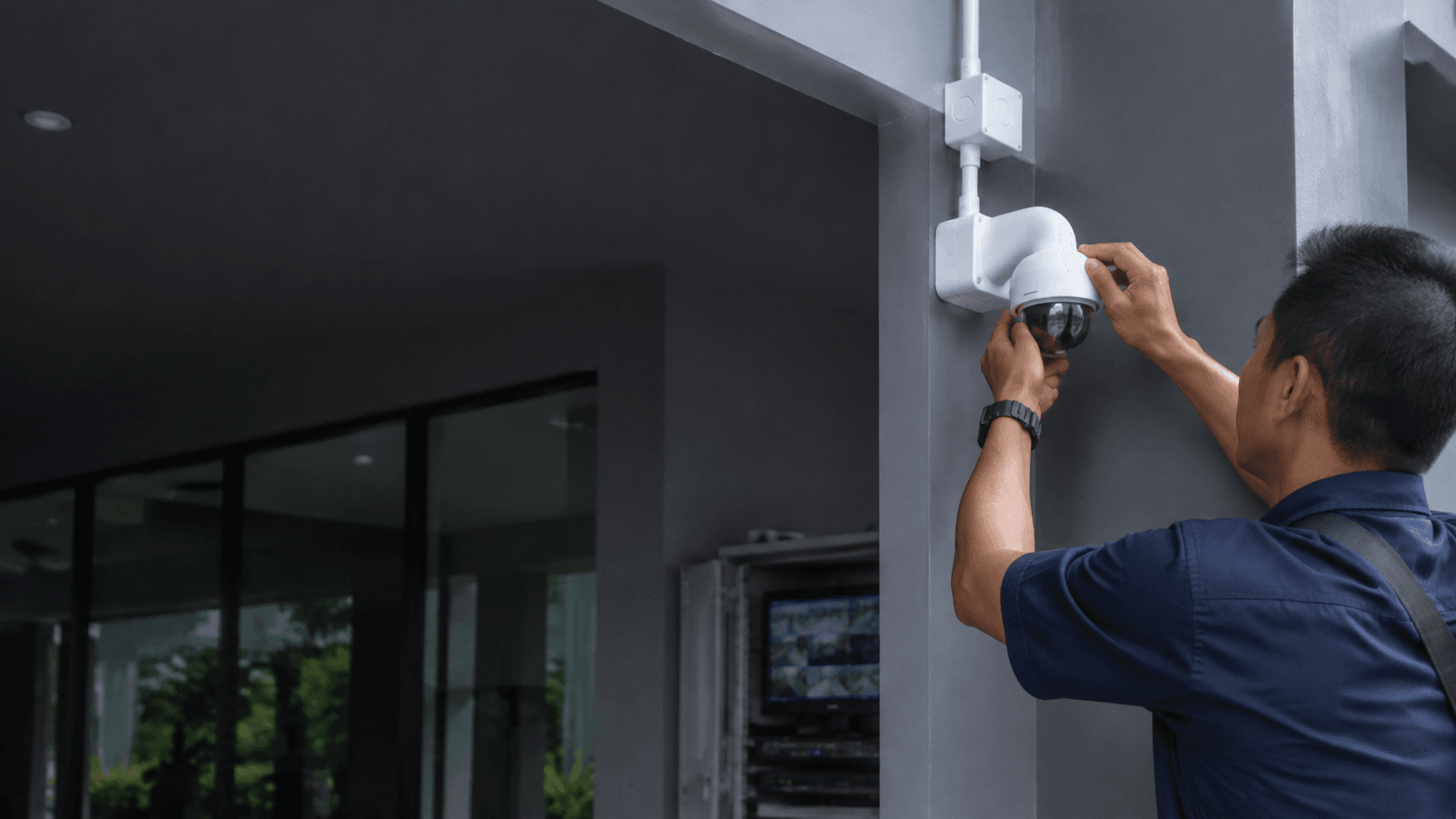
The term covers a broad family rather than one product. Hikvision builds network cameras in bullet, turret, dome and cube shapes, and infrared models sit alongside full-colour ColorVu and dual-light Smart Hybrid Light designs in the same catalogue. Buyers comparing options in Malaysia usually care less about the label and more about three practical questions: whether infrared will actually light the area at night, where the camera can be mounted and cabled, and how footage reaches a recorder and a phone.
Eyonic Sdn Bhd is a security system supplier in Sarawak that plans, supplies and installs monitoring systems with camera placement, recording and remote viewing for homes, offices, shops and industrial sites. The company's founder, Eric Yong, has worked in technical installation of digital security solutions for commercial businesses in Sarawak for more than 10 years.
Hikvision IR Network Camera. what the term covers
Infrared is a lighting method, not a product tier. An IR network camera carries infrared emitters around the lens, so when ambient light drops the camera switches from colour to black-and-white imaging and the emitters illuminate the scene. That is why IR models remain common for perimeter, corridor and after-hours coverage where a visible white light would be intrusive or draw attention.
Hikvision's own catalogue groups network cameras by series and form factor rather than by lighting type, and the same body shape can appear with infrared, ColorVu full-colour, or Smart Hybrid Light illumination. A turret sold as an IR model and a turret sold as a ColorVu model may look almost identical on a bracket. The difference shows up at night, and it shows up in how the site is planned.
Two consequences follow for anyone specifying a Hikvision IR network camera in Malaysia. First, the model code matters more than the marketing name, because the code carries the resolution, lens and lighting behaviour. Second, because no single IR specification is supplied here for a named model, the honest position is that the exact infrared range, resolution and housing rating must be confirmed against the datasheet for the specific unit before it is ordered.
Infrared versus full-colour night coverage
Infrared trades colour for reach. A scene lit only by IR emitters is recorded in monochrome, which is usually enough to establish that someone crossed a line, what they were carrying, and which direction they went. It is weaker at identifying clothing colour or vehicle paint.
Full-colour night coverage keeps colour but depends on either a very sensitive sensor or a visible white light. Eyonic's guidance on ColorVu-style cameras is to check the actual lighting conditions on site before confirming placement, because the published behaviour of a full-colour camera and the reality of a dim back lane or a shaded car porch are not always the same. The same discipline applies in reverse to infrared: the only reliable way to know whether IR will cover a gate, a walkway or a loading bay is to look at that spot after dark.
How IR night coverage is planned for Malaysian sites
Night coverage is decided by geometry and surfaces, not by a single number on a box. Infrared light behaves like a torch beam: it falls off with distance, it bounces off nearby surfaces, and it is absorbed or reflected differently by walls, foliage, glass and metal.
Several conditions recur on Sarawak sites and each one changes the plan.
- Reflective surfaces close to the lens, such as a white wall or a polished pillar, can bounce IR back into the sensor and wash out the image.
- Glass between the camera and the scene, including shopfront glazing and vehicle windscreens, reflects infrared and can obscure what is behind it.
- Deep overhangs, covered walkways and multi-storey car park decks block ambient light, so the camera relies almost entirely on its own emitters.
- Wide open boundaries, such as a long factory fence line or a perimeter road, spread the available IR over a large area and reduce usable detail at the far end.
- Rain and haze scatter infrared, so a scene that looks acceptable on a dry night can look softer during heavy weather.
Placement therefore follows the coverage requirement rather than the other way round. If the requirement is to read a number plate at a gate, the camera belongs close to the gate and angled along the approach. If the requirement is to see whether anyone is moving along a boundary, a wider view from a corner may serve better, with the understanding that faces at the far end will be small.
What a site survey should settle
A survey is where these questions get answered before anything is drilled. Eyonic's installation process begins with a site survey, and for night coverage the survey needs to happen at a time when the lighting conditions are representative, or at least with a clear record of what the site looks like after dark.
The survey should establish where power and network cabling can realistically run, which mounting points are reachable without scaffolding or a boom lift, which areas are public and which are staff-only, and where the recorder can sit without being trivially accessible. On the Kuching Immigration Office project, the scope centred on arrival flow, staff areas, visitor movement and dependable daily operation, which is the kind of brief that turns into camera positions rather than a camera count.
Hikvision IR Network Camera supply and installation steps
Eyonic's stated CCTV installation process runs through four stages. The sequence matters because each stage constrains the next: a proposal written before the survey tends to be revised, and a handover attempted before recording and viewing are configured leaves the site unable to use what it bought.
- Site survey. Review the property, the areas needing coverage, lighting conditions after dark, cable routes, mounting points and where the recorder and viewing devices will live.
- System proposal. Set out the camera positions, the recording and storage approach, and the remote viewing arrangement so the scope is agreed before work starts.
- Installation. Mount and aim the cameras, run and terminate cabling, commission the recorder, and configure recording schedules and remote viewing.
- Handover. Walk through live and recorded playback, confirm mobile viewing works, and explain how to retrieve footage when it is needed.
Two details in that sequence deserve emphasis. Aiming is not a formality. a camera rotated a few degrees can move a reflection out of frame or bring a doorway into view, and it is far cheaper to adjust during installation than to return later. Handover is also where most operational problems are prevented, because a system nobody can retrieve footage from is not doing its job.
Recording, storage and remote viewing
An IR network camera is only half a system. Footage has to be recorded somewhere and reached from somewhere. Eyonic's service scope covers NVR setup and remote viewing alongside camera placement, which means the recorder, the retention period and the mobile access are treated as part of the same design.
Retention is a decision, not a default. Keeping more days of footage requires more storage, and the storage requirement depends on how many cameras are recording, at what resolution, and whether recording runs continuously or only on motion. A site that needs a month of history is a different system from one that needs a week.
Remote viewing raises its own questions. Who needs access, on how many devices, and what happens when a staff member leaves? Access should be granted deliberately and reviewed, not handed out informally. Where the recorder sits also matters: a recorder in an open reception area is easier to tamper with than one in a locked cabinet or a restricted room.
What a setup costs in Malaysia
Published package pricing is the clearest starting point. Eyonic lists a Hikvision CCTV Package at RM 1,599 covering camera supply and setup, basic recording configuration and mobile viewing handover. That figure describes a package scope, not the price of an individual camera unit, and no standalone unit price for a Hikvision IR network camera is supplied here.
Larger or more complex sites sit in a different range. Eyonic's Kuching Immigration Office project carries an approximate budget of RM 12,000 to RM 28,000, and the KTA Sarawak Sdn Bhd office project carries an approximate budget of RM 8,000 to RM 18,000. Both are project-level figures for office environments with multiple coverage areas, cabling and configuration, and both are described as approximate.
What moves a budget between those two ends is usually scope rather than camera brand. The number of coverage areas, the distance and difficulty of cable runs, whether containment or trunking is needed, whether existing cabling can be reused, how much storage is required, and whether the site can be worked in during business hours all change the total. A single-camera addition to an existing system and a first-time installation across a two-storey office are not comparable jobs even when the cameras are similar.
It is worth being explicit about what is not covered by the figures above. Warranty terms, stock availability and lead times for specific Hikvision IR network camera models are not stated here, and neither is any regulatory or data-handling requirement that may apply to a particular site. Those should be confirmed directly for the property in question.
Where a suits daily operation
Infrared coverage earns its place where the priority is knowing what happened after dark without lighting the area. Common fits include office perimeters and back entrances, shop storerooms and rear service doors, factory yards and loading areas, and residential gates and car porches.
It fits less well where colour identification at night is the whole point, such as reading vehicle colour or clothing in a dim area, or where the scene is so wide that a single camera cannot resolve detail at the far edge. In those cases the answer is usually more cameras, different positions, or a different lighting approach rather than a different brand.
Daily operation is the real test. A system that records reliably, can be checked from a phone, and produces footage that can be found and exported when something happens is doing its job. A system with impressive specifications that nobody can operate tends not to be used, and unused systems are discovered to be misconfigured only when footage is needed.
The Kuching Immigration Office brief is a useful reference point for that idea. Arrival flow, staff areas, visitor movement and dependable daily operation describe an operational requirement, and the camera plan follows from it. The same logic applies to a shop in Kuching or an industrial site in Bintulu: decide what needs to be known, then choose positions and equipment that deliver it.
Questions to settle before confirming a
Most of the risk in a camera project sits in decisions made before installation. Working through the following points early tends to reduce revisions later.
- Which specific areas need coverage, and what needs to be established about each one: presence, movement direction, a face, or a plate?
- What does each area look like after dark, and has that been checked on site rather than assumed?
- Where can cameras be mounted so they are reachable for adjustment but not easily tampered with?
- How will cabling reach each position, and does the route need containment or approval from the building owner?
- Where will the recorder sit, and how many days of footage need to be retained?
- Who needs remote viewing access, on which devices, and how will that access be reviewed when staff change?
- What is the realistic budget range for the scope, and which parts of the scope could be phased if the budget is tight?
Two of these deserve a second look. Retention is often underestimated, because storage is sized for the worst case rather than the average day. Access review is often skipped entirely, and it is the point at which a well-installed system quietly becomes a liability.
Where the site is a workplace with staff and visitors, it is also worth deciding in advance who can view footage and under what circumstances, and recording that decision. That is an operational policy question rather than a technical one, and it is easier to settle before the system goes live than after the first request for footage arrives.
For sites in Sarawak, the practical next step is to describe the property, the areas needing coverage and the system required, so the survey and proposal stages can be scoped against the actual site. Eyonic can be reached on WhatsApp at +60 11-5111 7959 for that discussion.