
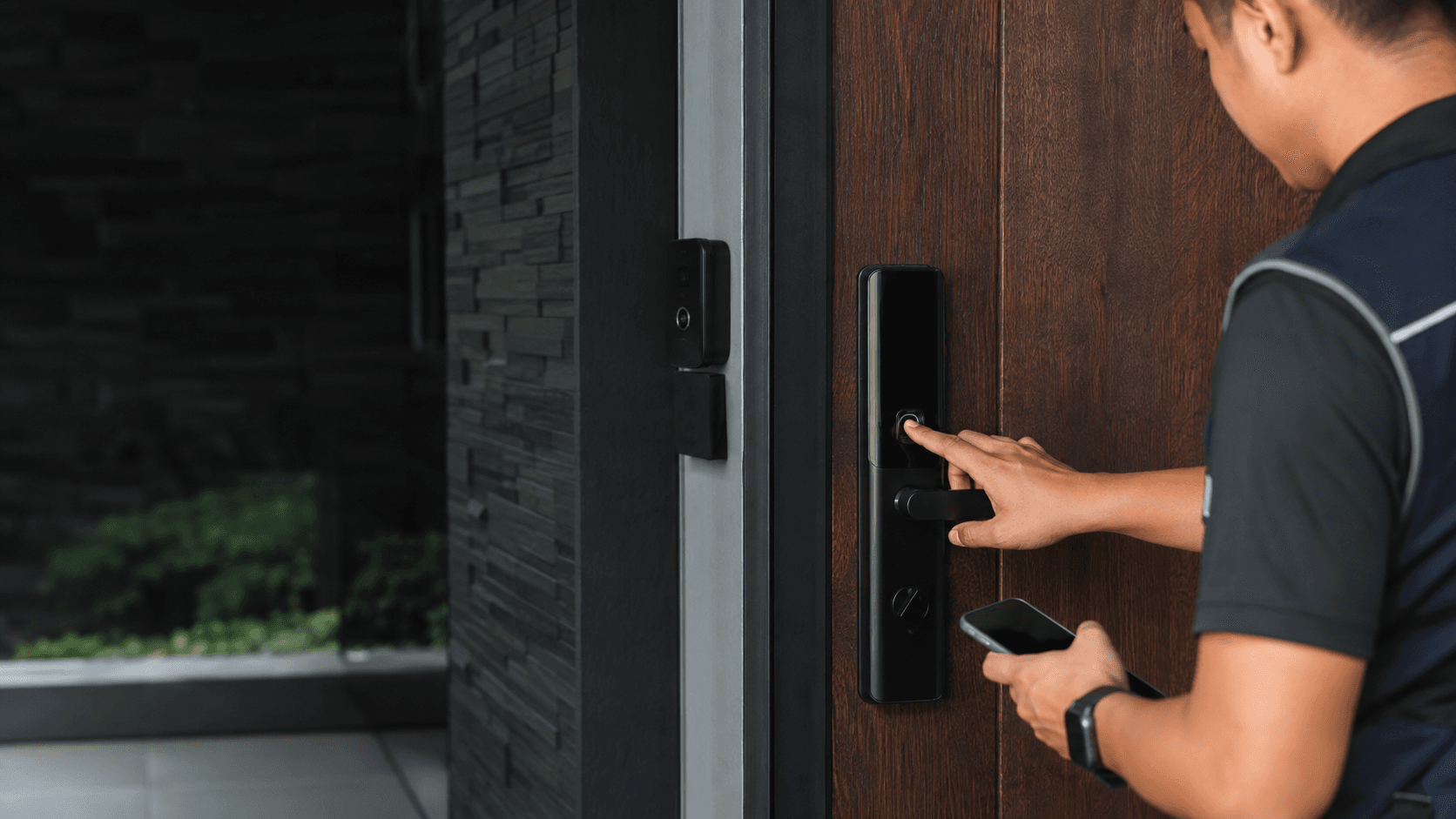
The category spans mechanical pushbutton levers, battery keypad levers and connected smart levers. Buyers in Malaysia usually meet it while upgrading a main entrance, an office door or a rental unit where key handover is a recurring problem. The practical question is not whether keyless entry works, but which lock body, door preparation and backup method suit the door already in place.
Keyless Door Levers. What Matters Before Choosing
Three things decide whether a keyless lever fits a door: the existing bore or mortise preparation, the door thickness and handing, and how the lock is powered and overridden. A lever that ignores any of these becomes a return or a rework.
- Confirm the door preparation. A cylindrical bore suits most residential keypad levers; a mortise pocket suits commercial electronic levers.
- Measure door thickness and note the handing, because many levers are reversible while mortise bodies are not.
- Decide the credential type. keypad code, pushbutton code, card, fob or app.
- Check the backup method, usually a mechanical key override or an external power point.
- Match the lever to the traffic level, since light commercial and residential models differ in duty rating.
- Plan code management before installation, especially where staff or tenants change often.
Factory Direct Hardware frames the same decision around door prep, function, codes, key override, batteries and controls, which matches how installers sequence the work on site. Kwikset separates mechanical levers from electronic and smart levers, a useful split because the two groups fail in different ways.
Choosing the Right Keyless Door Levers
Residential keypad levers typically run on AA batteries and offer a keypad plus key override. Commercial electronic levers often use cylindrical or mortise bodies, support multiple user codes, and may integrate with an access-control panel rather than standing alone.
Eyonic's own product guidance makes that distinction directly: smart locks work best when the door condition, user roles and backup method are reviewed before installation, and for business use the choice between a standalone smart lock and an access-control panel is worth checking first. That is the same fork a buyer faces when comparing a single keypad lever against a managed door.
What is keyless door levers?
Keyless door levers are lever-style door handles paired with a locking mechanism that accepts a code, card, fob or app instead of a cut key. The lever format matters because it is easier to operate than a round knob for people carrying items, and it is commonly specified where accessibility is a consideration.
The term covers several distinct products. Mechanical pushbutton levers need no battery and no wiring. Electronic keypad levers add a powered keypad and usually a key override. Smart levers add wireless connectivity so codes can be issued remotely. A passage lever with no locking function is not keyless entry at all, even though it is sold in the same listings.
Keyless Levers. Mechanical, Electronic and Smart
The three families differ in power, cost of ownership and failure mode. Mechanical pushbutton models avoid batteries entirely but offer a single shared code and no audit trail. Electronic keypad models add user codes and often a temporary code for visitors. Smart models add remote management but depend on a network and an app.
| Family | Power | Typical fit | Main constraint |
|---|---|---|---|
| Mechanical pushbutton lever | None | Utility doors, gates, low-traffic entries | One shared code, no audit trail |
| Electronic keypad lever | Battery | Homes, small offices, rental units | Battery replacement and code resets |
| Smart lever | Battery or wired | Managed offices, multi-user sites | Network dependency and app administration |
| Commercial electronic lever | Wired or battery | Offices, clinics, public counters | Higher cost and panel integration |
Battery life is the trade-off most buyers underestimate. A keypad lever on a busy entrance can drain faster than the same model on a storeroom door, so the low-battery warning and the override path deserve a check before purchase rather than after the first lockout.
Practical Considerations for Keyless Door Levers
Installation is usually the smaller cost; door preparation is the larger risk. A door that already has a cylindrical bore accepts most residential keypad levers. A door with a mortise pocket needs a mortise-compatible body, and a door with unusual thickness may need a different latch or an extended component.
Fire-rated and egress doors add constraints. Hardware on those doors must satisfy the door's rating and the local requirement for free egress, so a lever chosen purely on price may not be permitted. Accessibility is a related consideration: lever handles are generally preferred over knobs, but the operating force and the mounting height still matter.
For multi-door sites, the decision often shifts from a single lever to a managed system. Eyonic's work for the Kuching Immigration Office focused on arrival flow, staff areas, visitor movement and dependable daily operation, which is the pattern a public-facing entrance follows: the door hardware has to keep working through a full day of visitors, not just at handover.
Eyonic's project for KTA Sarawak Sdn Bhd covered a practical office setup in Kuching supporting staff movement, visitor handling, tidy cabling and clearer daily site control. Cabling tidiness matters more than it sounds when a wired electronic lever is added to an existing door frame, because the power route has to be planned before the frame is closed up.
Where keyless levers fit in a wider security setup
Door hardware is one layer. Eyonic supplies and installs CCTV, alarm systems, autogate systems, keyphone intercoms and Starlink internet across Sarawak, and a keyless lever is often specified alongside those systems rather than in isolation. A keypad lever on a main entrance and a camera covering the same approach answer different questions: the lever controls who enters, the camera records what happened.
Eyonic's founder, Eric Yong, has worked in technical installation of digital security solutions for commercial businesses in Sarawak for more than ten years, which is the kind of experience that shows up in door preparation and cable routing decisions rather than in the product box.
Making an Informed Choice About
The decision narrows quickly once the door is measured and the user list is written down. A single household entrance usually suits a battery keypad lever with a key override. A rental unit suits a lever with temporary codes and a simple reset process. An office with changing staff suits a model with individual codes or a panel-connected lever.
Cost is worth framing against the alternative. Eyonic's published packages for CCTV, alarm and autogate work are each priced at RM 1,599, which gives a sense of what a single-system installation costs in this market. Door hardware is usually a smaller line item than a full camera or alarm system, but it sits on the same site visit and the same cabling plan.
Two constraints deserve a final check. First, confirm the lever is rated for the door it will sit on, particularly on fire-rated or high-traffic doors. Second, confirm the backup entry method is documented and accessible to someone other than the person who installed it, because a keyless door with no override is a lockout waiting to happen.
Share the location, property type and required system with Eyonic on WhatsApp at +60 11-5111 7959 for the next practical step.