
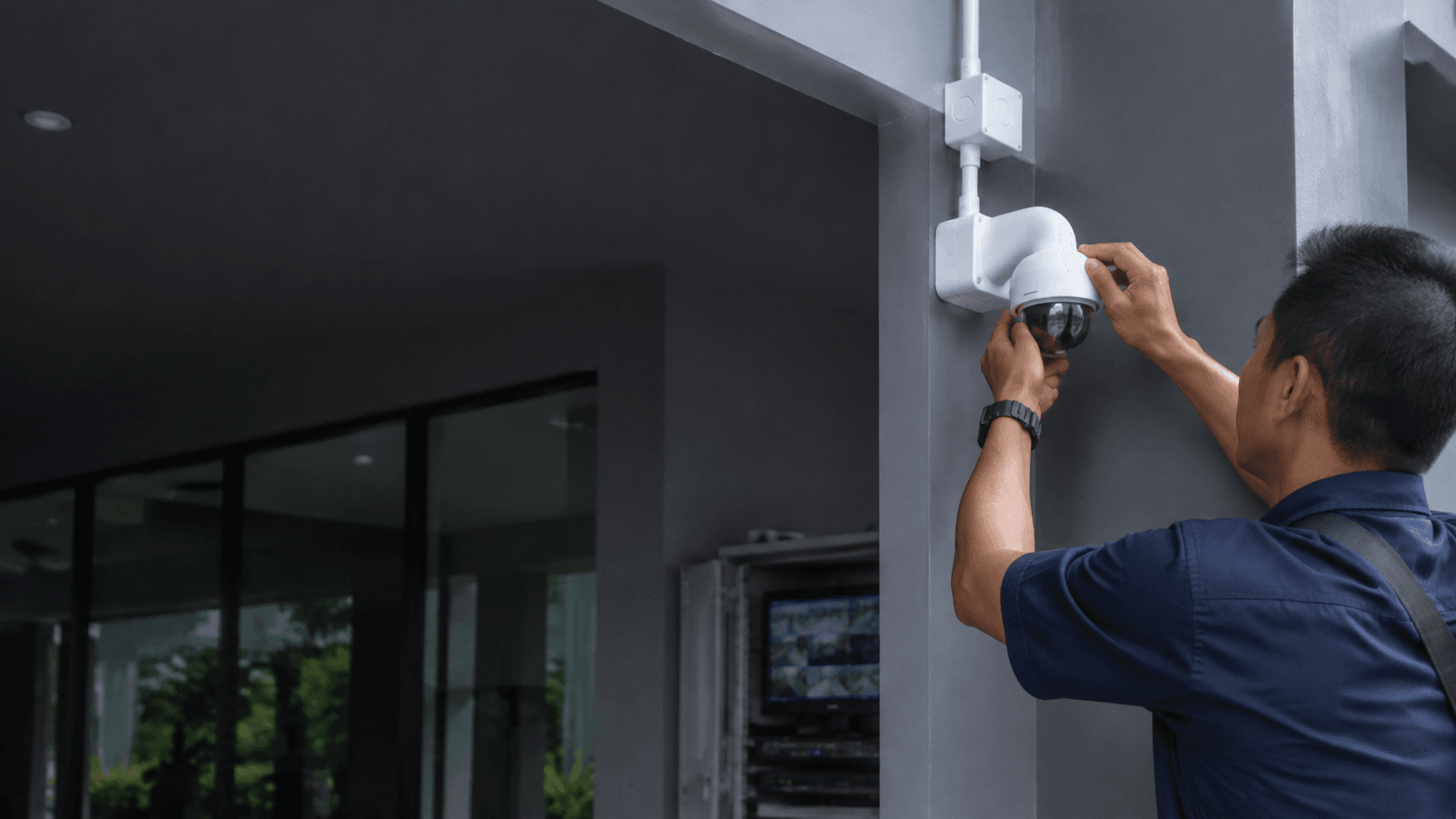
The term describes a private viewing loop. Cameras capture a scene, a cable or network carries the signal, a recorder stores it, and someone watches live or reviews footage later. That loop is why the abbreviation still fits modern digital systems even though the underlying technology has moved on from coaxial cable and tape.
What cctv full stands for in everyday use
The letters stand for closed-circuit television. The "closed circuit" part is the important half: the signal travels around a defined circuit of cameras, recorders and viewing devices instead of being transmitted for anyone to receive. A broadcast sends one signal to many receivers. A closed circuit sends many camera signals to a controlled set of viewers.
In Malaysia, the phrase is used loosely. A shop owner in Kuching asking about cctv full usually means the whole working arrangement: cameras on the ceiling, a recorder in a back room, a phone that shows the front counter, and footage that can be pulled up after an incident. The abbreviation covers the category, not one specific product.
Two related terms appear often enough to separate. A DVR records analogue camera signals, while an NVR records network cameras over an internet protocol connection. Both sit at the centre of a cctv full setup, and the choice between them usually follows the cameras already installed or planned rather than the other way around.
How a working CCTV setup is put together
A functioning system is a chain, and the weakest link decides the result. Cameras need a clear view and adequate light. Cabling or wireless links need a stable path back to the recorder. The recorder needs enough storage for the retention period the owner actually wants. The viewing device needs a network connection that reaches the recorder reliably.
Eyonic plans, supplies and installs monitoring systems with camera placement, recording and remote viewing for homes, offices, shops and industrial sites. The company's installation process follows a fixed order:
- Site survey — walk the property, check sightlines, lighting and where cabling can run.
- System proposal — match camera positions, recorder and storage to the site and budget.
- Installation — mount cameras, run cabling, configure recording and remote viewing.
- Handover — test the system with the user and confirm live view and playback work.
The sequence matters because placement decisions made before a survey are guesses. A camera aimed at a gate that floods with headlight glare at night performs differently from one aimed at a shaded walkway, and the survey is where that gets caught.
Recorder and storage choices
Storage is the constraint most owners underestimate. Continuous recording fills a drive faster than motion-triggered recording, and higher resolution fills it faster still. The practical question is how many days of footage need to be available, because that answer sets the drive size and the recording mode.
Remote viewing adds a second constraint. Footage that can be watched from a phone depends on the recorder being reachable over the network and on the upload speed at the site. A strong download connection does not guarantee smooth remote playback.
Planning camera placement around real lighting
Lighting decides whether a camera is useful after dark. Eyonic recommends checking actual lighting conditions before confirming placement for ColorVu-style cameras, which are designed to produce colour images in low light. The recommendation exists because a product description and a real doorway at 8pm are different tests.
Placement also has to account for what the camera is meant to prove. A camera covering a wide area shows that something happened. A camera positioned closer to the point of entry shows who did it. Many sites need both, which is why a single camera rarely covers an entrance well on its own.
Practical constraints shape the rest. Cabling routes may not exist where the ideal camera position sits. Direct sun can wash out an image at certain hours. A camera mounted too low becomes easy to tamper with, while one mounted too high may lose facial detail. These trade-offs are settled on site, not on a specification sheet.
What the Kuching Immigration Office project shows
Eyonic completed a project for the Kuching Immigration Office, focused on arrival flow, staff areas, visitor movement and dependable daily operation. The scope is instructive because it is not a single-camera job. A public office has several distinct zones, and each one raises a different question about coverage.
Arrival flow needs cameras that follow movement through an entrance without gaps between fields of view. Staff areas need coverage that supports daily operations rather than surveillance for its own sake. Visitor movement needs a record that can be reviewed if a question arises later. Dependable daily operation is the requirement underneath all of them: a system that works on an ordinary Tuesday, not just on the day it was installed.
The approximate budget for that type of work is RM 12,000 to RM 28,000. A separate Eyonic project for KTA Sarawak Sdn Bhd, an engineering consultancy office in Kuching, covered staff movement, visitor handling, tidy cabling and clearer daily site control, with an approximate budget of RM 8,000 to RM 18,000. The gap between the two ranges reflects scope and site conditions rather than a fixed price per camera.
For smaller premises, Eyonic lists a Hikvision CCTV package at RM 1,599 covering camera supply and setup, basic recording configuration and mobile viewing handover. That package sits at the opposite end of the scale from the office projects, which is a useful reminder that cctv full covers a very wide range of installations.
Questions to settle before installation
The answers change the design, so they are worth settling early. What needs to be seen, and from what angle? How long must footage be kept? Who needs to view it, and from where? What lighting exists at night? Where can cabling run without damaging finishes? Is the site a home, a shop, an office or an industrial space, since each brings different movement patterns and different tolerance for visible equipment?
One more question sits underneath the rest: what happens when the system is not working? A recorder that fills up, a camera that loses its connection or a router that resets can all leave gaps in coverage. Handover testing is where those failure points get checked, and it is the stage most easily rushed.
Eric Yong, founder of Eyonic Security Systems, has worked in the industry for more than ten years and is experienced in technical installation of digital security solutions for commercial businesses in Sarawak. That background shapes how the company approaches site surveys, because commercial sites tend to have more constraints on cabling and more stakeholders with an opinion on camera positions.
For anyone weighing up a cctv full installation in Sarawak, the useful next step is a site survey rather than a product list. Share your location, property type and required system with Eyonic on WhatsApp at +60 11-5111 7959 for the next practical step.