
Buyers searching for the latest CCTV camera usually want two things at once: newer camera technology and a system that still works years from now. Those two goals pull in different directions. A newer model may add colour night vision or smarter detection, while an older, proven model may cost less and have more spare parts available locally.
This guide separates what actually changes between camera generations from what stays the same, then shows how a Sarawak installation is planned from survey to handover.
Latest CCTV Camera. What Matters Before Choosing
Three things decide whether a newer camera is worth the money: how it performs in real lighting, how footage is stored, and whether the recorder can handle the resolution. Everything else is secondary.
- Check the actual lighting at each camera position, not the lighting at midday.
- Decide where footage lives — recorder hard drive, memory card, or cloud.
- Confirm the recorder supports the camera's resolution and codec.
- Map cable routes and power before drilling anything.
- Test remote viewing on the phone that will actually be used.
- Agree on who reviews footage and how long it is kept.
Eyonic's own installation process follows a similar order: site survey, system proposal, installation, then handover. That sequence matters because a camera chosen before the survey is a guess.
What is latest cctv camera technology actually changing?
Most movement is in four areas. Colour night vision lets a camera produce a colour image in low light instead of switching to infrared black and white. Higher resolution sensors push past 1080p into 2K, 4K and beyond. On-camera analytics can distinguish a person from a moving branch. And storage is shifting between local recorders and cloud services.
None of these are automatically better for every site. A 4K camera on a recorder that only handles 1080p will not deliver 4K footage. A colour night vision camera needs some ambient light to work as intended, which is why Eyonic recommends checking actual lighting conditions before confirming placement for ColorVu-style cameras.
Choosing the Right Latest CCTV Camera for the Site
The right camera depends on the job it has to do. A shop entrance, a warehouse loading bay and an office corridor each need different coverage.
Match the camera to the space
Indoor areas with even lighting suit fixed dome cameras, which are compact and less obtrusive. Outdoor entrances exposed to rain and direct sun need weather-rated housings and careful angle planning to avoid glare. Long driveways and perimeter fences usually need cameras with a narrower field of view so faces and plates remain readable rather than tiny.
Coverage overlaps matter more than camera count. Two well-placed cameras covering an entrance from different angles will usually identify a person better than four cameras all pointed at the same doorway from the same height.
Wired or wireless
Wired cameras carry power and data over a single cable and do not compete for Wi-Fi bandwidth. Wireless cameras are easier to add later but depend on signal strength at the mounting point, which is often weaker than it is inside the building. For a fixed installation covering a defined area, wired remains the more predictable choice.
Storage and retention
Footage retention is a decision, not a default. A recorder with a larger hard drive keeps more days of video. Higher resolution and continuous recording both consume storage faster, so a 4K system recording around the clock needs more capacity than a 1080p system recording only on motion.
Practical Considerations for Installations
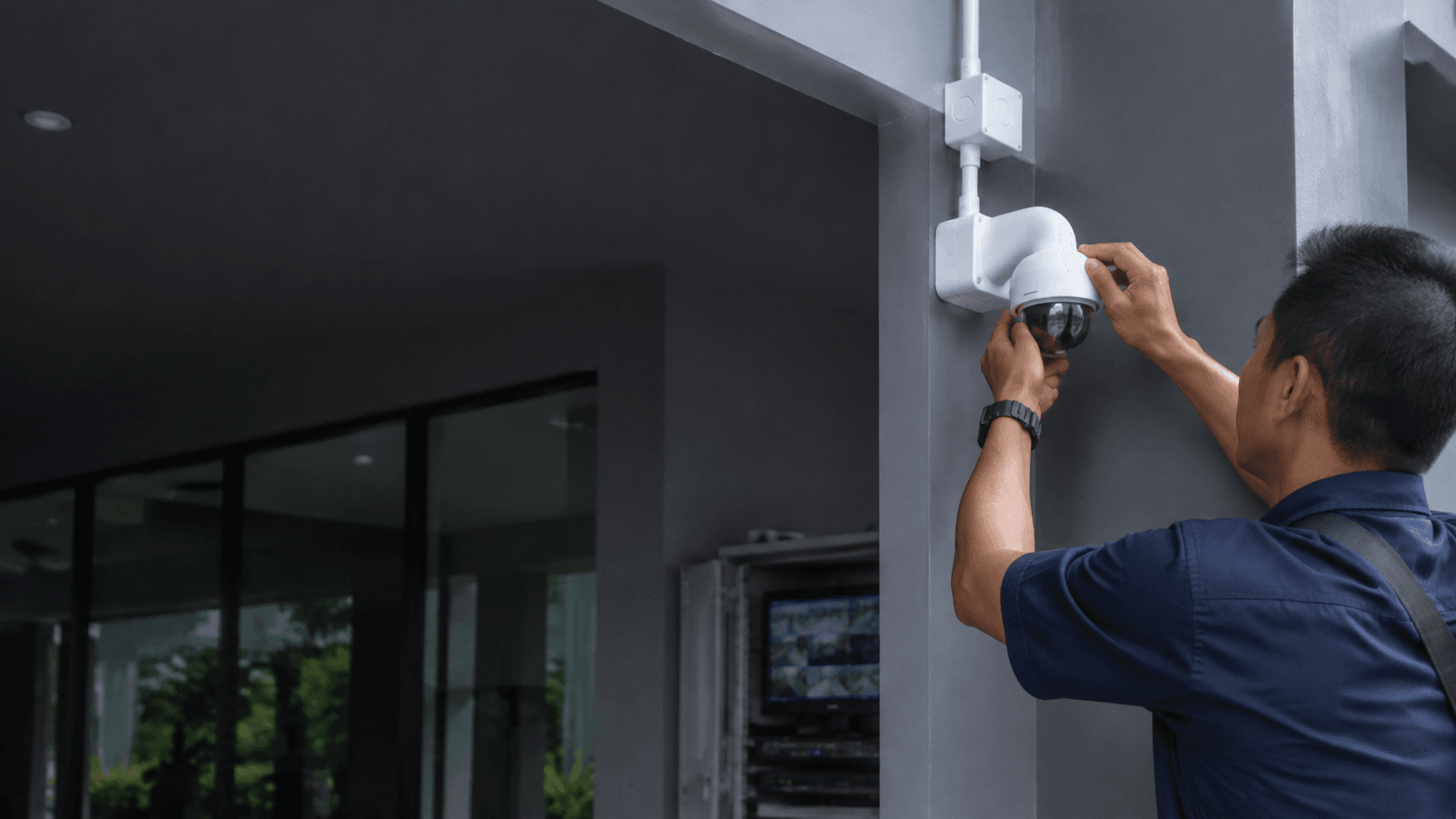
Installation quality decides whether a good camera performs well. Cable routing, camera height, and lens angle all affect what the footage actually shows.
Camera placement
Cameras mounted too high capture the tops of heads rather than faces. Cameras pointed directly at a bright doorway lose detail in the shadowed area behind it. Placement should be confirmed on site, with a test view, before brackets are fixed.
Lighting and night performance
Night performance is where most expectations break down. Infrared gives black-and-white images in complete darkness. Colour night vision needs at least some light. A street lamp, a porch light or a shop sign can be enough, but that has to be verified at the actual position rather than assumed from a specification sheet.
Remote viewing and handover
Remote viewing only counts if it works on the device the owner carries. Handover should include setting up the mobile app, confirming playback works, and showing how to export a clip if it is ever needed.
Working with an installer in Sarawak
Eyonic Sdn Bhd is a security system supplier based in Sarawak, specialising in CCTV and ELV systems. The company plans, supplies and installs monitoring systems with camera placement, recording and remote viewing for homes, offices, shops and industrial sites. Its founder, Eric Yong, has worked in the industry for more than ten years, with experience in technical installation of digital security solutions for commercial businesses in Sarawak.
Completed work includes the Kuching Immigration Office, where the focus was arrival flow, staff areas, visitor movement and dependable daily operation. A separate project for KTA Sarawak Sdn Bhd covered a practical office setup in Kuching supporting staff movement, visitor handling, tidy cabling and clearer daily site control.
Making an Informed Choice About the
A newer camera is worth buying when it solves a specific problem: a doorway that is unreadable at night, a blind spot on a perimeter, or footage that is too soft to identify anyone. It is not worth buying simply because the model number is higher.
The practical test is whether the whole chain works together — camera, cable, recorder, storage and viewing app. A mid-range camera on a correctly sized recorder will outperform a top-spec camera on an undersized one.
Budget expectations
Eyonic lists a Hikvision CCTV package at RM 1,599, covering camera supply and setup, basic recording configuration and mobile viewing handover. Larger commercial work sits well above that. The Kuching Immigration Office project carried an approximate budget of RM 12,000 to RM 28,000, and the KTA Sarawak Sdn Bhd project an approximate budget of RM 8,000 to RM 18,000. Those ranges reflect scope, camera count and site complexity rather than camera brand alone.
Common questions
Does a newer camera need a subscription? Not necessarily. Many systems record to a local recorder or memory card with no recurring fee. Cloud storage is an optional add-on, not a requirement of the hardware.
Can existing cameras be upgraded one at a time? Sometimes. It depends on whether the existing recorder supports the new camera's resolution and signal type. That is worth confirming before buying replacements.
How long does installation take? It varies with camera count, cable routes and building type. A site survey is what produces a realistic timeline, which is why Eyonic's process starts there.
Is 4K always better? No. 4K helps when detail matters across a wide area, but it increases storage use and demands a capable recorder. For a small indoor space, a lower resolution with good placement often reads better.
Share your location, property type and required system with Eyonic on WhatsApp at +60 11-5111 7959 for the next practical step.