
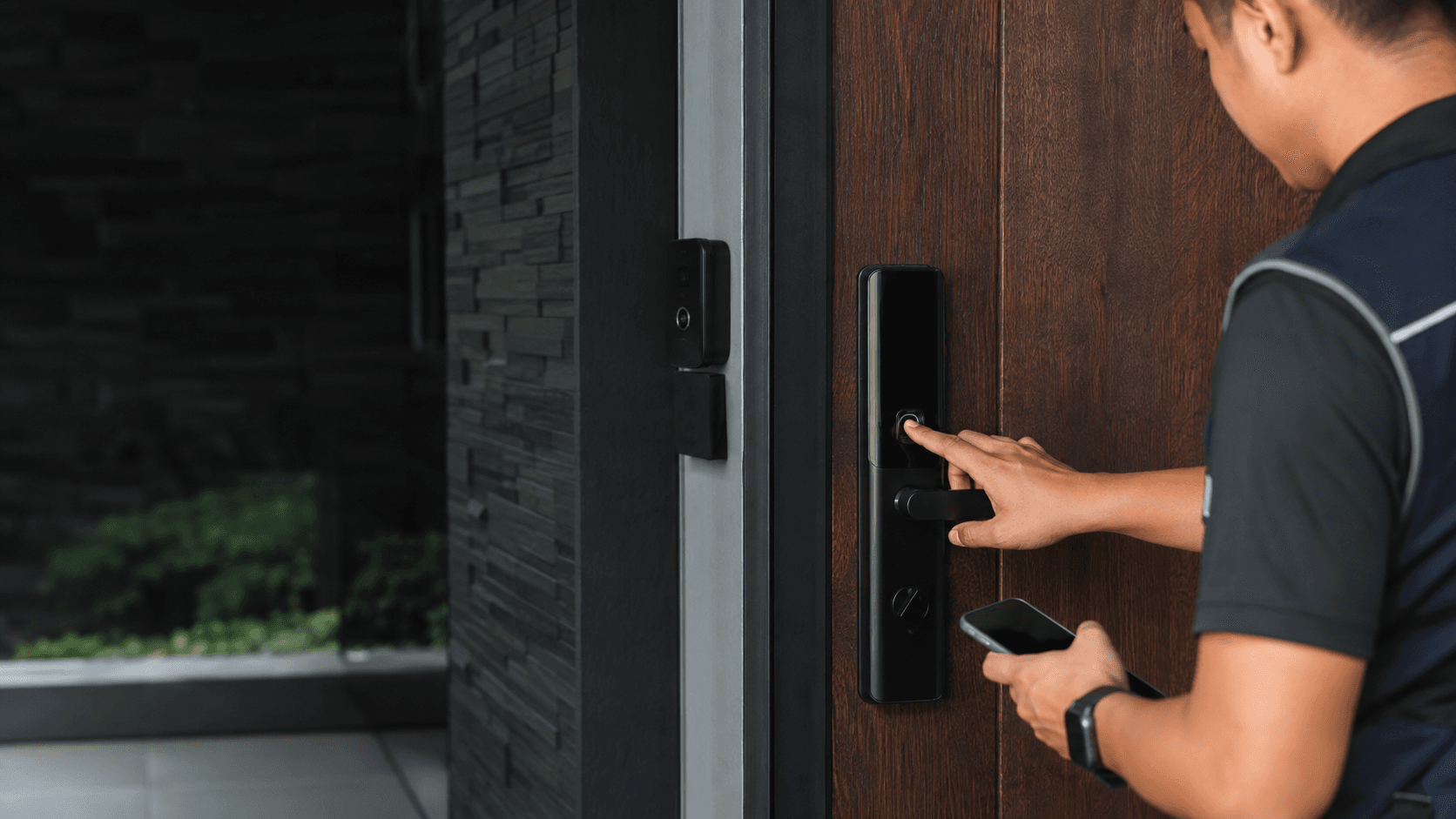
Those two formats are the core of the category. A deadbolt replaces the bolt already in the door; a handle set replaces the lever or knob and often carries the keypad in the handle itself. Both appear in the Lowe's electronic door lock listings that dominate current results for this query, and both raise the same practical questions about door preparation, user roles, and what happens when a battery dies or a phone is lost.
Malaysian readers arrive at this query with a specific problem. The Lowe's pages that rank are category listings with almost no explanatory text, so they show what exists without explaining what fits. This article covers the same lock formats and access methods in readable prose, then adds the checks those listings omit: door condition, user permissions, backup entry, and what to confirm before ordering anything from overseas.
Keyless Entry Door Lock Lowes. What The Category Covers
The phrase describes a shopping category rather than a single product. Lowe's groups electronic door locks under door hardware, and the listings that rank for this query are best-seller and new-release pages rather than buying guides. That structure tells the reader something useful: the category is organised by product listing, not by explanation.
Within that category, the recurring topics are electronic deadbolts, electronic handles, smart locks, biometric access, keypad entry, RFID access, remote app control, sliding glass door locks, mortise locks, and patio door security. Those topics describe two different jobs. Some products secure a swinging entry door. Others secure a sliding panel or a gate. A lock bought for one job rarely suits the other.
One practical consequence follows from the category structure. Because the ranking pages carry no specifications, no installation notes, and no regional availability information, a reader cannot confirm from those pages alone whether a given lock suits a Malaysian door. That confirmation has to come from the product documentation or from someone who has handled the door.
Electronic Deadbolt And Handle Formats
An electronic deadbolt keeps the familiar deadbolt position above or below the handle and adds an electronic method of throwing the bolt. The exterior side usually carries a keypad or a reader. The interior side carries a thumb turn or a motor. Installation normally reuses the existing bore holes, which is why deadbolt formats are the more forgiving choice on an existing door.
An electronic handle replaces the lever or knob assembly. The keypad sits in the handle or in a separate plate above it. This format suits a door that already has a handle and no separate deadbolt, or a door where the owner wants one integrated unit rather than two pieces of hardware. It is less forgiving, because handle backset and door thickness matter more when the whole assembly is being replaced.
Mortise locks form a third group. These sit inside a pocket cut into the door edge and combine latch and bolt in one body. They appear in the Lowe's topic cluster, and they are common on heavier doors. A mortise lock is not a drop-in replacement for a bored deadbolt, and the reverse is also true.
Sliding glass door locks and patio door security products address a different opening entirely. A sliding panel needs a lock that engages the frame or the track, not a deadbolt through a door edge. Treating these as interchangeable with entry door locks is one of the more common mistakes in this category.
Keypad, Biometric, RFID And App Control
The access method matters more than the brand name for day-to-day use. Each method shifts a different burden onto the user.
Keypad entry asks for a code. It works for anyone who can remember or be told a number, needs no phone, and fails only when the code is shared too widely or the keypad is worn. Code hygiene is the whole security model.
Biometric access reads a fingerprint. It removes the shared-code problem because there is nothing to pass along. It also introduces a new failure mode: a finger that is wet, dirty, or injured may not read, and enrolment is per person rather than per group.
RFID access uses a card or fob. It suits offices and shops where staff already carry a credential, and it makes revocation simple because a lost card can be removed from the system. The trade-off is that cards get lent, lost, and left in bags.
Remote app control adds a network dependency. The lock needs a bridge or a wireless connection, and the phone needs the app and an account. This is the most convenient method for granting temporary access and the most fragile when the network or the account is unavailable.
Eyonic's own product review notes that smart locks work best when the door condition, user roles, and backup method are reviewed before installation, and that for business use the choice between a standalone smart lock and an access-control panel deserves a deliberate decision. That is a useful frame for this category, because a home entry door and a shop staff entrance rarely want the same answer.
Door Condition And Backup Entry Checks
Before any lock is ordered, five checks decide whether the purchase will work. They are worth doing in order, because each one can rule out a format.
- Confirm door thickness and the existing bore. A deadbolt needs a bore of the right diameter and a door within the thickness range the lock supports. A door that is too thin or too thick removes most of the category.
- Confirm whether a deadbolt or a handle format fits the door. If the door already has a deadbolt bore, a deadbolt lock is the simpler path. If it has only a handle, an integrated handle set avoids cutting new holes.
- Confirm user roles and permissions. Decide who needs permanent access, who needs temporary access, and who needs to be removed later. A lock that cannot separate those groups will be managed by sharing one code, which defeats the purpose.
- Confirm a backup entry method. Every electronic lock needs a way in when the battery is flat, the phone is lost, or the reader fails. A mechanical key, an external power point, or a second entrance all count. A lock with no backup plan is a lock that will eventually strand someone.
- Confirm installation and handover support. Someone has to fit the lock, set the codes or credentials, test the backup path, and show the users how it works. If that person is not identified before purchase, the lock tends to sit in its box.
The backup entry check deserves emphasis because it is the one most often skipped. A keypad lock with a dead battery is a locked door. The mechanical override, the external power terminal, or the second entrance is not a feature to compare on a specification sheet; it is the difference between a lock and a problem.
Keyless Entry Door Lock Lowes In A Malaysian Setting
The category is American retail. Lowe's is a United States retailer, and the evidence available here does not establish that it ships to Malaysia, sells locally, or supports installation outside its home market. That gap is not a reason to avoid the category. It is a reason to separate the product research from the purchase route.
What transfers is the format knowledge. Electronic deadbolts, electronic handles, keypad entry, biometric access, RFID access, and app control exist in the Malaysian market as well, and the same door condition, user role, and backup entry questions apply. A reader who understands the formats can evaluate a locally available lock using the same five checks.
What does not transfer is the assumption of local support. A lock bought across borders has no local installer, no local warranty channel, and no local spare parts. If the lock fails, the replacement is another cross-border order. That is a real cost, and it belongs in the comparison alongside the price.
Door standards are the other variable. Malaysian residential and commercial doors vary in thickness and preparation, and the evidence here does not establish compatibility between Lowe's-listed lock formats and Malaysian door standards. Measuring the actual door is the only reliable answer, and it takes a few minutes with a tape measure.
For readers in Sarawak, the practical route is often a local supplier who can survey the door, recommend a format, install it, and hand it over with the codes and backup method tested. Eyonic's installation work follows a site survey, system proposal, installation, and handover sequence, and the same sequence applies to a door lock: look at the door, propose the format, fit it, and test it with the people who will use it. The company's project work for the Kuching Immigration Office and for KTA Sarawak Sdn Bhd both centred on how people actually move through a building, which is the same question a door lock answers at a smaller scale.
What To Confirm Before Ordering
Ordering is the last step, not the first. By the time a lock is bought, the door has been measured, the format has been chosen, the user roles have been decided, and the backup entry method has been identified. If any of those is still open, the order is premature.
Three numbers are worth writing down before the order goes out. The door thickness in millimetres, the bore diameter in millimetres, and the backset in millimetres. Those three figures rule out most incompatible products, and they are the first thing any installer will ask for.
Availability is the second confirmation. A listing page shows what a retailer stocks, not what can be delivered to a Malaysian address. Checking the delivery route, the expected lead time, and the returns position before payment avoids the situation where a lock arrives that cannot be returned and does not fit.
Support is the third. If the lock is installed locally, the installer is the support channel. If it is installed by the owner, the manufacturer documentation is the support channel, and it needs to cover the backup entry method and the user permission handling in a language the owner reads. A lock whose manual cannot be followed is a lock that will be misconfigured.
For a home entry door, a single electronic deadbolt with a keypad and a mechanical override covers most needs. For an office or shop with staff and visitors, the user permission question usually pushes the decision toward a system that can add and remove credentials cleanly, which may be an access-control panel rather than a standalone lock. Eyonic's review of smart lock door access makes that distinction explicitly, and it is the right question to settle before choosing a product.
Readers who want the door assessed rather than guessed can share the location, property type, and required system with Eyonic on WhatsApp at +60 11-5111 7959.