
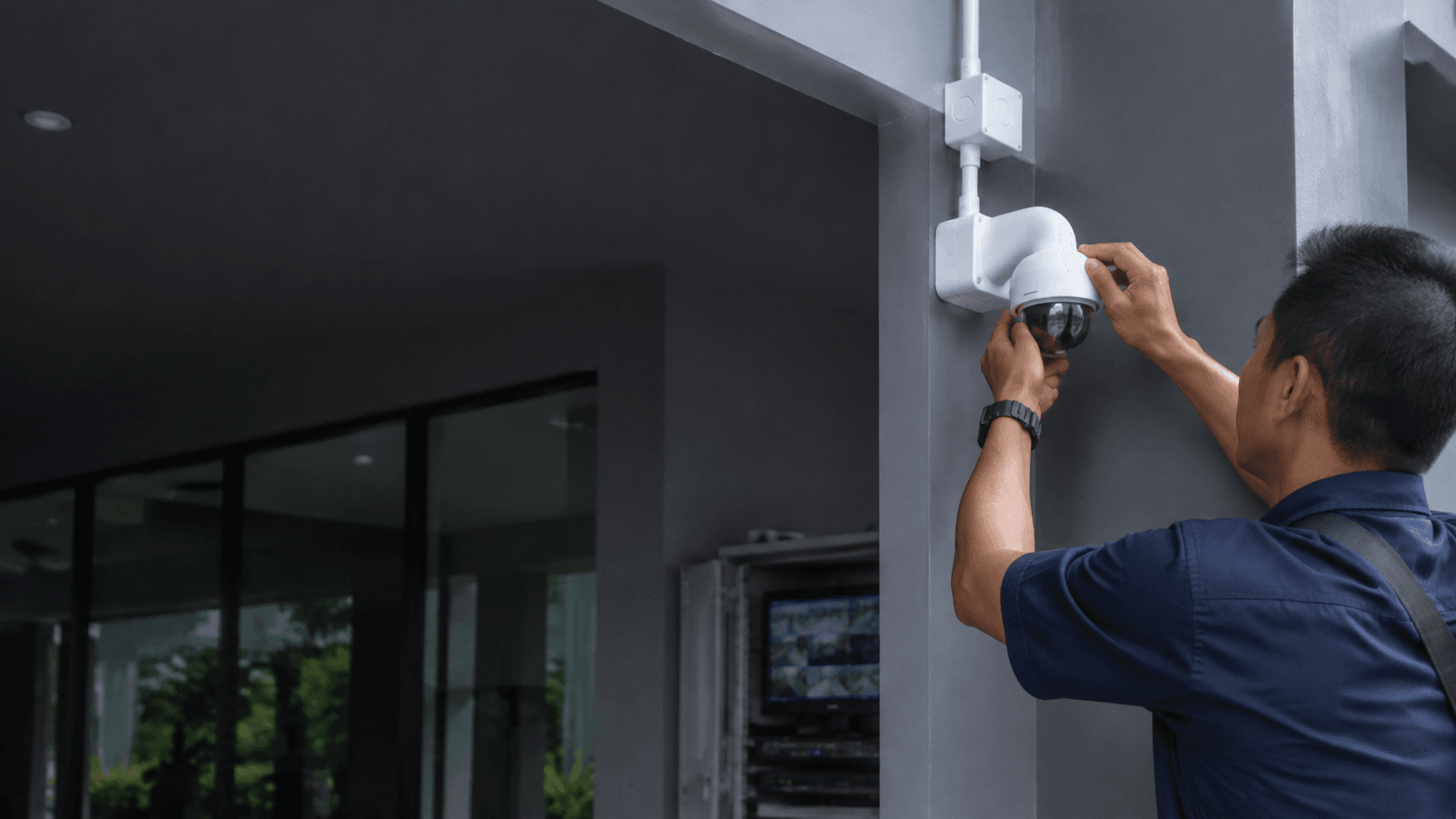
The phrase covers two different products. One is a self-contained portable camera that runs on its own battery and sends video over a mobile network. The other is a trailer-mounted unit that carries its own power, cameras and recording equipment, and can be towed between locations. Both exist because a fixed installation assumes cabling, mains power and a stable network path, and some sites have none of those.
In Sarawak, that gap shows up on construction sites, temporary yards, remote assets and short-term events. Eyonic Sdn Bhd plans, supplies and installs monitoring systems with camera placement, recording and remote viewing for homes, offices, shops and industrial sites, and its installation process runs through site survey, system proposal, installation and handover.
What a mobile surveillance camera is used for
The core use case is a location that needs watching before, or instead of, permanent infrastructure. A site under construction may have no meter box yet. A yard may sit far from the nearest building. An event may run for three days and then disappear.
A mobile surveillance camera fits those situations because it does not depend on the site's own wiring. Power comes from a battery, often topped up by a solar panel. Video leaves the site over a cellular connection rather than a broadband line. Recording may sit on a memory card inside the unit, on a network video recorder, or in cloud storage, depending on the product.
The trade-off is that every one of those substitutions introduces a dependency. A wired camera depends on mains power and a cable run. A mobile unit depends on battery capacity, solar yield, cellular signal and storage that has to be managed rather than forgotten.
Mobile surveillance camera power and connectivity choices
Power and connectivity decide whether a deployment works at all, and they are usually the two items buyers underestimate.
Battery life is not a fixed number. It depends on how often the camera records, whether it records continuously or only on motion detection, how much night vision is used, and how much sun the panel receives. A unit that streams continuously will drain far faster than one that wakes on movement and sends a short clip. Weather also matters. extended cloud cover reduces solar charging, and a unit that was fine in a dry month can fall behind in a wet one.
Cellular connectivity has its own constraints. Signal strength at the camera position is not the same as signal strength at the site entrance. A unit placed behind a container, in a basement, or in a valley may hold a connection intermittently. Remote viewing quality follows that connection, so a weak signal can mean delayed alerts and lower-quality live video even when the camera itself is capable.
Recording storage is the third decision. Local storage keeps working when the network drops but can be lost with the unit. Cloud storage survives theft or damage but depends on the same cellular link and usually on a subscription. Neither is automatically better; the choice follows what the site is protecting and how quickly someone can respond.
Where a mobile surveillance camera is placed on site
Placement on a mobile unit is a different exercise from placement on a building. The camera has to see the target area, keep its power source in reasonable sunlight, and hold a usable cellular signal, and those three goals can pull in different directions.
Eyonic recommends checking actual lighting conditions before confirming placement for ColorVu-style cameras, because a position that looks adequate in daylight can behave differently once the site is dark. The same discipline applies to any camera expected to work at night: the lighting at the position, not the lighting at the gate, is what the camera responds to.
Practical placement questions include what the camera must cover, whether the view is blocked by stored material or parked vehicles, whether the unit can be reached by someone intending to disable it, and whether the position is stable enough that the view does not drift. A trailer-mounted unit also has to be sited where it can be towed in and out without damaging the ground or blocking site traffic.
Mobile surveillance camera planning steps before installation
Eyonic's CCTV installation process follows a defined sequence, and the same sequence applies when a site cannot be wired.
- Site survey — review the location, the areas to be covered, available power, network or cellular conditions, and the practical constraints of the site.
- System proposal — set out the recommended camera placement, recording approach and remote viewing arrangement for the site.
- Installation — supply and install the agreed system, including camera placement, recording setup and remote viewing configuration.
- Handover — confirm the system works as intended and that the people responsible can use it day to day.
The survey stage carries the most weight. A site with no mains power and no fixed line is exactly the situation where an assumption made on paper becomes a problem after installation, because the fix is usually a change of position, power source or connectivity rather than a settings adjustment.
What Eyonic checks during a site survey
Eyonic's survey work is grounded in real deployments rather than a generic checklist. The company completed a project for the Kuching Immigration Office, focused on arrival flow, staff areas, visitor movement and dependable daily operation. A separate project for KTA Sarawak Sdn Bhd covered a practical office setup in Kuching supporting staff movement, visitor handling, tidy cabling and clearer daily site control.
Those projects show the pattern. the survey starts with how the site is actually used, not with a camera count. For a site without fixed wiring, the survey questions extend to where power can come from, whether a cellular link is viable at the intended position, how footage will be stored and retrieved, and who will review alerts.
Eric Yong, founder of Eyonic Security Systems, has worked in the industry for more than 10 years and is experienced in technical installation of digital security solutions for commercial businesses in Sarawak. That experience matters most at the point where a site's constraints rule out the obvious answer.
Mobile surveillance camera limits and evidence gaps
Several details that buyers ask about are not settled by available evidence, and it is more useful to name them than to fill them with assumptions.
No supplied evidence states resolution, lens, sensor, storage capacity, battery runtime, solar output, IP rating or operating temperature for any mobile surveillance camera. No supplied evidence states cellular band support, SIM arrangements, data plan costs or coverage quality in Malaysia. No supplied evidence states whether Eyonic supplies, rents or installs trailer-mounted or cellular mobile surveillance cameras, and no supplied evidence states warranty terms, monitoring service arrangements or response times.
Pricing is similarly narrow. Eyonic publishes RM 1,599 packages for a Hikvision CCTV package, a Hikvision alarm system and an autogate package, each covering supply, setup and handover. Those figures relate to those packages, not to a mobile or off-grid camera system, and no mobile surveillance camera pricing is supplied.
Malaysian regulatory or licensing requirements for wireless or cellular camera deployment are also not covered by the available evidence. A site that intends to transmit video over a cellular network, or to record in a public area, should confirm its own obligations rather than rely on a general article.
The practical conclusion is that a mobile surveillance camera is a reasonable answer to a site with no wiring, provided the power, connectivity and storage decisions are made against the actual location. Where those three are uncertain, the survey is what resolves them. Share your location, property type and required system with Eyonic on WhatsApp at +60 11-5111 7959 for the next practical step.